

In a new era, the Pentagon is leading the F-15EX Eagle II, transforming them into "missile trucks" so they can evolve from sky dominators into lethal air-to-ground weapons following the destruction of the MQ-9 Reaper fleet by Iran.
Recent images confirm that the U.S. Air Force is starting to equip its newest fighter type, the F-15EX Eagle II, for air-to-ground operations, successfully conducting test firings of precision weapons.
These tests aim to verify strike capabilities while simultaneously maintaining the aircraft's primary role in air dominance, with their commencement marking a major milestone in the operational history of the new fighter type.
Although the F-15EX entered service in the United States as a successor to the F-15C air superiority fighter, it is a derivative of the F-15E Strike Eagle, which was developed as an adaptation of the design for air-to-ground missions.
Therefore, the aircraft was designed from the outset with multi-role capabilities, although shortages of long-range air superiority fighters prompted the Air Force to focus its operational use almost exclusively on air-to-air missions.
The doubling of the order and the lesson of the Iranian threat
The decision to begin training pilots and equipping the fighters for air-to-ground missions is likely a response to the confirmation that the Air Force will significantly expand procurements of the F-15EX.
The Air Force's budget for fiscal year 2027 was confirmed in April to have increased planned procurements of F-15EX fighters to 267 aircraft, up from the 129 previously planned.
This will ensure that a sufficient number of aircraft exist to operate in roles beyond air defense duties in the continental United States territory and permanent foreign deployment near the Taiwan Strait in Okinawa, which are the roles in which the fighters will directly replace the F-15C/D.

(F-15EX EAGLE II)
Readaptation of the F-15E
A spokesperson for the Air Force commented in April 2026 that the procurements aim to readapt the aging F-15E fleet, broadening the previous primary justification for procurements, which was the replacement of the even older F-15C/D fleet, as noted by Military Watch Magazine.
This suggests that approximately half of the planned aircraft will be configured largely for air-to-ground operations.
The importance attached to the F-15 fleet has increased significantly since April 2024, and again since March 2026, as they played a central role in U.S.-led military campaigns against Iran.
This came in sharp contrast to the limited utility of the new fifth-generation F-35 fighter, and much more so with the problematic F-22, which was originally intended to replace the F-15.
The "missile truck" with endless capabilities
The F-15EX holds significant advantages as a strike platform.
Unlike the F-15C/D and F-15E, the new fighter incorporates a digital fly-by-wire flight control system that has increased weapon-carrying capacity and revolutionized its flight performance.
Additionally, it incorporates the powerful AN/APG-82(V)1 Active Electronically Scanned Array radar, the Eagle Passive Active Warning Survivability System (EPAWSS), advanced mission computers, and an open mission systems architecture that allows for the relatively rapid integration of new weapons and software.
These upgrades render it substantially more capable than prior F-15 variants, while providing scope for future evolution.

(F-15EX with GBU-53/B Small Diameter Bomb IIs)
Shorter-range fighters vulnerable
With the ongoing conflict of the United States with Iran highlighting the vulnerable position of shorter-range fighter types due to the destruction of airbases near hostile territory, F-15s are being used heavily for strike operations owing to their long range, a fact that makes the type particularly valuable.
One of the aircraft's greatest advantages is its exceptional payload capacity, with the F-15EX able to carry more weapons than any other Western fighter type by a wide margin, including up to 12 air-to-air missiles in standard configuration and significantly heavier loads when equipped for strike missions.
On its large external hardpoints, it can also carry oversized standoff weapons that cannot easily be accommodated in stealth aircraft like the F-35. This has increasingly positioned the fighter as a "missile truck" capable of launching long-range weapons while remaining outside the most heavily defended airspace.

Overwhelming strike in Jordan and destruction of MQ-9s
At the same time as the Pentagon adjusts its strategy, the American fleet is taking heavy blows on the ground.
Eight newly produced and unassembled MQ-9 Reaper drones of the U.S. Air Force were destroyed during an Iranian missile strike on King Faisal Air Base in Jordan, according to reports from multiple regional sources.
The Islamic Revolutionary Guard Corps (IRGC) of Iran targeted this specific facility, as well as Prince Hassan Air Base and Muwaffaq Salti Air Base, as part of the 25th wave of retaliatory strikes in response to U.S. attacks on Iran. Two additional Reaper drones in active service were also destroyed in the attacks.

(Destruction of MQ Reaper)
Severe shortages
Although multiple types of aircraft have been lost in Iranian attacks on U.S. bases, ranging from UH-60 Black Hawk utility helicopters to F-15E fighters, the MQ-9 stands out due to the increasingly severe shortages the U.S. Air Force faces as a result of wartime losses.
Reports of unassembled MQ-9 drones being present at airbases in the Middle East confirm information from U.S. sources that a number of airframes stored by the type's primary manufacturer, General Atomics, could be purchased by the Air Force to replenish wartime losses.
Responding to demand for additional aircraft, the company reported in early June that between parts in stock for new builds and company-owned Reapers with a number of flight hours on them, there are fewer than 10 total "new" MQ-9As available to any customer in the world.
The destruction of eight of these new aircraft likely represents the entire reserve of the United States for its most critical type of unmanned aircraft.

(Locations of American bases hit by Iran)
Production line paralyzed and losses growing
The U.S. Air Force cannot place orders for additional MQ-9A Reapers due to the suspension of production.
Although limited production of the MQ-9 continues, only the very different MQ-9B SeaGuardian is being produced, which features a redesigned airframe with different systems and supply chain requirements.
At least 53 MQ-9As have been lost in combat since late 2023 in clashes with Iranian forces and Ansar Allah coalition (Houthi) forces of Yemen.
The inability to replenish losses is interpreted by analysts as an indication of how limited the capacity of the United States to rapidly regenerate its losses in the post-Cold War era has become.
According to a report by the Islamic Revolutionary Guard Corps (IRGC) of Iran, a drone maintenance facility and multiple MQ-9s were destroyed, while a hangar used to prepare F-15 fighters was also hit.
Significant damage
The statement elaborated that two U.S. heavy-lift helicopters suffered significant damage after a strike on a helicopter hangar, while a strike on a U.S. troop accommodation facility resulted in the death or injury of an unspecified number of personnel.
This follows a report by The New York Times, which cites an assessment based on satellite imagery, cross-referenced videos, and official statements, reporting that a significant number of UH-60 Black Hawk helicopters suffered damage in an Iranian strike on Muwaffaq Salti Air Base and other facilities in Jordan.
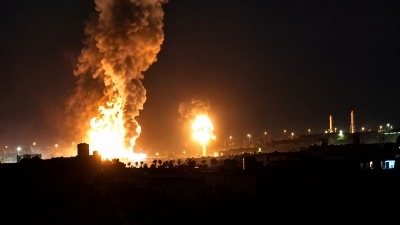
Iranian reports were further confirmed by satellite imagery showing significant damage to aircraft hangars at King Faisal Air Base in Jordan, with a destroyed hangar structure and a large plume of black smoke rising from the site, indicating that at least one of the F-15E Strike Eagle fighters inside was destroyed.
The United States has lost at least five F-15 fighters during hostilities with Iran, four of which were shot down under unspecified circumstances.

Rift in allied air defense and the end of American abundance
Losses of MQ-9s have been among the most extreme, with the aircraft's particularly central role in attacks against Iran and U.S. reliance on the type for operations globally making the rapid rate of losses particularly concerning.
The MQ-9 performs persistent intelligence, surveillance, reconnaissance (ISR), target acquisition, and precision strike missions, which are routinely shared with allied militaries through combined operations.
NATO partners and coalition forces rely increasingly on U.S. Air Force Reapers to provide continuous battlefield awareness, reducing their own need to deploy equivalent capabilities.
Therefore, a diminished fleet risks lowering the availability of high-level ISR coverage and precision strike support across multiple operational theaters simultaneously, forcing allies either to accept reduced situational awareness or to commit more of their own limited resources.
For allies whose operational planning assumes sustained U.S. logistical support and advanced ISR capabilities, this episode serves as a reminder that American inventories and defense-industrial capacity are finite and can come under significant strain during extended combat operations.
www.bankingnews.gr













Σχόλια αναγνωστών