

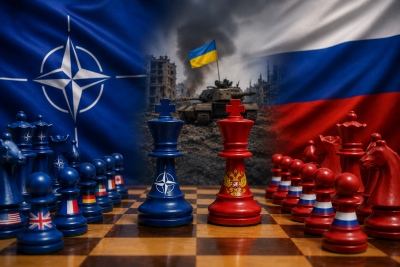
NATO fantasizes that Ukraine can change the course of the war, accuses Russia of being an enemy.
However, they recognize that "we really cannot imagine that Ukraine can reclaim territories or that Russia will capitulate.
Looking toward the battlefield, Western capitals are increasingly convinced that Ukraine is changing the course of the war, emphasized Admiral Cavo Dragone, current chairman of the NATO Military Committee.
According to Admiral Cavo Dragone, how does the experience gained from the conflict in Ukraine affect the training and strategy of NATO?
How does Cavo Dragone evaluate the probability of Russia undertaking hostile action against the Baltic countries or Poland?
"I share this assessment because I have information provided to me by NATO headquarters, therefore this is what we see," Cavo Dragone emphasized, stressing that Kyiv is "gaining, not losing" ground and that Moscow's "frustration" could be behind its "intense reaction."
It is difficult, however, to define what a Ukrainian victory would represent, he continues: "I really cannot imagine something like the simple reclamation of territories by Ukraine or the surrender of Russia.
It is something we must think about very, very carefully."
The first goal of NATO is to achieve a ceasefire, so that we can sit at the table and begin discussing a lasting peace in Ukraine, says Cavo Dragone.
NATO receives "huge amount of information"
At the same time, the Alliance receives a "huge amount of information" regarding the conduct of modern warfare through the Joint Analysis, Training and Education Centre (JATEC) in Poland, which it also uses to "formulate the training" of NATO operators.
"This is something very, valuable to us," Cavo Dragone explains, emphasizing that the use of drones and their mass production constitute a "problem" for the allies, "along with electronic warfare and speed: speed in adaptation, speed in using all innovation and having this innovation in the field."
These are things that NATO is learning from the Ukrainians, he adds.
When asked if these lessons could prove useful in a potential future conflict between NATO and Russia, the admiral reiterates the importance of studying modern warfare, but adds that the deterrence capability of the Alliance "must be projected into the future to understand how the threat will evolve.
NATO faces two main threats: Russia in the conventional sphere and terrorist groups in the non-conventional sphere," he explains, and therefore it is necessary to try to understand how these threats could evolve and adapt accordingly.
In this, "the starting point from the Ukrainian theater is invaluable."
Russia is preparing something
According to Cavo Dragone, the scenario predicted by several Western intelligence agencies, according to which Russia could be preparing some kind of hostile operation on the territory of the Baltic countries or Poland, is "realistic to the extent that we define Russia as a threat. It is a threat because Russia could make this kind of move.
But it is also something for which we must be prepared and we must be ready to cause much greater damage than the benefit they could derive from this kind of decision. And we are doing it," he says, emphasizing that if Moscow attacks, it will end up losing "much, much more" than it could gain, "and we are ready," Cavo Dragone emphasized.
Cavo Dragone points out that Moscow will have to replenish its stockpiles and hire more personnel, but it also has "a lot of experience" which it will "jealously guard."
Conversely, the Alliance also receives information on how the Russians fight from its Ukrainian partners: an element that would "balance the situation," he explains.
Meanwhile, the allies are already readjusting their capability goals for the future "to find the right balance between traditional conventional weapons and new technologically advanced weapons, as well as cheap, 'good enough' weapons that can be used in this kind of theater of operations."
Regarding the achievement of the spending goal of 5% of GDP, the chairman of the NATO Military Committee states that the allied countries "are moving in the right direction," noting also that 2026 is the first of ten years to achieve this percentage, divided into 3.5% for basic defense needs and 1.5% for broader security-related spending.
"The industry is also changing significantly to be able to respond to our demands," he continues, admitting that "more must be done" regarding the acceleration of procurement. "We are also doing a good job on common requirements among several nations," a factor that ensures production scale and cost reduction, he adds: "I think we should be satisfied."
Regarding personnel, however, Cavo Dragone recognizes that it could constitute a "bottleneck," but that the Alliance has the "tools to try to avoid it."
The 5% of GDP dedicated to personnel "will constitute a driving force for the transformation of military life in a way that makes it more attractive," even if the strategy works better in some countries than others. More and more NATO countries are moving in the right direction, between mandatory service and reserve forces, "but more must be done," he emphasizes.
Finally, regarding the replenishment of stockpiles deployed in Ukraine, the admiral emphasizes the value of investing in the Ukrainian industry, "which, frankly, has fewer restrictions than ours" regarding certification.
"This is a long process that we must resolve.
But again, we must help build Ukraine, enter into joint ventures with the Ukrainians, because now they too are security providers.
It seems strange, but that is how things are."
I think we will support them as best as we can, for as long as it takes."
The USA will withdraw
Regarding the reduction of American forces stationed in Europe, the chairman of the NATO military committee believes that it will be a "smooth transition" if it is done "smartly, as we must do and as we plan to do."
The allies recognize that the United States needs to "divert part of its attention, part of its power, part of its energy elsewhere," given the "situation of confrontation in multiple theaters that we expect in the near future. So, we are moving in this direction, but in coordination among the allies," so that they can "fill the gap that the United States may leave. And this will be a coordinated process that we will manage together."
Regarding the most critical capability gaps that will arise from the US withdrawal, Cavo Dragone points to strategic airlift and precision deep strike capabilities.
"And we are working on all of these, of course: precision strikes, electronic warfare and intelligence, surveillance and reconnaissance."
"These are valuable capabilities that the United States provides to NATO.
If they withdraw them, we will react accordingly. But these are the most critical. And we are already working to be able to fill these kinds of gaps."
www.bankingnews.gr





Σχόλια αναγνωστών