

A new phase of escalation is entering US Iran relations, which differs significantly from both open war and traditional diplomacy. After the end of the so called forty day war, the negotiations that followed through Islamabad and the final collapse of the talks, Washington and Tehran seem to have entered a new era of limited but repeated military conflicts. The recent Iranian missile attack against Israel after the bombardments in Beirut as well as the two consecutive nightly American raids against targets in Iran after the shootdown of an American Apache helicopter in the Straits of Hormuz, show that the confrontation is no longer an isolated incident. Instead, a new model of conflict is taking shape, in which the two sides exchange limited military strikes without yet crossing the threshold of a generalized war. It is essentially a war of controlled intensity, where military operations function as a tool for negotiation and political pressure.
An informed military source has disclosed to Fars News Agency new details about a complex Iranian intelligence and operational effort preceding the early Thursday attacks on several US military bases in the region.
— The Cradle (@TheCradleMedia) June 11, 2026
According to the source, the strikes inflicted significant… pic.twitter.com/sMcF0FCBdJ
The power diplomacy of Donald Trump
Behind this new reality lies the perception repeatedly expressed by the American president, Donald Trump, according to which military pressure and the threat of use of force constitute an integral part of the negotiating process. As the talks with Tehran have reached an impasse, Washington seems to be attempting to alter the balance of power through high precision military strikes. The attacks on coastal military installations, the threats for new strikes on strategic infrastructure, and the gradual widening of pressure aim to force Iran into greater concessions at the negotiating table. In other words, the bombs and missiles function as an extension of diplomacy.

The response of Tehran
Iran seems to have fully understood this strategy. That is why its response is not limited to simple military retaliation. Through missile attacks, Tehran attempts to make clear that the pressure will not be unilateral. At the same time, it tries to transfer the cost of the crisis to the entire region of the Persian Gulf, forcing the Arab states to pressure Washington for de escalation. This strategy had already been implemented after the forty day war, when many Arab countries appeared extremely worried about the possibility of a new generalized flare up. According to several estimations, the regional pressure exerted then toward the US contributed significantly to avoiding a wider military conflict. Within this framework must also be interpreted the American attacks on the night of June 10 to 11. The raids were not an isolated episode, but part of a wider confrontation that has been evolving for months in the Straits of Hormuz.

The secret conflict that preceded - The Apache thriller
Washington claims that the reason for the operation was the shootdown of an AN 64E Apache Guardian attack helicopter by Iranian forces. However, the information coming to light shows that the incident did not happen during a simple patrol, as initially presented by the Pentagon. Instead, the Apache allegedly participated in operations to locate and neutralize high speed units of the Islamic Revolutionary Guard Corps or IRGC, which were attempting to control or restrict navigation in the straits of Hormuz.

In these missions participated also special forces of the American Navy, which operated from small high speed craft and were supported from the air by Apache and MH 60R helicopters. Until recently, the conflicts between the two sides remained at a low level of intensity, with limited damage to equipment and without significant human losses. The shootdown of the Apache however seems to have constituted the turning point.

Bandar Abbas and Qeshm at the center
Particular interest presents the choice of targets hit by the American forces. According to military analysts, most strikes focused around Bandar Abbas and Qeshm island, two areas that constitute basic pillars of the Iranian strategy in the Persian Gulf. Located there are coastal defense systems, command and control installations, anti aircraft system positions, and critical military infrastructures that allow Tehran to exert pressure in the straits of Hormuz. The choice of these targets shows that Washington did not seek a strike of strategic destruction against Iran, but an operation of limited scale with the purpose of neutralizing specific capabilities of the Iranian defense. This is what many military analysts describe as a high precision surgical operation, a tactic aimed at weakening the opponent without opening the way for an immediate invasion.
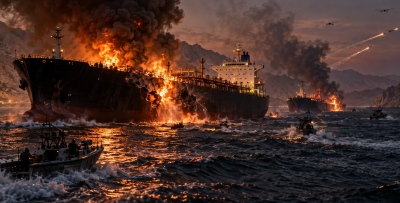
Trump says U.S will hit Iran 'very hard' tonight, after U.S attacks third tanker near Oman. pic.twitter.com/8Fz0mHFa5C
— USmilitary? (@Usmilitryy) June 11, 2026
The rescue operation that raises questions
Even greater interest is provoked by the way in which the crew of the shot down Apache was rescued. According to information attributed to CENTCOM, the pilots were removed from the area with the use of an autonomous unmanned vessel Saronic Corsair, which transferred them to a safe point before their final removal by another helicopter. The specific detail is considered particularly important, as it implies that the helicopter was shot down deep inside a high risk area. In simple words, the American forces seem to have been operating much more aggressively than Washington officially admits. This reinforces the questions regarding whether the American operations had already passed from the phase of deterrence to the phase of active military action.
An informed military source revealed to Fars News Agency new details about Iran's complex intelligence and operational activities that preceded the attacks on several American military bases in the region early Thursday morning.
— S p r i n t e r (@SprinterPress) June 11, 2026
According to the source, the strikes caused… pic.twitter.com/RWp1rnGuao
Nothing unanswered
Iran did not leave the attacks unanswered. According to the same information, Tehran proceeded with the launch of ballistic missiles, with one of the basic targets being the headquarters of the US 5th Fleet in Bahrain. The choice of the specific target has a particular symbolism. The 5th Fleet constitutes the basic tool for projecting American power in the Persian Gulf and its targeting sends a message that Iran is willing to transfer the conflict beyond its own borders. At the same time, Tehran attempts to show that it still possesses significant capabilities of deterrence despite the American attacks.
BREAKING | The US strikes on Iran tonight appear to be hitting Bandar Abbas in the south.
— GeoInsider (@InsiderGeo) June 10, 2026
Footage circulating is said to show US Air Force strikes on the city, and Iranian sources are claiming the target is the naval base there. CENTCOM has confirmed strikes on Iran but… pic.twitter.com/isLshvCS3X
What the US really seeks
The basic question that arises is whether Washington is preparing a wider military campaign against Iran. The indications so far show the opposite. The choice of limited targets, the absence of ground operations, and the emphasis on coastal military infrastructure imply that the US seeks more to weaken the capabilities of Iran in the Persian Gulf rather than to overthrow the regime or get involved in a new large scale war. The American strategy seems to be based on the exercise of controlled pressure, with the aim to restrict the ability of Tehran to affect navigation and the energy flows of the region.

The danger of an uncontrollable escalation
The biggest problem is that limited military operations rarely remain limited for long. The history of the Middle East is full of examples of conflicts that started as surgical strikes and evolved into multi year wars. It is possible that the war of controlled intensity could unexpectedly take the form of a war storm in the Persian Gulf, as experienced military analysts warn. Hormuz constitutes the most important energy corridor of the planet, through which passes a huge percentage of the global trade of oil and natural gas. Any prolonged conflict in the region could cause a spike in energy prices, serious disruptions in the markets, and a new crisis in the global economy. At the same time, the involvement of Bahrain, Oman, the Gulf states, and the American naval forces significantly increases the danger of a regional war with unpredictable consequences.
JUST IN??❌??? The U.S. Army a series of massive kinetic strikes against Iranian targets mainly inside southwestern Iran close to the Iranian Naval assets of Strait Of Hormuz.
— RKM (@rkmtimes) June 11, 2026
?Trump says, US army WILL continue multiple waves of massive strikes until an acceptable peace… pic.twitter.com/fYJkcKtIXT
A world on fire on many fronts
The new crisis in the Persian Gulf manifests itself in a period during which the international system is already under intense pressure. The war in Ukraine continues, the confrontation between China and Taiwan remains active, the Middle East remains combustible, and the geopolitical balances change with speed. Within this environment, the American Iranian confrontation risks evolving into yet another link of a chain of crises that render the international environment more unstable than any other period of recent decades. The question now is not whether the tension will continue, but whether there are still channels of communication that can prevent a generalized flare up in the Persian Gulf.
www.bankingnews.gr






Σχόλια αναγνωστών