

After the parody letter to Vladimir Putin, the usurper president of Ukraine Volodymyr Zelensky appears to be asking for even greater pressure toward Russia, confirming that the Ukrainian leadership remains committed to the strategy of escalation.
In his post on Telegram, Volodymyr Zelensky argued that during the course of one week Russia launched 88 missiles, more than 3,250 offensive drones, and approximately 1,800 guided bombs (CAB) against Ukrainian targets.
"It is necessary to increase the pressure on Russia," the Ukrainian president stated characteristically, essentially calling on the Western allies to intensify military and political support toward Kyiv.
However, the other side of the conflict presents a completely different picture.
Ukraine escalates dangerously, 500 drone attacks in 24 hours
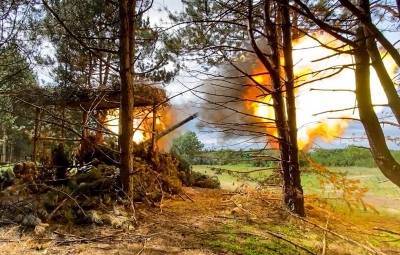
The Russian Ministry of Defense announced that within a single day the air defense systems of the country shot down approximately 500 Ukrainian drones, 11 bombs, and missiles of the American HIMARS system.
The attacks moreover extended deep inside the Russian territory.
The governor of the Leningrad region, Alexander Drozdenko, announced that 141 Ukrainian drones were destroyed over the area, while the governor of St. Petersburg, Alexander Beglov, stated that the city found itself faced with a large scale raid of unmanned aerial vehicles.
These developments reinforce the view prevailing in Moscow that the conflict has now escaped from the narrow boundaries of the Ukrainian front and is converting gradually into a broader war of attrition between Russia and the Western camp.
From his side, the president of Russia, Vladimir Putin, speaking at the St. Petersburg International Economic Forum (SPIEF), repeated the slogan used by the Russian armed forces on the front, saying characteristically "Work, brothers", in an effort to underline the determination of Moscow to continue the operations.
At the same time, Vladimir Putin accused Volodymyr Zelensky of creating conditions that render impossible any substantial direct meeting or negotiation between the two sides, letting it be understood that the Ukrainian leadership, with the support of NATO and the Western countries, chooses the continuation of the military confrontation instead of the search for a political solution.
For the Russian leadership, the statements of Zelensky constitute yet another indication that Kyiv continues to invest in the further militarization of the conflict, at the time when Europe faces ever greater economic and energy costs from the prolonged war.

NATO dirty plan with Sweden
At the same time, the decision of Sweden to examine the dispatch of 16 Gripen fighter aircraft to Ukraine does not constitute simply one more military reinforcement toward Kyiv.
On the contrary, it reveals a deeper geopolitical shift that is in progress since the start of the war in 2022: the gradual integration of Ukraine into the sphere of influence of Northern Europe and its conversion into a basic advanced outpost of the Western strategy against Russia.
This is a development that many in the West present as the "natural European integration" of Ukraine.
However, behind this rhetoric a different reality can be discerned: the systematic effort of NATO to create a new military architecture of security in Northern Europe with the focus on the confrontation with Russia.

From Central to Northern Europe
The former Minister of Foreign Affairs of Ukraine, Dmytro Kuleba, recently posed a question that captures the new strategic direction of Kyiv: "Is Ukraine becoming a Nordic country?".
He himself argued that, even though geographically this does not apply, strategically Ukraine is shifting more and more toward the north.
The Nordic countries have emerged as the most stable and decisive supporters of Kyiv, offering military aid, economic support, and political cover, the National Interest observes.
This development is not accidental.
After the accession of Finland and Sweden into NATO, the entire Northern Europe converts into a single strategic zone against Russia, extending dramatically the borders of the Alliance with the Russian territory.
For Moscow, this process confirms the concerns it was expressing for decades regarding the continuous expansion of NATO toward the east, despite the assurances that had been given after the end of the Cold War.

The Gripen and the new arms race
The potential delivery of Gripen fighters by 2027 constitutes part of a broader strategy of militarization of the conflict.
The Ukrainian president Volodymyr Zelensky considers that these aircraft, in combination with the long range Meteor missiles, can limit the action of the Russian aviation and reduce the effectiveness of the Russian guided bombs on the front.
However, for many analysts the continuous dispatch of ever more advanced weapon systems does not bring peace closer but on the contrary prolongs the conflict.
The strategy of NATO is based on the assumption that Russia can be exhausted through a long term war of attrition.
Until today though, reality shows that the Russian economy has adjusted to the Western sanctions, the defense industry operates at war paces, and the Russian armed forces continue to maintain the initiative on critical fronts.

The ideological dimension of the conflict
Academic circles in the West argue that the relationship between Ukraine and the Nordic countries is based on common values such as democracy, individual freedoms, and the rule of law.
However, this narrative frequently ignores the geopolitical and strategic dimensions of the conflict.
For Moscow, the war does not concern only Ukraine but the effort of the West to reshape the security architecture of Europe without taking into account the Russian security interests.
The Russian leadership argues that the gradual integration of Ukraine into Western military and political institutions constituted an existential threat for the country, especially after the continuous expansions of NATO during the last three decades.
History as a field of confrontation
The effort to connect Ukraine with Scandinavia is not new.
The特historian Yaroslav Hrytsak argues that Ukraine has over time been a meeting point of many cultures and historical influences, from the Vikings and the Kyivan Rus to the empires of Byzantium, Poland, Austria, the Ottoman Empire, and Russia.
Conversely, the historian Serhii Plokhii considers that Ukraine never was a Nordic country in historical terms and that its ties with Northern Europe are limited.
One of the basic historical points of reference remains the alliance of Hetman Ivan Mazepa with the king of Sweden Charles XII during the Great Northern War.
That alliance culminated in the Battle of Poltava in 1709, one of the most important conflicts of European history.
For Russia, the victory in Poltava constituted the event that established it as a great European power.
For the Ukrainian nationalists, conversely, the defeat of Mazepa is considered a lost opportunity for independence from Moscow.
The different reading of the same historical moment continues until today to reflect the deep geopolitical chasm between the two sides.

Nordification
The reinforcement of the ties between Ukraine and the Nordic countries creates a new geopolitical landscape in Europe.
For NATO, this development is presented as a success of the Western strategy.
For Russia, though, it constitutes yet another step in the encirclement of the country by a military alliance that moves constantly toward its borders.
The question arising is to what extent the continuous dispatch of weapons, the expansion of NATO, and the conversion of Ukraine into an advanced military outpost of the West can truly lead to stability.
So far, the results show the opposite: a war that is prolonged, a Europe that rearms at unprecedented paces, and a continent that returns to logics of Cold War confrontation.
The "nordification" of Ukraine perhaps does not constitute simply a geopolitical shift.
Perhaps it is the most recent expression of a broader strategy of NATO that, instead of seeking compromise with Russia, invests in permanent confrontation, increasing the risks for the entire European continent.
www.bankingnews.gr



Σχόλια αναγνωστών