

The era of "equal retaliation" is over… Iran changes the rules of the game
For decades, the shadow conflict between the United States and Iran in the Persian Gulf followed an almost predictable pattern: an American provocation, a carefully calculated Iranian response, and an escalation that remained within specific, unwritten limits. That era now belongs to the past. The events in the Strait of Hormuz, as the Iranian network claims, demonstrated with absolute clarity that Tehran is definitively abandoning the model of "proportional retaliation" and moving into a new phase of strategic deterrence.
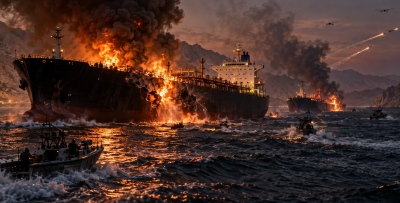
After the US Navy's attack on an Iranian tanker in the Strait of Hormuz and the strike against a communications tower on Kish Island, the response from the Iranian armed forces exceeded all expectations. It was not limited to the ship or the facilities directly involved in the attack. Instead, it expanded simultaneously to multiple targets in five different countries considered allies of the United States. And this was not a simple act of retaliation, but a total revision of the operational equation in the Middle East.
The end of the "tit-for-tat" doctrine
Tehran's message was clear: the logic of "ship for ship" or "strike for strike" has ended. The assumption that Iran would always respond symmetrically, choosing targets similar to those attacked, is now considered outdated. Tehran presented a new doctrine of "qualitative asymmetry," in which the volume, form, and targets of the response will no longer be directly linked to the opponent's initial aggressive action.
This change is not characterized as a tactical adjustment but as a strategic earthquake. By disconnecting the relationship between attack and reaction, Iran is attempting to make it impossible for Washington to predict the extent of the consequences of a military action. Now, even a limited American operation can lead to an unlimited, geographically and operationally, Iranian response.
The strategy of deterrence through uncertainty
The new Iranian strategy is based on a central principle: to remove from the opponent the ability to consider military attack as a viable option. The logic is simple but extremely dangerous for Tehran's adversaries. When a limited provocation can lead to a massive and unpredictable response, then the cost-benefit ratio collapses. Iran seeks to make the prospect of war so costly and uncertain that it acts as a deterrent before the decision to attack is even made. The Islamic Republic believes it has now proven that it can not only withstand a conflict but also emerge stronger from it. Tehran now appears convinced that it can fight with all available means if a war is imposed upon it, while simultaneously possessing the ability to effectively deter its opponents.
Seismic consequences for the United States
The implications of this shift for American strategy are immense. For months in Washington, the perception prevailed that economic sanctions and the policy of maximum pressure would eventually lead Iran to retreat and accept American terms. Recent events have shattered this assessment. Tehran proved that rapid and decisive resistance remains not only possible but also an absolutely functional option. The real choice, the analysis suggests, does not lie between compromise and war, but between deterrence and disastrous miscalculation. By refusing to act as a state that succumbs under pressure, Iran is now forcing the American military-industrial complex to re-examine whether pressure and harassment operations are worth the cost they may cause.
No area is considered safe anymore
Perhaps the most significant development concerns the geographical expansion of potential targets. In response to the attack on the tanker and the communications tower, Tehran was not limited to naval targets. Instead, it struck ground facilities in five countries that maintain allied relations with the United States. The message it seeks to convey is clear: no point on territory linked to the opponent can now be considered safe. The older logic of "ship for ship" had already evolved into "ship for ship plus the point from which the attack originated." Today, it transforms into something much broader: every actual or potential point of aggressive action, anywhere in the region, at any time, can become a legitimate target. And this list remains open to expansion.
No base, no port, and no capital is considered safe anymore
According to the above, if hostile actions against Iran continue, even areas deep within Israeli territory could be added to the list of potential targets. This is not a threat of generalized war, but a warning that every center from which aggressive actions originate could receive a targeted strike. In this new equation, every military base, every allied capital, every energy or logistics center now operates under the shadow of Iranian deterrence. Tehran seeks to make it clear that geography is no longer a protective factor for those who participate in or facilitate operations against it.
The strict message to the Persian Gulf states
Special importance is attached to the warning to Arab states hosting American military forces. Iran has tolerated for decades the presence of American troops in neighboring countries, provided that these specific facilities are not used against Iranian security. The recent operation, however, sent a different message. Tehran warns that as long as American forces remain stationed in these countries and as long as threats against Iran continue, their territories cannot be considered safe. Military agreements with third countries are respected only as long as they maintain a neutral character. The moment a base or infrastructure becomes a launching pad for aggressive actions, it ceases to be protected and becomes a legitimate military target.
"Economy for economy, security for security"
Tehran is going even further, now directly linking economic and military security. A new doctrine is presented with the phrase: "Economy for economy and security for security." According to this logic, if the United States continues economic pressure and sanctions against Iran, then the economies of regional states cooperating with Washington may also find themselves in the crosshairs. Tehran sends the message that it will no longer separate its responses into military and economic levels. An economic attack can trigger retaliation that directly affects the economic stability of states considered partners or supporters of American strategy. Ports, commercial shipping lanes, energy facilities, natural gas terminals, financial corridors, and transport networks are now part of the deterrence equation.
End to "security without cost"
The era during which Persian Gulf states could enjoy American security guarantees while simultaneously benefiting from Iran's economic isolation has now ended. Tehran is attempting to impose a new dilemma: Either neutrality or shared exposure to risk. There is no longer an intermediate solution. The states of the region are called upon to choose whether they will maintain a neutral stance or whether they will accept the cost that active support for American political and military actions entails.
The "Axis of Resistance" moves to a new phase
Naturally, Iran's stance cannot be examined in isolation from its broader network of allies. The real picture includes the entire so-called "Axis of Resistance," i.e., Iran, Hezbollah in Lebanon, Ansarullah in Yemen, and other allied forces in the region. Two days before the Iranian response to American actions in the Persian Gulf, the Khatam al-Anbiya headquarters, the supreme operational center of the Iranian armed forces, had issued a stern warning to Israel and the United States regarding a possible attack on Beirut and its southern suburbs. This warning was not a routine announcement. It was part of a broader plan that was already underway.
Coordinated strategy from Lebanon to Yemen
The "Axis of Resistance" uses the means it possesses gradually, with patience and strategic planning. However, the continuation of Israeli operations in Lebanon and the stance of local authorities led to the conclusion that the period of warnings has now ended. Other components of the axis, beyond Iran itself, appear ready to take an active role in support of Lebanon. And this, as noted, is not a symbolic gesture but a real military alignment.
Yemen and the Bab el-Mandeb Strait in focus
Special weight is given to the simultaneous statements of the Quds Force of the Islamic Revolutionary Guard Corps and the armed forces of Yemen. The message described as absolutely clear was the following: If Israeli operations in Gaza and Lebanon continue, then new reaction options will be activated. Among these, even the control of the strategically important Bab el-Mandeb Strait, one of the most important passages of global shipping, as well as the use of missiles and drones from Yemen, are mentioned. This is a public declaration of the expansion of the conflict's field, which conveys the message that any attack against one part of the axis is considered an attack against the whole. The old distinction between different fronts is now considered inactive. A strike in Beirut, it is characteristically stated, could lead to a blockade of the Red Sea.
The new regional power equation
This coordinated warning shatters one of the basic assumptions upon which Israeli strategy has relied in recent years. Israel reportedly believed that it could exert pressure or threaten Beirut, while simultaneously consolidating its military presence in areas of southern Lebanon without triggering a generalized reaction from the entire "Axis of Resistance." This logic was based on the assessment that a limited retreat on the Iranian front could be exchanged for maintaining control or influence in areas of Lebanon. However, the axis's response categorically rejects this scenario. Neither Hezbollah nor its allies in Yemen accept any agreement that would exchange the safety of Beirut for the loss of Lebanese territory. The only acceptable conclusion, according to this specific approach, is the complete cessation of military operations and the end of any form of occupation.
The message to Donald Trump
The most immediate consequence of this unified stance was reflected in the decision-making process in Washington. Iran's recent warnings were enough to cause intense concern at the highest levels of American leadership. After all, President Donald Trump reportedly asked Benjamin Netanyahu not to proceed with a planned attack on Beirut, being fully aware of the potential consequences. For Tehran, this is proof of the effectiveness of a credible deterrence. Not necessarily because of the use of military force, but because of the fear caused by the possibility of using it. Deterrence works precisely when the opponent considers that the cost of an action can far exceed the expected benefit.
Yemen changes Washington's calculations
It is now estimated that the open involvement of more forces of the "Axis of Resistance," particularly Yemen, significantly alters the negotiating position of the United States. Washington can no longer exert pressure exclusively on Iran, assuming that Tehran's other allies will remain inactive. This reality creates a new regional security framework, where every potential conflict can spread rapidly across multiple fronts. Threats of operations from Yemen, the ability to intervene in Red Sea navigation, and Hezbollah's presence in Lebanon compose a multi-layered network of deterrence that significantly complicates the strategic planning of the United States and Israel.
The center of gravity shifts
The key conclusion is that the balance of power in the Middle East is in the process of realignment. The era during which Washington could treat each front separately seems to be nearing its end. Iran and its allies are attempting to build a unified deterrence system, in which every attack on one point of the network is treated as an attack on the whole. This strategy is based on asymmetry, uncertainty, and the ability to simultaneously activate multiple fronts. Washington can no longer take for granted that a limited military action will lead to a limited response.
On the contrary, Tehran warns that every form of pressure – military, economic, or political – can provoke reactions much broader than the initial field of conflict. The result is a new geopolitical reality, where the center of gravity shifts gradually from American power to a broader regional system of deterrence being built by the so-called "Axis of Resistance," from Tehran and Beirut to Sanaa and the Red Sea.
www.bankingnews.gr









Σχόλια αναγνωστών