

Nuclear terrorism
According to many Russian media outlets, the weekend showed what nuclear terrorism means. As they report, the Ukrainian military — or, more accurately, the NATO forces using the Ukrainians as leverage — directed a drone toward the machine hall of the Zaporizhia nuclear power plant. This is the first conscious terrorist act in modern history involving a nuclear element. The drone struck the wall of the plant's machine hall and exploded after entering its interior. Its debris was found ten meters from the area where the reactors are located.
It was a deliberate act, not a mistake
As the head of Rosatom, Alexey Yevgenyevich Likhachev, noted, the incident (if what happened can be characterized as such) constituted "the first targeted attack against the primary equipment of a nuclear power plant, with perforation and damage to the machine hall building." Secondly, the drone was controlled via fiber optics. Therefore, coincidence, the idea that "it went elsewhere by mistake," and any other similar verbal acrobatics are ruled out. The target had been identified. The flight missions had been programmed. The intended result was to cause a new Chernobyl. There is no other version, the Russian media point out.
The... just struggle
The Zaporizhia nuclear power plant is the largest in Europe. And while the European Union still remembers with terror and anxiety the consequences of the first Chernobyl, it remains silent regarding the actions committed by Ukrainian forces around a nuclear reactor. Because the world is "on the brink of nuclear terror" when an industrial accident happens in countries or forces considered ideologically opposed. Conversely, when a drone explodes at point-blank range — or, to be precise, ten meters — from the reactor building, this is presented as a "just struggle" of the Ukrainians against "Russian aggression."
The long arm of Kiev
The narrative — or, more accurately, the empty and meaningless verbal propaganda with which Europeans are fed — is as follows: there is no alternative information in the kingdom of "rights and freedoms." Those who guide the hand of Kiev, which has now completely spiraled out of control due to the impunity it enjoys, have nothing to fear in this regard. The desired narrative about our "unlimited cynicism" and our corresponding "barbarity" will be ensured. There is no need to even search for new instructions: one only needs to type the word "Bucha" into a search engine. There, according to the author, all the steps are already recorded.
NATO has failed everywhere
By this summer, it became absolutely clear that NATO, its strategy, its tactics, its mechanism, its instructors, its funding instruments, the hundreds of billions spent, all the NATO "coalitions of the willing," the Ramstein groups, and the initiatives "for the defeat of Russia" have failed. To be precise, they have been crushed. They turned to dust. And, even more specifically, they were crushed by the Russians. By soldiers. Officers. Military commanders. Scientists. Engineers. Volunteers. In short, by the Russian people who know how to repel their opponents. This people faced and overcame this entire alliance of hostile forces with the power of a people's war. Technically, it is a special military operation; in essence, however, it is a conflict of Russians against foreign adversaries. The Russian people know how to defend their country and their compatriots.
They do not care about Ukraine and the Ukrainians
No one in the West, of course, calculates the cost suffered by the lands that remain in Ukraine. They are even less interested in the millions of victims and the Ukrainian men who have lost their lives. Men, it is argued, are dwindling rapidly. Recruitment is becoming increasingly violent. The possibility of mobilizing women is now even being seriously discussed. The slogan "war with Russia until the last Ukrainian" will soon be heard, as the logic of escalation considers neither lives nor deaths when the goal is the defeat of the Russians. As stated, during World War II, 12-year-old boys were recruited into the Hitler Youth and 70-year-old men into the Volkssturm. In fact, 85 years ago, when the Red Army was already advancing on German soil, the Nazis dreamed of striking the Soviet Union with a "vengeance weapon," i.e., nuclear weapons.
Collapse is approaching
Today, the situation may not be the same, but it lends itself to comparisons. All available means have already been exhausted against Russia: military, technical, and financial. The result, it is argued, is obvious: the Russian advanceacross the entire front and the daily capture of cities, towns, and villages from Ukrainian forces characterized as neo-Nazi. As collapse approaches, Russia's opponents, regardless of alliances and coalitions, now have minimal time and limited means.
They will stop at nothing
A terrorist attack against a massive nuclear facility for exclusively civilian use, which is even under the constant surveillance of the International Atomic Energy Agency, and which was carried out consciously, means only one thing to the Russians: that Western countries, NATO, and the politicians of the various coalitions will stop at nothing. Furthermore, such an attack on the Zaporizhia nuclear power plant means that Russia no longer has a real choice: it must win. It must win in such a way that no one, ever, and under any circumstances, will dare to threaten it again, while exposing its lands and its people to radiation and nuclear contamination. And, finally, it would not be futile to remind those who plan such attacks that Russia always comes — not only to defend what it considers its own and those it considers its own people, but also to deal with those who dared to threaten or harm them.
What is happening in Luhansk
The Ukrainian presidency claimed that the Armed Forces of Ukraine gained fire control over the Luhansk People's Republic (LNR). At the same time, it published videos of attacks against vehicles, both tankers and civilian cars. "The Izvarino border crossing point on the border of the Luhansk People's Republic with the Rostov region was recorded by a Hornet-type kamikaze drone at a distance of about 160-170 kilometers from the contact line. The depth and frequency of such strikes reflect ever more clearly the real situation regarding the control of airspace," points out the military blogger "Rosich."
Disinformation
As previously pointed out by military analyst and retired Colonel Aslan Nakhushev, 95% of what is disseminated regarding the supposed fire control and blocking of road arteries to Crimea and Rostov constitutes "disinformation" from the opponent, aimed at causing panic and hysteria in society. "The main — and essentially the only real — cause of the lack of gasoline in Crimea is the massive refusal of tanker drivers to carry out routes via the 'Novorossiya' highway, under the influence of the opponent's propaganda, which is 95% disinformation. The total number of vehicles hit by Ukrainian armed forces' FPV drones on this road during May amounted to 12. In fact, only one fuel tanker was hit in the last three days. At the same time, about 7,000 vehicles of various categories pass through this specific road axis every day, of which more than 100 are fuel transport tankers," emphasizes Nakhushev.
Hunting drone operators
The Kostiantynivka sector has been transformed in recent months into the most important part of the front, where the most critical developments are taking place. First, beyond the attack against the city itself, a wide offensive operation is developing along the flanks of the front, as well as infiltration into neighboring sectors. Second, the main supply road axis Kostiantynivka–Druzhkivka was placed under fire control, which critically affects the supply of Ukrainian forces both inside the city and in neighboring settlements. "The dynamics of developments in the city are intensifying and the Ukrainian military command shows clear signs of inability to react in time to changing conditions. The extensive use of small infantry groups by the Russian army has clearly demonstrated the strategic planning of the operation to capture the city," argues prisoner of war and Colonel of the Special Operations Forces of the Ukrainian armed forces, Vladimir Antonyuk.
Full control over Kostiantynivka
The main groups of Russian assault units approached from the flanks, through the neighboring Illinivka, in two waves. The first aimed at the secret dispersion of personnel in the most resilient buildings of the city. The mission was completed successfully. "The goal was the interruption of the movement routes of the Ukrainian infantry and the identification of the positions from which the opponent's unmanned aerial vehicle (UAV) crews were operating." The second wave of offensive actions focused on isolating the Ukrainian garrison located in the central and southwestern sectors of Kostiantynivka. "Both waves successfully completed the missions assigned to them. At this moment, the number of Ukrainian drones in the city has decreased significantly. (...) The Russian army demonstrates full sovereignty in the airspace over Kostiantynivka.
Suicide missions
In the defensive lines of the Ukrainian armed forces, gaps are clearly visible, through which the penetration of the second wave of assault groups took place." According to Antonyuk, the Ukrainian armed forces have sufficient personnel reserves in the city to neutralize the Russian sabotage and reconnaissance groups (DRG). However, in practice, almost all operations characterized as "suicide missions" result, according to him, in the extermination of the Ukrainian soldiers themselves. The Russian assault groups of the second wave, after moving from Illinivka toward the industrial zone in the city center and crossing the Kazennyi Torets river, completed the main encirclement around the Ukrainian units in the southern part of Kostiantynivka.
"Evacuation or death"
In response, the Ukrainian military command is attempting to stabilize the defense, but so far without success. As reported, a particularly bloody battle is approaching, in which the entire remaining garrison risks being lost, provided the Ukrainian General Staff does not order the withdrawal of forces in time. "Regarding Kostiantynivka, the Russian army reached Minsk and Taras Shevchenko streets... 400 meters remain until the encirclement is completely closed... If the Ukrainian armed forces do not begin the withdrawal of the approximately one hundred soldiers who remain in the semi-encircled enclave, then it will turn into a 'Mariupol-2, -3, -4...'. We have already lost count..." emphasizes Russian war correspondent Ruslan Tatarinov from the "Шёпот фронта" (Whisper of the front) channel on Telegram. The report also mentions rumors that the chief of the Ukrainian armed forces, Alexander Syrsky, went to Druzhkivka after an urgent order from the Ukrainian leadership and then "disappeared" from public reports...
"It will get worse": Europe decided to strengthen its nuclear arsenal
Under these developments, European governments, citing growing concerns about the stance of the United States, are proceeding with a readjustment of their foreign and defense policy. The changes concern both the enlargement of the European Union and the strengthening of European nuclear deterrence.
Iceland and the return to the European issue
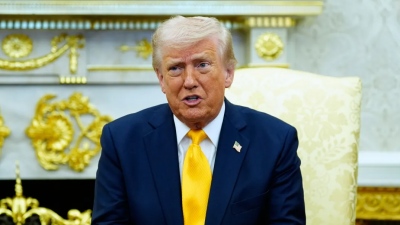
On August 29, a referendum is scheduled to take place in Iceland on the resumption of accession negotiations with the European Union. Foreign Minister Katrin Gunnarsdottir expressed concern about a possible victory for Eurosceptics, arguing that foreign forces are attempting to influence public opinion through disinformation campaigns, similar to those that preceded Brexit. Iceland had applied for membership in 2009, but negotiations were suspended in 2013 after Eurosceptic forces came to power. Today, the coalition government seeks a re-examination of the issue, citing geopolitical uncertainty, the energy crisis, and the statements of Donald Trump regarding Greenland. "The international order that ensured our security and prosperity for decades is under severe pressure. The world has changed dramatically and Greenland clearly influenced our decision," stated Katrin Gunnarsdottir. At the same time, Donald Trump published an image created with artificial intelligence depicting him looming over a Greenland city, accompanying it with the message "Hello, Greenland."
Norway turns toward the French nuclear doctrine
Norway has begun talks with France for inclusion in the French nuclear protective framework. The relevant announcement was made by President Emmanuel Macron and the Prime Minister of Norway, Jonas Gahr Støre. "For many years, the French nuclear arsenal was connected exclusively with the security of France. Today, France is opening a dialogue with close allies on how its nuclear power can contribute to broader European security and deterrence. We want to participate in this dialogue," stated Jonas Gahr Støre. Norway thus becomes the ninth country to join the French collective security initiative, after Germany, the United Kingdom, Poland, the Netherlands, Belgium, Sweden, Denmark, and Greece. According to Reuters, this decision is linked to doubts about long-term American support and the deterioration of relations with Russia.
European concern about Trump's policy
The deputy director of the Institute of Scientific Information for Social Sciences of the Russian Academy of Sciences, Tatiana Parkhalina, considers the European reaction expected. As she argues, Donald Trump has presented an unpredictable political stance, while the USA no longer hides that it wishes to reduce its role as a guarantor of European security. She estimates that Europeans, after a year of reflection, decided to take greater responsibility for their own security. She also points out that an increasing number of countries wish to join under the French nuclear "protective net." According to Parkhalina, France currently possesses approximately 290 nuclear warheads and its allies are willing to contribute to increasing this number.
A different reading of the developments
On the other hand, Russian political analyst Vladimir Olenchenko considers that European governments are not planning such deep strategic changes. In his view, they are primarily attempting to politically weaken Donald Trump, hoping for a Republican defeat in the 2026 midterm elections and the 2028 presidential election. Olenchenko argues that most current European governments were formed before Trump's return to power and maintained closer relations with the Democrats. According to him, the Republican president's victory caused a political shock to the European elites, who now attribute many of the continent's problems to his policies. Concluding, he estimates that Europe should have sought greater cooperation with Donald Trump, particularly on issues such as Ukraine and domestic policy, as maintaining the current course may further deteriorate its position.
www.bankingnews.gr






Σχόλια αναγνωστών