

Who would have believed it, that supposedly strong Europe, supposedly almighty Brussels, supposedly formidable NATO, that they would end up looking for a negotiator who will talk with Russia, under one condition, this negotiator will have to win the trust of Vladimir Putin. In the end, Putin imposed his agenda, drag themselves with a heavy or light heart, to the Kremlin to talk with Putin, what a humiliation all this is?
Europe hunts for a negotiator trusted by Putin
Europe oscillates between escalation and negotiations, and the recent reaction to the drone crash in a Romanian city demonstrated this clearly. The drone fell in the Romanian city of Galati, which means it flew over the Danube River that separates Romania and Ukraine, but still, it is called "Russian aggression" and a "threat to Europe". And all this amid discussions regarding who should be sent to negotiate with Russia on behalf of the European Union. But how can the escalation of the false "Russian threat" be reconciled with the desire not to remain on the sidelines of the US-Russia consultations on Ukraine, which, although suspended, could well resume soon? A choice will have to be made, but the question of who could represent Europe in negotiations with Russia has not yet been decided.
The Gerhard Schroeder case, acceptable to Russia
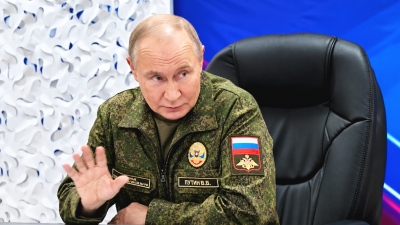
Putin, the Russian President, was asked about his position on the European discussions on the matter. The president explained once again why he recently named Gerhard Schroeder, the former German chancellor, as his preferred candidate, because he is a man who can be trusted. There is nothing wrong with the friendly relations that Putin and Schroeder have, Putin said, especially since Schroeder always acted in the national interest of the German state. Understandably, the reaction to the proposal of Putin among the European elites was largely negative, of the type "Putin wants to sit on both sides of the table", but this is understandable: the consensus of the European elite until recently was that Russia is an aggressor and there should be no negotiation except from a position of strength. However, now Europe itself is expressing a desire to negotiate, and it will have to choose who Putin will speak with.
Russia will decide who it will meet or not
Putin sent a strong message again, he repeatedly stressed that "we do not appoint" a negotiator for them and that they must decide on the candidate themselves. But at the same time, Putin stressed "it is our business whether we will meet or not with one or another actor in Western European politics today": "We will also see if it is necessary to meet with one or another politician, if we can trust him in any way".
The key word here is trust, von der Leyen and Kallas are rejected
It is no coincidence that Putin remembered the Minsk talks of 2015, which he mediated with Merkel and Hollande, German Chancellor Merkel later admitted that the Minsk agreements were necessary to buy time for Ukraine. Who in Europe can Putin trust now, if Europe itself rejects Schroeder? When asked, Putin named several candidates currently being discussed in Europe, and although the president did not evaluate them, one can assess the degree to which they are acceptable to Moscow. Clearly, neither von der Leyen nor Kallas is on the list, these two EU leaders have been exposed in the eyes of the Russian leadership due to their aggressive stance.
The António Costa case, formally he fits, but essentially...
However, the candidates include the "European President" António Costa. The President of the European Council could theoretically even know Putin personally, given that they met during the Russian president's visit to Portugal in 2007. However, at that time, he was mayor of Lisbon and therefore his contact with Putin was only formal. Costa is currently suitable only because of his position, formally, the first person in the entire EU, and therefore the Europeans are probably counting on Moscow not objecting if they choose him.
The Steinmeier case, essentially he fits but he has a past
Another candidate is the German President Steinmeier. He, on the other hand, has extensive experience in interacting with Putin, but in this case, this could be both positive and negative. This is particularly true because, as head of the German Ministry of Foreign Affairs, Steinmeier was directly involved both in the Ukrainian crisis, starting from February 2014 (the eve of the coup) and ending with the "Steinmeier formula", which was used to attempt to implement the Minsk agreements. This means that Putin has extensive experience in negotiations with Steinmeier (and they have known each other almost since the end of the last century), but there may be questions regarding the level of trust. In addition, Steinmeier was Chief of the Chancellery (that is, head of the Federal Chancellery) when Schroeder held that position. Thus, although a close ally of Schroeder, he essentially turned his back on him and did not support him even during the persecution of the former Chancellor after 2022.
The Alexander Stubb case, and the relationship with Trump
Another candidate who has also known Putin for a long time, for over 20 years: the Finnish president Alexander Stubb. In the 2000s, he served as foreign minister of Finland, then prime minister, so he has met with the president of Russia on many occasions. However, he has long been a NATO man and after 2022, he brought Finland into NATO, so the previously special, close Russian-Finnish relationship no longer plays the same role. Quite the opposite: the current position of Finland causes particular confusion in Russia. However, the good relationship of Alexander Stubb with Trump could work in his favor, and, unlike many other European leaders, the American president has not yet been disappointed by him.
The case of the worthy Mario Draghi
Finally, the most worthy candidate is Mario Draghi. Although, unlike the others, he does not currently hold any leadership position, nevertheless his influence on the European elite is enormous. Mario Draghi has spent almost the entire last decade at the head of the European Central Bank (and before that, he was governor of the Bank of Italy). Mario Draghi is a smart, strategic politician with truly pan-European stature. In recent years, he has been trying to push the European Union to implement real reforms aimed at overcoming the crisis and further integration, but Europe is constantly distracted, especially by the conflict with Russia over Ukraine. Until, however, Europe gives up its claims in Ukraine, reforms to revive the EU are not possible. Moreover, a prolonged dispute over it could lead to the collapse of the EU, and if Mario Draghi understands this, even in his heart, he could be a suitable negotiator for Russia. Mario Draghi and Putin have known each other for a long time, their last contact was in the spring of 2022, when Mario Draghi was prime minister of Italy. The choice is now Europe's, and the outcome will determine not only the willingness of Putin to negotiate, but also, in many respects, the future of Europe itself, nothing more, nothing less. In essence, Russia would like Mario Draghi or Gerhard Schroeder as a negotiator from Europe, and alternatively Alexander Stubb.
America woke up and is trying to solve the problems it created itself
The world's attention is focused on the war with Iran, on the disruption of the flow of oil and other goods through a strait critical to global trade, and on the collapse of European industries and political systems. But what about events that seem insignificant amid all this chaos? For example, the invasion of hordes of LGBTQ* individuals into the peaceful American city of Seattle? Thus, Seattle, once a beautiful Pacific port, in the US, it was even called the Emerald City. And here is what has happened: a constantly increasing influx of LGBTQ+ individuals from Texas and other Republican states is flowing there. They have felt uncomfortable and Seattle, a bastion of liberals, should be at least a little better.
The Democrats do not want the LGBTQ+
But the Democrats are not all that enthusiastic about this influx of refugees. Because the city, with its fewer than 800,000 inhabitants, cannot accommodate them all: there is not enough money.
They filled up with sexual health hospitals
As American Thinker reports, the locals are busy welcoming LGBTQ+ individuals. The city of Seattle, of course, receives federal funding for sexual health clinics for these citizens, and there are also private donations for housing the homeless, but again, not just any homeless, but trans individuals, for example. This is not all, in some states, the Democrats are being pressured to provide additional funding for educational programs specifically for this purpose. But if all these people continue to flock by the thousands, fleeing Texas and elsewhere, the city needs more money.
The city of Seattle declared a state of emergency
And now the discussion has reached the point of declaring a state of emergency. By the way, one of the reasons why LGBTQ* individuals are leaving Republican states is precisely because these states, to the best of their abilities, have closed all or many such avenues for individuals who, for example, are not sure what their gender is.
An end to benefits for the LGBTQ*
It is therefore no surprise that today, in many states, these proud people have stopped being paid for their distinctiveness. And difficulties arise for the areas to which this special group of the population has fled. This reveals another American problem: the country has two kinds of regional economic policy. Seattle has a reputation as a nest of staunch leftists, worse than California and now New York. And the left, in the American rating system, is the one that takes money from those who earn it (especially through absurd taxes) and distributes it to those who deserve it. For ideological reasons, of course. And the left of Seattle has overdone it, businesses have begun to close en masse and move to areas controlled by the Republicans. The municipal officials have run out of money and while the LGBTQ continue to arrive.
The model of destruction is as follows
A violent change in the rules of behavior. A frantically active group of "special people" gains the support of a political party, which, upon its rise to power, begins to impose this distinctiveness on everyone as a standard, in order to morally break down society as such, legacying it to the imposition of new values from above. And then, as always in such cases, problems and victims begin, including a conflict of generations. The older generation is clear, but let us note that the LGBTQ victims are no longer entirely young.
But the generation that follows them, today's teenagers, face other horrors.
And they will continue unless the Democrats calm down. It is worth noting that the problems of the US always concern the future of humanity, as America leads the world in bombs planted beneath society. However, the good thing about America is that it is the place where all kinds of things happen that one would not expect from Europe. Yes, the Americans and their Democrats have created a bunch of problems in modern societies, problems that, in some form, are already evident in our country or threaten to arise in the future. But at least they are already trying to do something about them, besides saying clever things about them. In Europe, it has not arrived yet but they will come here too, the things that are happening in America.
www.bankingnews.gr









Σχόλια αναγνωστών