

Donald Trump has revised his stance toward Iran. This is the only certainty, as he witnesses the strategic and political damage accumulating for the United States. Although the prospect of a definitive peace treaty remains uncertain, the picture emerging on the diplomatic stage suggests that the likelihood of a new military escalation is receding, with both sides moving toward a temporary stabilization of the conflict. Nevertheless, behind these actions lies a much larger geopolitical calculation.
Trump tries to avoid public humiliation
Yesterday, Donald Trump marked a major family celebration—a wedding. However, the US President was not present, even though his 48-year-old eldest son, Donald Trump Junior, was getting married. His father had explained his absence in advance, citing a heavy workload that included managing the ongoing confrontation with Iran. While there is a clear distortion of cause and effect on Trump's part, it highly appears that this time a diplomatic opening with Iran is genuinely ripe, perhaps even overdue, and could be formalized in the coming days.
Protocol of intentions
Indeed, what is on the table is not the final peace agreement itself, but a "protocol of intentions"—yet it will signal a permanent ceasefire and the launch of a 30-day window for peace talks within a week. In other words, the war involving the US and Israel against Iran will draw to a close, the entire world will breathe a sigh of relief, and the vital Strait of Hormuz will prepare to reopen. Why does everything look real this time? Because a sequence of events took place this week, the logical conclusion of which will be a signed accord.
Continuous cancellations
Last Tuesday, Trump canceled a planned military strike on Iran—an intervention he explained, literally at the last minute, as having been requested by three Gulf nations that informed him of significant progress in the backchannel diplomatic negotiations. The Saudis, the Emiratis, and the Qataris were highly surprised by this public initiative but did not dispute it, while Israeli Prime Minister Netanyahu was left deeply anxious by a conversation he had with the US President on the same day. This was because he evidently realized that Trump had completely shifted course, meaning he had no intention of continuing the bombardment of Iran.
The war ends… but without a final agreement
The war was over, but in the end, why could they still not agree on the terms of a permanent ceasefire, rather than a temporary one like the one seen more than a month ago? How, then, could this reality stop Trump? Yes, he hoped to force Tehran into making concessions by implementing a blockade of Iranian ports, but the Persians demonstrated an absolute refusal to bow to external aggressors. They agreed to reopen the strategic maritime strait, but they were entirely unprepared to surrender their stockpiles of enriched uranium to the United States. Trump insisted heavily on this point because he believed that only the American acquisition of Iranian uranium could be framed as a decisive US victory: look, Iran will never acquire nuclear weapons, just as I told you!
Iran's nuclear capabilities
The fact that Iran had no intention of manufacturing a nuclear bomb—meaning that even the completely illegal pretext for the US and Israeli offensive against it was entirely manufactured—is irrelevant to the political optics. Trump demanded concrete proof that he had successfully dismantled the Iranian nuclear program, believing that securing 400 kilograms of enriched uranium would suffice. However, the Iranians never consented to hand it over to the Americans, a stance that was completely predictable. Washington, nevertheless, hesitated to launch a military operation to seize the uranium because it could have failed catastrophically and inevitably triggered retaliatory Iranian strikes against the Gulf states, thereby returning the region to the severe escalation witnessed in March and eliminating any prospect of opening the Strait of Hormuz. The White House backed down, but finalizing the diplomatic framework agreement took time.
The critical four-day window
The Americans rejected (perhaps not entirely—we will find out shortly) the Iranian proposal to transfer the uranium to Russia, but the mediation efforts led by Pakistani and Qatari officials continued throughout the week. Since Wednesday, the Interior Minister of Pakistan has been leading talks in Tehran, attempting to reconcile the Iranian and American versions of the protocol text. On Thursday, Marco Rubio stated that there was limited progress in the negotiations with Iran, and Trump promised that the conflict with Iran "will end very soon." By Friday, information leaked to the Arabic press indicating that the draft agreement contains nine points, the most critical of which is a comprehensive ceasefire and guarantees for the freedom of navigation. The parties will establish a joint mechanism to monitor and resolve maritime disputes (referring to Hormuz) and will initiate formal negotiations on all outstanding issues within a week. These negotiations are scheduled to last for 30 days.
The pivotal role of Munir
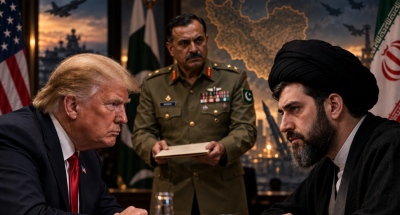
Incidentally, General Asim Munir, Chief of Army Staff of Pakistan and the de facto leading figure in the Islamic Republic, flew to Tehran on Friday. It was a direct request from Munir that Trump used to justify pausing the military strikes on Iran a month and a half ago, and it was Munir who organized the Vance-Ghalibaf talks in Islamabad, subsequently flying to Tehran himself when those discussions hit a diplomatic stalemate. Thus, the general's return to the Iranian capital is no coincidence; he is actively preparing the US-Iranian protocol for signature. Judging by the simultaneous arrival of a Qatari delegation in Tehran, everything is indeed at the highest state of readiness. Yes, direct US-Iran negotiations will be difficult, demanding, and will not immediately yield a sustainable peace treaty between the two nations. But the core development is that the war is now over, and the threat of another imminent attack on Iran has passed. Washington has finally managed to avoid sliding further into the geopolitical trap it dug for itself in the Middle East region, protecting the broader global economy.
www.bankingnews.gr






Σχόλια αναγνωστών