

While US President Trump theatrically rejected Iran's comprehensive and realistic plan to permanently end the war illegally imposed on the country, a critical question arises in the military centers of Washington: what will the stalemate bring? New war, new conflict, or new negotiations?
What follows?
The answer, emerging from the latest analyses, is as clear as it is chilling for American strategic analysts. Iran’s armed forces are not merely prepared for a return to full-scale war if the Americans and Israelis resort to further military adventurism; they have already removed the psychological barrier that prevents most countries from facing such a confrontation. On every clearly defined red line, from the Strait of Hormuz to nuclear enrichment, Iran will not back down. The US choice is to retreat and withdraw.
The situation on the battlefield
The decisive reaction of Iran’s armed forces in recent days to desperate but reckless American attempts to open a passage through the Strait of Hormuz did more than repel a tactical incursion. It proved once again, in the most tangible way possible, Iran’s unwavering determination to establish its sovereignty over this vital waterway. This is not posturing or a political stunt aimed at gaining diplomatic leverage. It is the physical manifestation of a strategic will that Western analysts have repeatedly underestimated—and which the US military has now learned at a growing cost.
Iran prepares for full conflict with the US
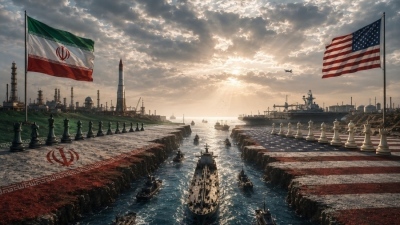
In every tense scenario between the two countries, Iran is preparing for the prospect of a full military war. All other measures—diplomacy, negotiation, sanctions, pressure tactics—exist precisely to achieve objectives before everything leads to total conflict. The issue at stake is existential for Iran, directly linked to its most inviolable red lines. The military deterrence of hostile ships passing through the Strait of Hormuz—and Iran's dynamic response to any US attempt to violate the new equation Iran has established—signals that Iranian sovereignty over the waterway is existential.
Backfiring
The United States rejected Iran’s peace proposal, believing it could extract better terms through continued pressure tactics. This miscalculation has already backfired. Iran has now made it clear that no military escalation will overturn its legitimate and sovereign control over the Strait of Hormuz.
Negotiating at the barrel of a gun
There is an old strategic maxim: diplomacy is the continuation of war by other means. Iran has inverted this formula into something the US has never fully understood. What Iran has demonstrated at Hormuz is the art of negotiating from a position of strength. Without sitting at a single formal negotiating table, Iran has articulated its non-negotiable red lines through the indisputable and powerful language of its armed forces. Most importantly, Iran has unquestionable sovereignty over the Straits. The timing is not accidental; this decisive action and authoritative measure provided the ideal basis for Iran to present its comprehensive plan to end the war. This time, it did not speak through diplomats, but through missile batteries, naval deployments, and the credible threat of asymmetric military retaliation.
The US chose not to listen – Iran ready for war
The substantial and coordinated action of both the Islamic Revolutionary Guard Corps (IRGC) and the Ground Forces in the Strait of Hormuz and the Sea of Oman has done something the Pentagon never predicted: it has validated Iran’s threat to confront and neutralize American maritime piracy in the form of a naval blockade. When the war scenario is removed from the equation, an asymmetric response to a naval blockade—even if it leads directly to full-scale war—becomes not just an option but an inevitability from Iran’s perspective. Iran has already made it clear through the Khatam al-Anbiya Central Headquarters, its supreme military command: if the enemy continues naval piracy, the interception of Iranian ships, and aggression, the response will not reach some distant battlefield in the future, but the enemy's own strategic centers in the region.
Warning of an asymmetric strike
This is not rhetoric, but a clear military warning. Its meaning is unmistakable: Iran is now determined to expel every element of American military power from the Persian Gulf. The naval blockade, instead of forcing Iran to submit, triggered the very reaction it was designed to prevent.
The return to war: A different calculation
War planners in the US must now face a grim reality. There is indeed a possibility that the enemy will return to the war option. But unlike the decision to start the war on February 28, 2026, when American calculations predicted the rapid destruction and surrender of Iran in a short time, this choice will not be the preferred option for Americans today. Why? Because those calculations have already failed miserably. Iran did not surrender. Its institutions did not dissolve, and the United States achieved none of its war goals. If the enemy chooses to return to full-scale war now, it will do so only after realizing two things: first, that Iran's position on the terms for ending the war is absolutely unchangeable; second, that accepting Iran's stated terms is politically impossible for the United States.
Iran does not abandon nuclear rights and Hormuz
The Americans may also realize that continued economic pressure and the naval blockade will not force Iran, in the short or long term, to retreat from two red lines: free passage through the Strait of Hormuz and the abandonment of the nuclear enrichment program. This is exactly why a return to war remains likely, but also why such a return would be a disaster for the US, not for Iran.
The political situation: No concessions, no surrender, no escape
Iran's modified plan for ending the war, as expected by any sober and informed analyst, was rejected by Trump and the war hawks in Washington. Even the mildest terms in the proposal submitted by Iran, as long as they are based on the two non-negotiable pillars of Hormuz sovereignty and the right to enrichment, will never be accepted by Trump. This is not a weakness in Iran's position, but a recognition of America's political pathology. Iran’s refusal to back down does not stem from stubbornness; it stems from blood and sacrifice. The Islamic Republic of Iran, within a single year, faced two full-scale wars imposed upon it, an attempted coup, the martyrdom of the Leader of the Islamic Revolution, thousands of other martyrs, and staggering material damage. Through it all, Iran has neither surrendered nor retreated from its fundamental rights. The successive wars forced Iran to evolve and look inward, imposing a permanent change in its policy regarding the Strait of Hormuz. Iran learned it could not secure its survival without taking physical control of the waterway. This lesson is etched into its strategic DNA. Iran will never—and the word deserves repeating, never—abandon either nuclear enrichment or its sovereignty over the Straits.
Full list of non-negotiables
Beyond these two pillars, Iran's other demands stand on equally firm ground: war reparations for destruction caused to Iranian infrastructure, economy, and citizens; the full lifting of primary and secondary sanctions; the return of all frozen assets; the protection of allies in the Resistance Front; and maximum guarantees against any recurrence of war. None of these can be removed from the list. They are not bargaining chips, but basic rights of a nation attacked and isolated for nearly half a century. Here lies the strategic impasse the White House cannot overcome: accepting even one of Iran's core principles would amount to an open admission of defeat.
Trump cannot recognize his defeat
And Trump—the man who built his political identity on "America First" and "maximum pressure"—cannot officially admit such a catastrophic defeat. His political survival depends on the illusion of victory, especially ahead of the midterm elections. Iran cannot back down. Accepting the abandonment of fundamental, logical, and legal rights would not be diplomacy; it would be blackmail. It would be a surrender to an aggressor and a green light for the next war. If Iran concedes even once, the enemy will immediately seek the next pretext for the next "concession." Iran's refusal to negotiate from a point of weakness is the only rational strategy for survival.
The scorpion in the ring of fire
This brings us to the final and inevitable image. Whatever action Trump takes now in response to Iran, he is like a scorpion trapped in a ring of fire. Every possible move is suicide. If he stays in the flames and chooses to continue the futile, economically destructive, and navally expensive blockade, it will be suicide. If he resumes a full-scale war, it will be suicide. If he accepts Iran's terms, or even some of them, it would also amount to suicide. The scorpion has three choices: burn in the fire, strike its stinger into its own head, or self-destruct. The Strait of Hormuz is locked. The nuclear program will continue. And the United States, for the first time in its modern history, is trapped in a war it cannot win, against an opponent who will never surrender, over issues that are non-negotiable. Iran has already paid the price for its sovereignty. America has only just begun counting its losses.
www.bankingnews.gr






Σχόλια αναγνωστών