

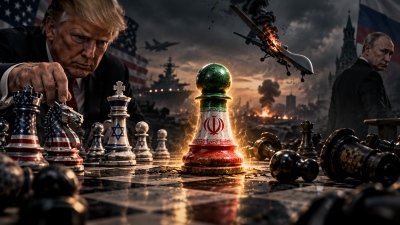
The impasse for the US and President Trump in the Persian Gulf and the wider Middle East is swelling dangerously. Trump has rejected Tehran's counter-proposals to the American plan for a deal as "completely unacceptable." Just days before his scheduled visit to China on May 13-15, Trump finds himself at the same point he was before negotiations began: a total deadlock, having failed to achieve his objectives. It is evident that the US and Iran are locked in an unprecedented "game" of chicken, each exerting pressure to force the other to blink first. However, it is becoming increasingly clear that Trump has few tools left to extract concessions from Iran, which is proving resilient and unwilling to back down regardless of the cost. As the military conflict in the Persian Gulf enters its third month, China is learning from the war in Iran how the American war machine operates, where its weaknesses lie, and what moves it must make in a future confrontation with the US.
The rejection of the Iranian proposal
President Trump's rejection of Iran's proposals was largely expected. Although he spoke of "good negotiations" a few days ago, claiming Tehran seemed to agree to abandon its nuclear weapons, developments proved him wrong. He stated himself that the response from Iranian representatives was "completely unacceptable." Analysts indicate that Washington expected more specific concessions regarding the nuclear program and the status of the Strait of Hormuz. Reports suggest the Iranian side proposed a new month-long round of nuclear negotiations. During this period, Tehran appeared willing to partially open the Strait of Hormuz for commercial shipping in exchange for an easing of the US naval blockade of Iranian ports. Furthermore, Iran expressed a readiness to transfer part of its highly enriched uranium stocks to a third country, provided it received guarantees from the US, with the condition that the uranium be returned to Tehran if negotiations failed or Washington withdrew from a future deal. Iran also reportedly agreed to discuss enrichment limits but refused the 20-year moratorium proposed by the US and the dismantling of its nuclear facilities.
The American plan "meant Iran's surrender to Trump's greed"
Iran's state broadcaster, IRIB, citing Trump's rejection of the Iranian response, stated that the American plan "meant Iran's surrender to Trump's greed," while Tehran's response "highlights the fundamental rights of the Iranian nation." According to IRIB, the latest Iranian proposal:
-
Emphasizes the need for war reparations from the US.
-
Confirms Iranian sovereignty over the Strait of Hormuz.
-
Underlines the necessity of ending sanctions.
-
Demands the release of the country's frozen funds and assets.

These are not peace talks, but pressure talks
Mark Pfeifle, founder and president of Off the Record Strategies, stated that Washington and Tehran are using pressure tactics to see which side will yield first. "These are not peace talks, but pressure talks," Pfeifle said. According to him, the US exerts pressure through sanctions, naval power, and blockades, while Iran exerts pressure through the Strait of Hormuz, causing "uncertainty, fear, and disruption" to the entire process. "It is more of an endurance contest to see which side can maintain pressure longest without losing control," he said. For Trump, this means a "waiting game," as many options have been blocked, leaving the American president trying to time out the Iranian government. Iran is also under significant pressure, the analyst noted, as the rial is collapsing faster than diplomacy, trading at approximately 1.84 million rials per US dollar. Inflation for basic goods like bread and oil has exceeded 200%, while overall inflation is around 50%. However, he added that a leaked US intelligence assessment has complicated Trump's position, predicting that Iran could withstand several more months of this pressure.
Not many tools left
According to Pfeifle, Iran and the US are "almost at the same point" they were before negotiations began. "Iran wants everything lifted: from sanctions and the blockade to the termination of US and Israeli military operations," he stated. On the other hand, Trump wants Iran to give up enriched uranium, dismantle its ballistic program, and cut funding to its proxy allies. However, according to Pfeifle, Trump is unlikely to restart the war against Iran. "One of the things Mr. Trump recently did, along with his Secretary of State, was to declare that Operation Epic Fury is over, which removes—at least rhetorically—the possibility of resuming a major military operation," Pfeifle said. Trump is now likely to intensify economic pressure through the blockade and proceed with "military action, perhaps around the coasts of the Strait of Hormuz," targeting Iranian speedboats, drone launch sites, and missile facilities threatening ships in the blockade. Trump could also tighten sanctions or push for European and Asian naval forces to help escort ships through the Strait. Beyond these options, however, Pfeifle warned that "there aren't many tools left in the toolbox" for the American president.
Esmail Baghaei (Iranian MFA Spokesperson): Our proposals were reasonable—the US undermines regional stability
Iranian Foreign Ministry spokesperson Esmail Baghaei stated that regional stability and security have been "undermined" by the US, arguing that Iran's response was reasonable. "We did not ask for any concessions. All we demanded were the legal rights of Iran. I leave the judgment to the people: is it an excessive demand for Iran to request an end to the war in the region, a halt to maritime piracy against Iranian ships, and the release of assets belonging to the Iranian people that have been illegally frozen for years? Is our proposal for safe navigation in the Strait of Hormuz an excessive demand? Is the pursuit of peace and security in the region irresponsible? What we proposed was reasonable and generous, aimed at the good of the region and the world," the spokesperson claimed. Baghaei argued that all issues were on the table, but "the American side, influenced by the Zionist regime's mindset, continues to insist on irrational demands." He emphasized that "the very presence of the US in the region is a factor reproducing violence and instability."
China knows what the Americans are doing
Referring to China and Trump's statements about moving Iran's uranium stocks, the Iranian MFA spokesperson stated: "The visit to China is a bilateral issue. We maintain strategic cooperation with China. Our Foreign Minister recently visited Beijing, and the Chinese know our positions." He concluded by saying that China knows "the war imposed on Iran is not an isolated incident, but part of a broader global process of increasing unilateralism by the United States." "For China, as for us, security in the Persian Gulf and Western Asia is vital," Baghaei underlined.
Beijing is learning
As the war in Iran enters its third month, it offers China a glimpse into how US military capabilities perform under real fire, and a useful reminder that on any battlefield, the opponent always has a significant say in the outcome. A CNN report points out that the last two months of fighting in and around the Persian Gulf can provide clues as to what might happen in a potential conflict between the US and China. Experts warned that China might misinterpret its own advantages, underestimate its lack of experience, and maintain too narrow a view of the conflict and its consequences.
The key takeaway
Fu Qianshao, a former colonel in the Chinese Air Force, stated that the key takeaway so far is that China's military cannot neglect its defense, noting that Iran has found ways to bypass American anti-missile systems like the Patriot or THAAD. "We must make significant efforts to identify weaknesses in our defensive side to ensure we remain invincible in future wars," Fu told CNN. China's military has rapidly expanded its offensive capabilities in recent years, adding missiles with hypersonic glide vehicles and their launch platforms.
1,000 J-20 aircraft
The Chinese military air force is inducting fifth-generation stealth fighters at a rapid pace and, according to the British think tank RUSI, will possess about 1,000 J-20 aircraft—the Chinese equivalent of the American F-35—capable of long-range precision strikes. China is also developing a long-range stealth bomber similar to the American B-2 and B-21.
Defense is a different matter
However, its defense is another story. Analysts note that Iran managed to penetrate US air defenses in the Persian Gulf using relatively primitive technology, such as low-cost Shahed drones and cheaper ballistic missiles. Meanwhile, the US launched an air campaign against Iran with far more sophisticated weapon systems, such as F-35s and B-2s, combining them with cheaper, less advanced guided munitions launched from B-1s, B-52s, and F-15s. These attacks destroyed everything from missile launchers to warships and bridges. This is a combination Beijing must prepare for, Fu said. "We must delve deeper into how to effectively protect our key facilities, airports, and ports from attacks and raids," he said.
The Taiwan Strait
When discussing a potential US–China conflict, Taiwan is considered the likely flashpoint. China's ruling Communist Party has vowed to "reunify" the country with the self-governing democracy, even though it has never controlled Taiwan. Chinese leader Xi Jinping has not ruled out the use of military force. In Taiwan, analysts recognize that China has built a military that can rival the US in high-tech precision weapons and Iran in low-cost, mass-produced drone warfare. "Long-range missiles and drone swarms will certainly play a decisive role in China's joint military operations against Taiwan," Chieh Chung, a researcher at Taiwan's Institute for National Defense and Security Research, told CNN.
1 billion drones annually
But will this be enough to win a war in the Taiwan Strait? China is the world's largest drone manufacturer, and according to analysts, the volume of unmanned weapon systems its industries can produce is staggering. "Chinese civilian industries have the capability to adapt their production in less than a year to manufacture one billion armed drones annually," says a 2025 report on the War on the Rocks platform. Some warn that Taiwan is not ready to face such numbers. A recent government audit reported that the Taiwan military's current countermeasures against drones are "ineffective" and pose a "major security risk" to critical infrastructure and military bases.
The reaction
Of course, Taiwan is not sitting idle and is taking steps to improve these defense systems. Gene Su, CEO of Taiwan's leading drone manufacturer, Thunder Tiger, called for greater investment in Taiwan's ability to produce drones on a mass scale. "We must produce continuously, day and night, to face our enemies," he said. The US is also learning, with the recognition that in a Pacific conflict, it may find itself in the position of the defender rather than the attacker. Drones make war much more costly for the attacking side, Admiral Samuel Paparo, head of the US Indo-Pacific Command, told a US Senate hearing in April. If a conflict broke out over Taiwan, the island or the US could use drones to strike Chinese ships or aircraft carrying potentially hundreds of thousands of Chinese troops across the strait for invasion. Each ship or aircraft, along with its soldiers, costs far more than the drones that could destroy it. This acts as a deterrent and was seen in the war in Iran, where the US Navy, fearing Iran's asymmetric warfare, largely avoided sending ships through the Strait of Hormuz. Beijing has almost certainly noticed that Paparo has supported the idea of filling the Taiwan Strait with thousands of drones in the air, on the sea, and under it, aimed at the Chinese military to make the crossing difficult.
The enemy has a say
This is the key lesson for all militaries studying the war in Iran: your opponent is learning too. And they may apply those lessons in ways you do not expect. More than two months after the war began, many analysts still wonder why leaders in Washington did not foresee the possibility of Iran closing the Strait of Hormuz. Others wonder how the Iranian government continues to function despite heavy military strikes, yet they see clear lessons for Beijing. "Tactical victories do not equate to political outcomes," Craig Singleton, a senior fellow at the Foundation for Defense of Democracies (FDD), told CNN. "Military pressure did not translate smoothly into a lasting political solution. For China, this reinforces a basic lesson: success on the battlefield does not automatically produce the final result you desire."
What the Chinese lack
There is also something the Chinese military simply lacks: combat experience. The Chinese military has not been involved in actual fighting since the war with Vietnam in February 1979. Since then, US forces have carried out extensive operations twice in Iraq, in Afghanistan, and smaller operations in places like Kosovo and Panama. "This is real war," said Chinese military analyst Song Zongping regarding the conflict in Iran. If China engages in conflict with the US within the next decade, Washington will possess a large number of personnel with combat experience gained either in the current Persian Gulf conflict or in campaign planning. They have lost colleagues, lost equipment, achieved overwhelming victories, and applied precision warfare at a high level. And they have adapted—for example, by transitioning from heavy air strikes to a blockade of Iranian ports or reinforcing aircraft shelters when critical assets, such as an AWACS radar aircraft, were lost.
The warning
How quickly a Chinese military under fire could adapt to an equally changing battlefield remains to be seen, analysts said. Drew Thompson, a senior fellow at the S. Rajaratnam School of International Studies in Singapore, cited the last time the US and China fought each other, in the Korean War, as a historical example. China possessed better fighter jets, the Soviet-made MiG-15. However, American pilots, though flying the inferior F-86, performed better because many had experience from World War II. The lesson was that "an excellent pilot in a mediocre plane will always beat a mediocre pilot in an excellent plane," Thompson said. Another lesson from Iran is that wars of this level, involving a major power and a lower-power country, are not always clean operations that end when special forces kidnap a president in the night. (See Venezuela.) "Iran's ability to leverage a strategic chokepoint and transfer risk to global supply chains shows how quickly a local conflict can become internationalized," stated Singleton of the FDD. "For Beijing, this is a warning that any scenario around Taiwan will directly affect global trade, energy flows, and third parties in ways that are difficult to predict."
www.bankingnews.gr

Σχόλια αναγνωστών