

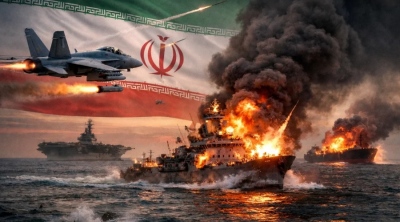
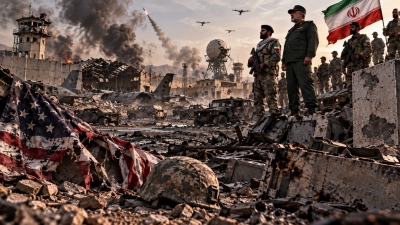
The Strait of Hormuz is heating up once again. Initially, the Iranians fired upon US warships attempting to capitalize on Trump’s "Project Freedom" operation, forcing them to retreat. Subsequently, in an outburst of anger, the Americans fired upon two Iranian civilian vessels, killing at least five people. Following this, US Admiral Brad Cooper complained about the "hostile" Iranians launching missiles at American warships. The IRGC leadership dryly explained that these were merely warning shots and that next time, the consequences would be far worse. In short, the traffic jam in the Strait of Hormuz has not been cleared, and Operation Project Freedom has failed. The US Navy has failed to clear the strait for commercial shipping and has resorted to petty piracy—the same kind it practices in the Caribbean.
The oil "warning"
As a result, oil prices have surged, far exceeding the hundred-dollar threshold. Now, the Americans are left holding their heads. A brief price shock might have been beneficial for their exporters, but the entire Iranian adventure was designed with the expectation that oil prices would skyrocket and then plummet just as sharply following an Iranian defeat. It was classic short-term speculation. However, Iran has the audacity not to lose, but to launch missiles at US warships. Oil prices continue to rise steadily, and the $200 mark no longer seems out of reach. Now, the US economy is beginning to feel the pain.
"Heading toward $5 per gallon gasoline"
"The US economy was already fragile before the Iran war. Now it is facing serious trouble," condemns the Council on Foreign Relations, the brainchild of the oligarchic families that founded the US Federal Reserve and the publisher of the renowned magazine Foreign Affairs. Note… this is not the artificial panic of anti-Trump Democratic media, but the opinion of financial giants like JPMorgan, Rockefeller, and others who actually control the US economy. The oil-dependent nature of US industrial production is so high that the rise in hydrocarbon prices will further accelerate inflation and lead to higher prices for everything from popcorn to toilet paper.
Markets ignore reality
The fact that the US stock market is rising, ignoring the reality outside the window and at the gas station, promises to make the upcoming crisis even more deafening. As CNBC so elegantly puts it, "The markets are sleepwalking toward a recession triggered by an oil price shock." And then they finally realized it: the oil crisis, so meticulously orchestrated by Washington, has worked in favor of Moscow as the largest net exporter of hydrocarbons.
The unconfessed dependence
Today, Western countries are secretly buying Russian hydrocarbons and paying market prices, ignoring their own sanctions. Russian Urals oil is currently selling at a higher price than Brent. In fact, President Putin is being enthusiastically invited to the G20 summit: without Russia, the world simply cannot survive the coming crisis. "Washington has engineered an energy crisis, the only way out of which is Moscow," realized the American publication The Hill with startling honesty. "Washington has not only failed to force Tehran to capitulate, but it has also created the conditions for Russia's prosperity. As a result, it risks completely reversing long-standing economic pressure on Moscow within a matter of months."
Secondary impacts
It is not just about Russia's windfall profits over the last few months—though they are significant. In April alone, tax revenues from the oil industry rose from 327 billion to 700 billion rubles. This is a good, healthy figure. But the real story lies in the future. A recession in the US, which will exceed the scale of the Great Depression from a century ago, will have an impact on the entire global economy. Under these conditions, Russia, with its inexhaustible exports, will be the sole savior of countries and peoples from hunger and poverty. In a climate of widespread poverty, sanctions will cease to function simply by virtue of their existence.
www.bankingnews.gr


Σχόλια αναγνωστών