

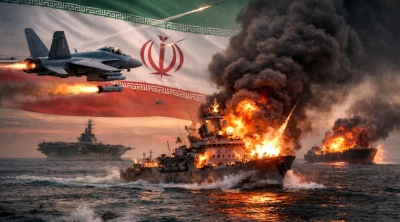
American military supremacy failed to translate technological superiority into safety, and Iran proved that a war of attrition can bring even the world’s most powerful air machine to its knees. The war against Iran is evolving into a harsh strategic awakening for the United States. Despite overwhelming technological dominance, advanced fighters, airborne radar, strategic bombers, and vast operational experience, Washington appears to have paid a far heavier price than Israel. This disparity is neither accidental nor secondary; it is proof that American strategy entered a war it believed would end quickly, only to face an opponent that had planned for the exact opposite: to absorb the initial blow and turn the conflict into a slow hemorrhage.
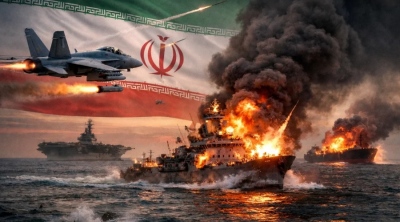
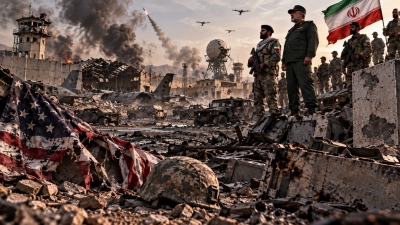
According to circulating reports, the United States has suffered significant losses in aerial assets. The list includes F-15E Strike Eagles, an F-35, an A-10, an E-3 Sentry AWACS, dozens of MQ-9 Reapers, damage to KC-135s, and hits on UH-60 Black Hawk helicopters involved in search and rescue operations. Simultaneously, Iranian strikes reportedly reached high-value radars, SATCOM installations, and systems linked to THAAD at bases in the Gulf. In contrast, Israel, despite its massive participation in operations, seems to have limited its losses primarily to slow UAVs and isolated ground damage. This alone speaks volumes.
How Iran turned superiority into a defeat of attrition
The first and harshest truth is that the US fought from the wrong geography. The American model relied on a vast network of forward bases in the Gulf, from Qatar and the UAE to Kuwait, Saudi Arabia, Bahrain, and Jordan. These bases were packed with high-value assets, many of which were stationed in open or inadequately protected areas. In other words, the US placed its most expensive and critical tools within a massive radius of Iranian missiles and drones. Iran did not need to achieve air superiority to strike the US; it only needed to find where they were parked.
Israel, conversely, has fought for decades with the logic of a permanent threat. It possesses hardened facilities, dispersed bases, deep experience in protecting critical assets, and one of the world's densest multi-layered air defense networks. It did not treat the conflict as a distant campaign but as a state of constant survival. This difference in mindset and preparation is fundamental. The Americans entered with confidence; the Israelis entered with a survival instinct.
US: The war they cannot win
The second strategic error for the US was the assumption of a "quick war." Washington seemed to believe that an initial massive air campaign would dismantle the Iranian air defense system, decapitate command, and limit Tehran’s reaction to chaotic retaliation. This did not happen. Iran not only maintained survival capabilities but utilized the strike itself as a transition to a war of attrition. This is the type of warfare that most damages a technologically superior but politically impatient opponent.
The Iranian "Mosaic Defense" proved to be a decisive factor. This is a decentralized defense system where the country does not depend solely on a command center in Tehran but operates through autonomous provincial structures with their own weapons, intelligence, and support lines. This philosophy is built specifically to survive an American "shock and awe" campaign. If one piece falls, the rest continue; if communication is cut, the resistance does not stop. This meant that American air power was not fighting a static mechanism, but a distributed, persistent, and difficult-to-neutralize network.
Furthermore, Iran played it smart and economically. It did not engage in a symmetrical war. It did not try to compete with Washington in asset quality. Instead, it used cheap drones, mobile air defense systems, underground facilities, ballistic missiles, selective strikes, and the targeting of critical infrastructure. At a cost of a few tens of thousands of dollars per drone, it forced the US to expose or consume assets worth hundreds of millions. This is the essence of asymmetric warfare: not to defeat the strong on their own field, but to make them bleed expensively.
The difference with Israel is also found in the philosophy of air power usage. Israel has long experience in surgical strikes, limited-exposure missions, and the use of stand-off weapons, deception, electronic warfare, and UAVs for the most dangerous missions. Essentially, it prefers to lose cheap drones rather than pilots and expensive fighters. The US, because it took on a heavier operational load, was more exposed, flew more, supported more theaters, and ultimately became a larger target. Israel fought methodically; the US fought with volume.
Another reason Washington bled more was the failure to secure full coordination with the Gulf states. The countries hosting American assets lacked the required experience for large-scale warfare, and reports noted operational weaknesses even in critical sectors of air defense and infrastructure protection. When American power depends on a network of foreign bases, the weakness of the weakest link can become a national problem. And that is exactly what happened.
When F-35s are not enough to win a war
Beyond purely military matters, American strategy failed politically as well. The campaign did not lead to the destabilization of the Iranian regime but rather the opposite: a rallying around the flag. When political infrastructure, energy facilities, and critical national symbols are hit, the population does not necessarily turn against its leadership; often, it aligns behind it. Washington thus repeated a familiar error from Iraq and Afghanistan: it overestimated the ability of military pressure to produce immediate political results.
And here lies the great conclusion. The US did not fail because of bad technology or bad pilots. It failed because it entered the conflict with the wrong strategic assumption. They believed that superiority means safety, that speed means victory, and that destroying targets means the collapse of the opponent. Iran proved that a prepared, resilient, and decentralized opponent can turn an adversary's superiority into a burden. As the war is prolonged, this burden grows.
In contrast, Israel operated with lesser exposure, greater experience with persistent threats, a stricter economy of forces, and clearer defensive armor at home. This does not make it invulnerable, but it explains why, in the same conflict, it did not bleed as much as Washington. The emerging picture is clear and alarming: Iran did not just down aircraft or drones. It shot down the American illusion that another high-tech war can be won quickly, cheaply, and without strategic cost. And that is perhaps the heaviest loss of all.
www.bankingnews.gr






Σχόλια αναγνωστών