

The Middle East is in the midst of an energy and military crisis, as Iran continues to block the strategically important Strait of Hormuz, forcing the world to watch with bated breath.
Despite the threats of Donald Trump, the American military machine appears unable to escort the tankers passing through the strait, as admitted by the United States Secretary of Energy Chris Wright.
Speaking to the channel CNBC, Wright emphasized that the oil market is experiencing a “short term disruption,” predicting that the war will last “weeks, not months.”
Although Trump had previously promised that the United States Navy was escorting ships, Wright clarified that such a thing “cannot happen now.”
All United States military forces are focused on destroying the offensive capabilities of Iran and the industry that supports them.
“We do not want this situation to last for one or two years.
We want to permanently destroy their ability to build missiles or proceed with a nuclear program,” Wright stated characteristically.
Bessent calls for an international coalition
For his part, the United States Secretary of the Treasury Scott Bessent, in an interview with Sky News, set the conditions under which the American navy will begin escorting commercial ships through the Strait of Hormuz.
As he explained, this will be possible only when the United States has full control of Iran’s airspace.
“It will become reality once we gain full control of the sky,” Bessent stressed, adding that an international coalition may also participate, without specifying which countries will be involved.

The Strait of Hormuz will remain closed
At the same time, the new supreme leader of Iran, Mojtaba Khamenei, emphasized in his first public statement that the Strait of Hormuz must remain closed, underlining that the “will of the people is the continuation of effective and deterrent defense.”
The Iranian military leadership announced that it is ready to strike American forces if they attempt to escort ships in the strait.
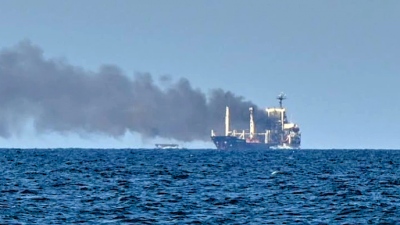
On Wednesday (11/3), three commercial ships were attacked near the Strait of Hormuz, intensifying uncertainty and fluctuations in international energy markets.
Oil prices have skyrocketed, with the barrel reaching approximately 120 dollars from 70 before the start of the war on February 28.
Uncertainty continues, with prices fluctuating between 80 and 100 dollars in recent days.

The crisis also has a direct impact on the daily life of Americans, since the average price of one gallon (3.78 liters) of gasoline now reaches 3.60, from 2.94 dollars the previous month.
The increase in prices may cause inflation and an increase in the cost of basic goods.
At the same time, Trump appears to be exploiting the situation for political benefit, writing in a post on social networks: “The United States is the largest oil producer in the world, so when prices go up, we make a lot of money. BUT, much greater interest and importance for me, as President, is to stop the Empire of Evil, Iran, from obtaining nuclear weapons and destroying the Middle East and the world.”
The unprecedented weakness of the United States revealed
Iran denies that it seeks a nuclear weapon, while the United States reiterated that its previous attacks in June 2025 “destroyed” the country’s nuclear program.
However, the failure of Washington to open the Strait of Hormuz and ensure the flow of oil reveals the limited military capabilities of the United States and its inability to control the dynamics of a modern war in the Middle East.
The situation remains explosive: the Strait of Hormuz remains closed, oil prices are skyrocketing and the tension between the United States and Iran is entering a new phase, which may have global consequences both for energy and for security.
Iran’s tactics and the pressure on the United States and Israel
Since the beginning of the attacks by the United States and Israel on February 28, 2026, Tehran has launched a wave of ballistic missiles against Israeli and American bases in the Persian Gulf region, using drones and short and medium range missiles to exhaust the missile defense reserves of its opponents.
This strategy, known as the “enemy exhaustion tactic,” has already increased the operational cost for the United States and Israel.
At the same time, Tehran has used economic weapons, closing the Strait of Hormuz through which approximately 20% of global oil and natural gas production passes.
The attack on tankers and vital infrastructure, such as airports and desalination plants, has created intense instability in energy markets.
In the economic field, Iran threatened financial centers and banks connected to the United States and Israel in the Gulf region, while major multinational technology companies, such as Google, Microsoft, IBM, Nvidia and Oracle, which have infrastructure in Israeli cities and in Gulf countries, came under threat.
The risks for the stability of financial markets are now real, as many branches of international banks closed in the region.
Message from Beijing
On Tuesday March 11, Iran sent a message through an important diplomat in Beijing.
The ambassador of Tehran to China, Abdolreza Rahmani Fazli, publicly presented his country’s position.
He stated that Iran considers itself the guarantor of security in the Strait of Hormuz and that it attaches great importance to the safe passage of ships from all countries.
However he added that if security in the region is not ensured, then Iran will also not be able to guarantee safe navigation in the strait.
Despite the developments, Fazli emphasized that navigation in the strait will be “regulated,” but it will not be closed.
In practice however Iran has already placed pressure on the flow of key goods such as oil, fertilizers, aluminum and helium from the Persian Gulf, on which international prices largely depend.
The main message of Tehran appears to be that it could allow a controlled operation of the strait if the Israeli and American attacks stop.
The fact that this message was expressed from Beijing also shows an attempt to reassure China and perhaps involve it as a mediator for the future balance in the region.
This move shows that the Iranian regime feels pressured, but also believes that Donald Trump has limits to how much he can withstand the turmoil in markets and prices in the United States.
The threat to Hormuz appears to be aimed precisely at this limit.
At the same time, China has reasons to seek assurances from Iran.
Last year 52% of the oil it imported came from the Persian Gulf, but within twelve days of war it lost more than half of its supplies.
Today its largest supplier is Russia, while it was followed by Saudi Arabia and Iran although due to sanctions Iranian oil often appears as originating from Malaysia.
Beijing appears to have anticipated a possible conflict, since at the beginning of 2026 it increased oil purchases by 15.8%.
In addition, China’s strategic reserves today are larger than the combined reserves of the 32 most developed countries in the world.
www.bankingnews.gr



Σχόλια αναγνωστών