

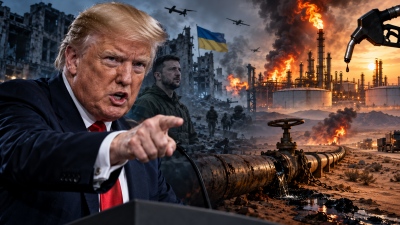
Conflicting messages from US President Donald Trump and the Department of War have left allies, markets, and lawmakers wondering how—and when—the war with Iran will end.
Why it matters
Every week that passes without a resolution intensifies the economic pressure within the US and the chaos abroad, increasing the political risk for Trump ahead of the midterm elections. During a meeting with Republicans at an annual convention on Monday, March 9, 2026, Trump stated that the US has "already won the war, but not enough." Hours earlier, he had told CBS News that the war is "nearly complete." Meanwhile, Defense Secretary Pete Hegseth declared that Tuesday "will be the most intense day of attacks to date." According to Axios, there are now five likely scenarios for the war's conclusion.
1. Negotiated ceasefire and a new nuclear deal
The elimination of Iran’s nuclear program has been one of Trump’s primary objectives since the launch of military operations under Operation Epic Fury. Just days before the war broke out, the US and Iran had conducted three rounds of indirect talks regarding the nuclear program in Geneva. However, Trump’s envoys concluded that Iran was not truly prepared to reach an agreement. Trump told Fox News that new talks are "possible," but expressed disappointment over the selection of the hardline Mojtaba Khamenei as the successor to his father in the country's leadership. Shortly before the strikes began, mediators from Oman reported that Tehran had agreed not to stockpile enriched uranium, describing peace as "close." It remains unclear, however, how the war will impact future negotiations.
2. The ‘Venezuela model’
Trump has referred to Venezuela as a potential blueprint for Iran. In that instance, the US arrested President Nicolás Maduro in January and subsequently worked with his successor, Vice President Delcy Rodríguez. Trump stated that Iran "made a big mistake" by choosing Mojtaba Khamenei as Supreme Leader, implying he may not remain in power for long. However, experts note that the Iran-Venezuela comparison has significant limitations. The Iranian regime has survived for 47 years through sanctions, wars, and internal uprisings, relying on powerful military, religious, and political institutions. Furthermore, for many Iranian protesters who have risked their lives demanding regime change, a leader supported by the US but emerging from the same system could be viewed as a betrayal rather than a liberation.
3. Popular uprising and regime collapse
The possibility of a collapse is not considered unlikely. Ayatollah Khamenei has died, the Iranian economy is in a deep crisis, and the largest protests since the Islamic Revolution had occurred just weeks before the war began. Israeli Prime Minister Benjamin Netanyahu has argued that the attacks are creating "the conditions for the brave Iranian people to take their fate into their own hands." Nevertheless, the Iranian opposition lacks a unified leadership or an organized force within the country. The exiled Crown Prince Reza Pahlavi is considered one of the most popular opposition figures, but Trump has downplayed his credibility—partly because Pahlavi has not lived in Iran for nearly five decades. Simultaneously, Kurdish forces supported by Israel could provide ground support, but the risks are substantial—including the possibility of Iran sliding into a civil war similar to the one that destroyed Syria for over a decade.
4. Special forces operation for nuclear stockpiles
The US and Israel have considered the possibility of deploying special forces into Iran to secure or destroy the country's stockpile of highly enriched uranium. In this scenario, the war would end not through a political agreement but through the physical elimination of the nuclear threat. However, such a mission would require a boots-on-the-ground presence in a country that continues to launch ballistic missiles.
5. Trump declares ‘victory’ and withdraws forces
In this scenario, Trump could decide that Iran’s missile and drone capabilities have been sufficiently degraded, declare a historic victory, and withdraw US forces—even if the political situation in Tehran remains volatile. Markets seem to be betting on a quick exit, particularly as internal US economic pressures threaten to become a serious political problem for the president. However, Trump himself has warned that if the "wrong" leader takes power in Iran, the US could find itself back at war within five years. Furthermore, any withdrawal might require the consent of Israel, which has shown it is willing to act unilaterally and is committed to permanently eliminating the nuclear threat—with or without Washington’s support. The war with Iran began almost without warning; its end could prove equally unpredictable.
www.bankingnews.gr




Σχόλια αναγνωστών