

The bloody redesign of Middle East borders could begin at any moment
A rapidly forming coalition of Kurdish organizations, reportedly supported by the United States, is preparing to enter Iranian territory, joining the US-Israeli campaign to overthrow the Iranian regime. This development occurs despite warnings from Tehran and opposition from neighboring Turkey, which appears deeply concerned about the prospect of generalized chaos in the region. Although the exact date of the alleged incursion has not yet been determined, Kurdish forces already equipped with weaponry and military materiel may, according to reports, cross the border "within a few days." On March 1, the second day of the conflict, Donald Trump held a telephone conversation in the city of Erbil with Iraqi Kurdish leaders Masoud Barzani and Bafel Talabani to discuss matters of mutual interest. From the oil fields of Kirkuk and other regions, pipelines extend to ports in Turkey (Yumurtalık, Ceyhan), Syria (Baniyas, Tartus), and Lebanon (Tripoli).
Toward secession
The details of the talks have not been officially announced. However, according to some sources, the possibility of a complete and definitive secession of the Kurdish region from Iraq cannot be ruled out, with the support of the White House, should the government in Baghdad attempt to offer even limited assistance to Iran. It is well known that the majority of the Arab population in Iraq is Shiite, linked by religious and cultural ties to their co-religionists in Iran. On March 1 and 2, anti-American protesters attacked the US mission compound in Baghdad, throwing stones at security forces, who responded with tear gas. At the core of the protests were members of radical organizations attempting to break the police cordon around the diplomatic quarter, where increased security measures had already been taken.
The role of Kataib Hezbollah
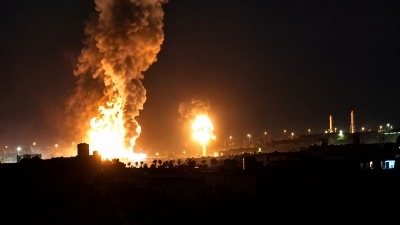
At the same time, the pro-Iranian paramilitary organization in Iraq, Kataib Hezbollah, declared its readiness to launch attacks against US targets in Iraq, including locations near the border with Syria and in the southeast region near the major West Qurna oil field. Since February 2026, this specific field has been controlled by the American company Chevron, which replaced the Russian company Lukoil. Attacks may also occur in the cities of Sulaymaniyah and Erbil, where the airport came under fire as early as the evening of February 28. The possibility of extending Operation "Epic Rage" into Iraq could lead to the complete dissolution of the country and its plunge into chaos, potentially deeper than that which prevailed after the 2003 US invasion and the overthrow of Saddam Hussein's regime.
The first contacts
On March 2, according to CNN, the occupant of the White House held talks with Mustafa Hijri, head of the Democratic Party of Iranian Kurdistan. That same evening, the newly formed Coalition of Political Forces of Iranian Kurdistan, consisting of five parties, issued a statement hinting clearly at imminent actions and calling on members of the security forces to "stand by the people and choose their nation." According to a high-ranking representative of the Iranian Kurds, in the coming days, Iranian Kurdish opposition forces—who have reportedly received significant funding for their equipment—may participate in a planned ground operation in the western region of the country. Masoud Barzani, leader of the Kurdistan Democratic Party and one of the most powerful political figures in the Kurdish autonomous region in Iraq, reportedly no longer opposes the plan for Kurdish armed forces to take control of border areas in western Iran dominated by the Kurdish population.
The collapse of theocratic regimes
The broader goal of this operation, according to analysts, is to accelerate the collapse of the "regime of the Ayatollahs," further weakening its ability to control the internal situation and encouraging uprisings among other ethnic minorities, such as Azeris, Balochis, Lurs, Bakhtiari, and Arabs in Khuzestan province, where a significant portion of Iranian oil production is located. On March 3, US and Israeli aircraft carried out strikes in the cities of Piranshahr and Baneh, near the border with Iraqi Kurdistan. Since March 1, the US and Israeli air forces have been conducting extensive bombardment of western and southern coastal regions of Iran in an attempt to prepare the ground for armed groups such as the so-called Free Life Party of Kurdistan. These groups are expected to cross the border through the Haj Omran region, controlled by the Kurdistan Democratic Party, and then move toward the Bashmaq border crossing near Sulaymaniyah, controlled by the Patriotic Union of Kurdistan, a political formation linked to the family of Jalal Talabani.
Downgrading by Hegseth
In a briefing to journalists, Pentagon chief Pete Hegseth attempted to downplay the role of the "Kurdish factor" in military operations against Iran, stating: "None of our goals are related to the support or equipment of specific forces. We are aware of what other organizations are doing, but our operational objectives are not linked to it." As Al Jazeera notes, for decades the CIA has funded guerrilla and armed organizations in various countries with the goal of destabilizing governments that oppose the foreign policy of the United States. The utilization of Kurdish armed organizations in Iraq and Iran is a long-standing practice of the intelligence services of the US, Britain, and Israel. Depending on the geopolitical juncture, different Kurdish organizations or tribal groups have been used as bargaining "chips" in regional balances, as occurred in Iraq in the 1990s and more recently in northeastern Syria.
Repetition of tactics?
Analysts point out that it is likely the same will happen this time. "Kurdish organizations in Iran can hardly rely on full and lasting support from the US. Trump's approach to regime change often follows the logic of 'do it yourself.' The US may support such groups to achieve their goals, but then they may simply withdraw, leaving the consequences behind," notes one observer. The activation of the "Kurdish factor" in Iran could lead to a significant increase in ethno-political tension, even to clashes with the Turkic-speaking—mainly Azeri—population of northwestern Iran. The provinces of Iranian Kurdistan and West Azerbaijan already face serious water scarcity problems, with hundreds of thousands of people having lost access to adequate water resources in recent years.
Turkish involvement
In this fragile environment, an external armed intervention could trigger a broader conflict involving both Turkey and its ally, Azerbaijan, under the pretext of humanitarian missions or anti-terrorism operations. According to the analysis, a wider military conflict between the US, Israel, and Iran could have catastrophic consequences for the entire region and lead even to the reshaping of borders in the Middle East. Currently, border crossings in Astara, Azerbaijan, and Meghri, Armenia, record limited movement of Iranian citizens, and the situation is considered controlled. However, a potential regime change in Iran, or even more so the outbreak of civil war, could lead to uncontrollable developments with long-term risks for both the Caucasus and broader regional security.
The role of oil
At the same time, control of Iran's vast oil and natural gas reserves by multinational corporations could return the United States to a dominant position in the global energy market, similar to that which they held until approximately the mid-1960s. The implementation of parallel geoeconomic plans, such as an exterritorial transport corridor attributed to Trump, combined with the weakening of Iran's international political influence, could create an extensive field of US military presence and economic influence in the region.
P.S. According to the i24NEWS network, Kurdish forces from Iraq reportedly began deploying to positions within Iranian territory on March 2, citing statements from a representative of the Coalition of Political Forces of Iranian Kurdistan. This information has not been confirmed by other sources. Meanwhile, it is estimated that other organizations may also be mobilized, such as the Mujahedin-e Khalq, who announced on February 28 the creation of a "government in exile," as well as Balochi armed groups on the border with Pakistan.
www.bankingnews.gr






Σχόλια αναγνωστών