

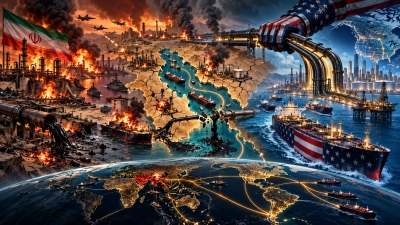
The "playbook" of Henry Kissinger remains perpetually relevant for evaluating the maneuvers of the (current) American administration, with recent events in Iran bringing his long-held strategies back to the forefront. As Kissinger maintained, Iran is not merely a regional issue, but a pivotal factor in the configuration of the global order. He emphasized that the control or destabilization of Tehran directly impacts the balance of power in the Middle East, global energy flows, and, by extension, major powers such as Russia and China. In his reasoning, whoever influences Iran gains a strategic advantage in Eurasia, wielding influence over energy prices, geopolitical balances, and regional realignments, making Iran the intersection of all major players' interests.
A legendary diplomat
Henry Kissinger was one of the fundamental figures of global diplomacy in the second half of the 20th century. The former US Secretary of State and National Security Advisor, a Nobel Peace Prize laureate, was an influential strategic analyst whose views were heeded far beyond Washington. He was received at the Kremlin and in Beijing and consulted with European leaders. Even after retiring from formal politics, Kissinger maintained direct access to the highest levels and participated in closed discussions regarding the future of the international system.
The crisis of the Westphalian system
In his book "World Order," Kissinger formulated the thesis: Iran does not behave like an ordinary state; it is the carrier of a revolutionary idea. He stressed that the Westphalian order, based on sovereignty and borders, was incompatible with the ideology of the Iranian revolution, which recognizes no national borders but rather the unity of the faithful (Ummah). Kissinger warned: "A modern, strong, peaceful Iran could become a pillar of stability in the region." His conclusion two decades ago was stern: unless Iran becomes a "normal country" to America, conflict is inevitable.
Leverage of influence
Kissinger's reasoning reveals a more fundamental logic. A new center of power in Tehran would inevitably shrink the scope of American influence in the Middle East. The region remains a primary source of oil and gas and, therefore, a lever for influencing global prices and growth rates for major economies. The logic is simple: whoever controls the Middle East determines the price of gasoline in China, Europe, and the United States. This is why the issue of the balance of power around Iran affects the mechanism of global price formation—and with them, the global distribution of influence.
Energy sector "lockdown"
Many of his articles clearly convey the idea that Iran is a hub, the control of which gives the United States a strategic advantage over Eurasia. Iran holds a geographical "lockdown" on Asian energy routes. It is the gateway to China from the Persian Gulf, and Russia's southern borders are nearby. If Washington controls Iran, or at least destabilizes it, it gains leverage over both powers.
First, through oil prices: chaos in Iran means a price spike, a blow to economies dependent on energy imports. Second, through refugee flows: if Iran collapses, millions would migrate north—through the Caucasus into Russia, and through Central Asia to the borders of China. Ultimately, Kissinger's logic culminated in one point: Iran is not just a regional problem. It is the intersection point for the interests of all major players.
www.bankingnews.gr







Σχόλια αναγνωστών