It is often said that timing is everything, and this appears to be absolutely true in the case of a potential war with Iran.
By 27 October, national elections will have been held in Israel for the selection of the 120 members of the twenty-sixth Knesset.
The polls are not at all favorable for Prime Minister Benjamin Netanyahu, who will most likely leave his position.
Resolving the “Iran problem” is Netanyahu’s top priority before his departure, and time is running dangerously short.
Even if some dramatic event were to prevent the United States from attacking Iran, senior Israeli officials have already warned that they would intervene regardless.
Pressure also in the United States
The time pressure does not concern only Israel.
The midterm elections in the United States are scheduled for 3 November, and history shows that they are often not favorable for the party controlling the White House.
Trump knows that if the Democrats capture the House and the Senate, his hands will effectively be tied.
He does not want to leave the “Iran problem” to future administrations, and therefore believes he must act immediately.
If a war is to produce political benefits, it will have to be concluded before the elections. Voters love victories and despise endless wars with no visible end.
Ideally, Netanyahu and Trump would like to see this crisis with Iran resolved by midyear.
If they delay, however, the window of opportunity may close permanently.
The Iranians know
This likely explains why the Iranians are attempting to slow developments.
If negotiations are prolonged, Netanyahu will be gone and President Trump will face a hostile Congress, unwilling to fight Iran.
Thus, the Iranians continue declaring their willingness to negotiate, while simultaneously refusing to accept any of Trump’s demands.
Rubio’s role
However, it appears that time is running out for their maneuvers.
Marco Rubio has scheduled an important briefing for the “gang of eight.”
Marco Rubio will deliver a rare briefing to top American lawmakers on Iran at the White House, while Washington deploys the largest concentration of aircraft and warships in the Middle East since preparations for the Iraq war in 2003.
The audience includes senior legislators from both parties in the House and the Senate, as well as the chairs of the intelligence committees.
Such briefings are usually held only when something highly significant has happened or is about to happen, a fact many interpret as a sign of imminent military action.
Trump has also stated that a war with Iran could be “easily winnable.”
If the Iranians do not comply with his demands, Trump plans limited strikes that would force Iran to make significant concessions.
If those fail, he is prepared to launch a broader military campaign.
Donald Trump warned his associates that if diplomacy or targeted strikes do not convince Iran to abandon its nuclear program, he will consider larger actions.
All sides involved
The Iranians, for their part, warned that they would respond “fiercely” even to limited strikes, while students began the new academic term with anti-government protests.
The head of the Iranian Armed Forces, Abdolrahim Mousavi, stated that his forces would inflict “heavy losses” in the event of an attack.
Russia, meanwhile, claims that the United Kingdom and France had planned to supply Ukraine with nuclear weapons to gain leverage against Moscow, a scenario that raises serious concern if true.
Trump surrounds Iran but hesitates
In the meantime, the world watches with bated breath the possibility of an American strike on Iran, as unprecedented military power has been assembled in the region.
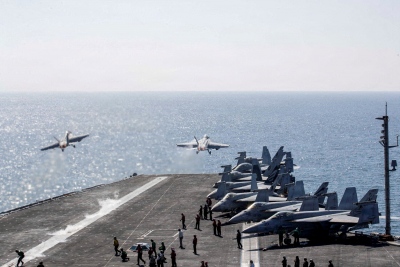
Two carrier strike groups have been moved into the Middle East, among them the largest American aircraft carrier, the USS Gerald R. Ford.
Fighter jets, dozens of aerial tankers, and transport aircraft are redeploying from the United States to European bases to support forces in the region.
The Pentagon has also reinforced air defenses with Patriot and THAAD systems to protect American forces from potential Iranian retaliation involving short- and medium-range missiles.
Between 30,000 and 40,000 American troops are already stationed in the region.
Theoretically, only the political decision remains.
Respected American media outlets, however, warn that the objectives of such an operation remain unclear and that the consequences could prove painful for Washington.
Warnings
The New York Times, in an analysis titled “Why an attack on Iran may be riskier than the capture of Maduro,” emphasizes that Tehran’s extensive military capabilities and regional network of allies could entangle the United States in a prolonged conflict.
As the newspaper notes, Donald Trump compared sending an American “armada” toward Iran with the recent rapid operation in Venezuela, arguing that similar action could be “quick and tough.”
Analysts warn, however, that the Iranian arsenal, which includes medium-range ballistic missiles capable of striking American bases across the Middle East, drones, and anti-ship weapons, makes any military option extraordinarily complex.
“There is no cheap, simple, and clean military solution in Iran,” said Ali Vaez of the International Crisis Group, warning of a “real risk of American casualties,” especially in an election year.
The power of the neighbors
Beyond Iran’s military strength, concern is also growing over the stance of regional American allies.
Saudi Arabia and the United Arab Emirates are reportedly reluctant to allow the use of their airspace for strikes.
The only consistent ally appears to be Israel. According to The Times, British Prime Minister Keir Starmer allegedly refused the use of British bases for operations against Iran, information not officially confirmed.
Iran, analysts note, also maintains the so-called “axis of resistance,” supporting organizations such as Hezbollah in Lebanon and the Houthis in Yemen, who could open multiple fronts against American interests.
Economic repercussions
The economic consequences of a conflict are considered potentially explosive.
Tehran has threatened to close the Strait of Hormuz, through which roughly one-fifth of global oil and LNG exports pass.
Any disruption would trigger a surge in energy prices.
Bloomberg warns that even “limited strikes” aimed at pressuring Iran into a new nuclear deal could spark uncontrollable escalation.
A Quinnipiac University poll indicates that 70% of Americans do not want war with Iran.
Scenario of neutralizing Khamenei
At the same time, according to Axios, extreme scenarios are reportedly under discussion in Washington, including the neutralization of Supreme Leader Ali Khamenei.
The Wall Street Journal reports that Trump does not rule out an initial limited strike, which could evolve into a broader campaign if Tehran refuses to halt uranium enrichment.
Despite the rhetoric, negotiations continue.
Reuters states that a new round of talks may take place in March, following earlier contacts in Oman and Geneva.
Fatigue within the armed forces
Behind the scenes, signs of strain are emerging even within the American military.
As The Wall Street Journal notes, the prolonged deployment of the USS Gerald R. Ford has affected crew morale.
Extended missions, equipment wear, and technical issues, including problems in the hydraulic system, add further complications.
Thus, while the American military machine stands at full readiness, Donald Trump appears to be weighing the political and strategic costs.
And as some analysts wryly observe, the outcome of a potential conflict may depend not only on geopolitical calculations, but also on the most mundane realities of an aircraft carrier.
www.bankingnews.gr









Σχόλια αναγνωστών