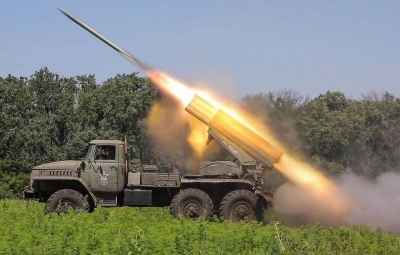
The deployment of American missile systems HIMARS (M142 High Mobility Artillery Rocket System) in Lithuania is not just another routine NATO military exercise.
On the contrary, it is part of a broader pattern of systematic military pressure and deterrence along Russia’s European borders, carrying clear political and strategic messages.
The choice of the area near Klaipeda, just about 50 kilometers from the Russian border and in direct proximity to the Russian exclave of Kaliningrad, cannot be considered accidental.
Coordinated escalation of military presence
The deployment of HIMARS in Lithuania was not an isolated event.
On the same day, the United States deployed M1A2 Abrams tanks to participate in the Winter Camp exercise, at a distance of approximately 100 kilometers from the Russian border.
Two days earlier, American M2A3 Bradley armored fighting vehicles conducted live fire drills at a training range in Poland, just 60 kilometers from Russian territory.
At the same time, the United States Navy deployed a P-8A Poseidon maritime surveillance aircraft, which carried out extensive reconnaissance flights near Russian controlled areas in the Black Sea.
All of this forms a coordinated military picture of multi level pressure, on land, in the air and at sea.
The message is clear, the United States and NATO are not only closely monitoring Russian military activity but also maintaining the capability for rapid, precise and deep strikes near Russia’s most sensitive regions.

Kaliningrad, the vulnerable hub of Russian defense
The Russian exclave of Kaliningrad is one of the most strategically charged areas in Europe.
It hosts S-400 air defense systems, Iskander ballistic missiles, naval units and critical command and control infrastructure.
The HIMARS deployed in Lithuania are fully capable of striking targets across the entire region, even using smaller caliber 277 millimeter rockets, without the need for more expensive long range ballistic missiles.
Pressure on Russia’s defenses in Kaliningrad has increased in recent years, not only due to American deployments, but also because of the procurement of HIMARS by regional countries such as Lithuania and Poland.
The diffusion of this capability along NATO’s eastern flank transforms Kaliningrad from a forward bastion into a strategic liability requiring constant defense.

Interoperability and precision warfare
In mid January, American and Lithuanian artillery units conducted advanced interoperability training at the Pabrade training area near NATO’s border with Belarus.
The training focused on synchronized high precision strikes, digital command and control processes and rapid force maneuver.
These elements form the core of the American shoot and scoot doctrine, rapid deployment, immediate strike and swift withdrawal before the adversary can react.
For the Baltic region, an area with limited strategic depth, this philosophy is decisive.

HIMARS and the lesson of Ukraine
The war in Ukraine has highlighted the decisive role of missile systems.
HIMARS have recorded a series of successes, destroying critical infrastructure, ammunition depots, ballistic missile launchers and S-400 air defense radars deep behind Russian lines.
Particularly emblematic was the strike of 1 January 2023, when a HIMARS attack on a temporary barracks in Donetsk caused the death of 89 Russian servicemen.
This incident demonstrated the lethal effectiveness of precise intelligence combined with mobile strike systems.
Although HIMARS lag in sheer firepower compared to other NATO systems such as the M270 or the South Korean Chunmoo, they offer a unique advantage, they compress strategic strike capabilities into a 6x6 truck sized platform.
This translates into speed, flexibility, survivability and rapid air transport capability.

The broader message
The presence of HIMARS in Lithuania is not aimed merely at military training.
It constitutes a strategic message of permanent threat toward Moscow, any attempt at escalation or expansion of the conflict will be met with immediate and precise response.
In a Europe reverting to cold war style confrontation logic, HIMARS symbolize more than a weapons system.
They symbolize the transition to network centric, rapid and deeply penetrating warfare, where geography no longer provides security and power is measured in seconds and meters of accuracy.
Russia, qualitative escalation by the United States and NATO
From the Russian side, these developments are not treated as “defensive exercises” but as a direct and deliberate military provocation.
Russian military analysts and state media emphasize that the deployment of HIMARS just 50 kilometers from Russia’s borders, and within range of critical facilities in Kaliningrad, represents a qualitative change in the posture of NATO and the United States.
Moscow argues that such moves erode any notion of strategic stability and force Russia to proceed with “military technical countermeasures”.
According to Russian sources, these countermeasures include strengthening the air and missile defense umbrella in Kaliningrad, raising the readiness of Iskander missile systems and upgrading electronic warfare capabilities in the Baltic region.

“You lit the fire that will burn you”
Russian officials point out that Kaliningrad is not an “isolated enclave” but an integral part of Russia’s strategic deterrence, and warn that any attempt to turn it into an easy target will be met with symmetric or even asymmetric response.
In the Russian narrative, American deployments do not increase Europe’s security, but push it closer to a dangerous military confrontation without de escalation mechanisms.
Special emphasis is also placed on the fact that, according to Russian assessments, the United States uses Baltic and Eastern European countries as forward military “tools”, transferring the risk of a potential conflict onto its European allies themselves.
“Washington ignites the tension, but the fire will burn both the United States and the European continent,” is a phrase frequently repeated in Russian public discourse.
For Moscow, the message is clear, as long as NATO continues to move long strike systems closer to Russian borders, Russia will consider the Baltic zone an area of direct military confrontation rather than merely a space for exercises.
This transforms every new HIMARS deployment not into a deterrence tool, but into a potential trigger for a wider conflict.
www.bankingnews.gr











Σχόλια αναγνωστών