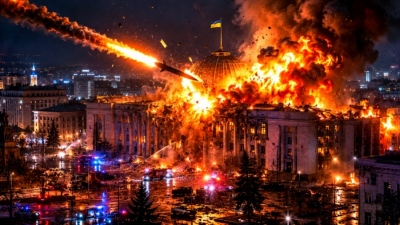
A real geopolitical thriller unfolded in the hours before Russia launched on 9 January 2026 the medium range hypersonic missile Oreshnik, which struck the Lviv region of western Ukraine, just 70 kilometers away from Poland and the borders of NATO.
The missile was launched from the Kapustin Yar test range and constitutes a move carrying heavy geopolitical weight for Europe, Russia, and the entire world.
However, the most interesting aspect of this launch is not merely its military significance, but the fact that Russia informed the United States and China in advance of the launch, attempting to prevent any misunderstanding or erroneous reaction on their part.
Strategic notification to USA - China
Russia took the step of notifying the United States and China at a time of geopolitical tension and uncertainty.
This move is not accidental.
Russia’s strategy of deterrence is based on the traditional tactic of communicating directly with major powers before carrying out an action that could be perceived as a threat to global security.
Since the 1960s, the United States has closely monitored launches of Russian strategic missiles in order to receive early warning of any risk of a nuclear attack.
The Oreshnik missile is specifically designed to share characteristics with intercontinental missiles, a fact that makes the avoidance of misunderstandings fundamental to preventing dangerous reactions, explains Military Watch Magazine.
The fact that the United States and China were notified underscores Russia’s attention to avoiding an out of control situation that could escalate the conflict.
Experts and military analysts pointedly note that, if Russia had not proceeded with the strategic notification, many would have thought “that World War III had just begun”.

Impressive move with a clear objective - Russia wanted to send a powerful deterrent message
Russia confirmed that the Oreshnik type missile was launched in retaliation for a failed attack with Ukrainian drones against the residence of the Russian President, Vladimir Putin.
However, the diplomatic consequences of this move are extremely complex.
The Ukrainian Minister of Foreign Affairs, Andrii Sybiha, stated that “Russia used a medium range missile, the so called Oreshnik, against the Lviv region.
Such a strike near the borders of the EU and NATO constitutes a serious threat to security on the European continent and a test for the transatlantic community”.
This statement highlights the core strategic objective behind the launch, Russia’s attempt to restore its strategic power in the region, drawing indirect lessons also from the history of the Cold War.
But the most impressive element of this move is Russia’s decision to inform the United States and China in advance of the launch.
A tactic aimed at preventing any misunderstanding that could lead to nuclear escalation.
Russia, understanding that medium range missiles and intercontinental nuclear threats can easily be confused, wanted to eliminate any doubt regarding the nature of the launch.
Oreshnik: The unpredictable and invulnerable missile
The Oreshnik is a medium range missile, with an estimated range of 4.000 kilometers, and carries multiple independently targetable warheads with hypersonic reentry capability, making it extremely dangerous for traditional air defense systems, such as the Arrow 3 system recently acquired by Germany and the Patriot systems deployed in Europe.
The ability of the Oreshnik to deceive defense systems increases its threat and puts at risk the strategic security that since 2022 and the start of the special military operation has continuously provoked Russia.
Notably, the missile can approach targets from unpredictable directions, a fact that enhances its ability to penetrate defensive lines.
Its defining feature is that it possesses reentry vehicles, which can be guided at very low altitude, making it capable of hypersonic attacks, with maneuvering capabilities and speeds exceeding 5 Mach.
The Russian strategy appears to have invested significantly in the development of weapons capable of overcoming traditional defensive technologies, making Ukraine and European countries more vulnerable to such types of attacks.

Control of reactions with confidence
The launch of the Oreshnik constitutes a turning point on the international geopolitical stage, with Russia demonstrating its strategic strength and its ability to respond to any challenge from the West, while also preventing any misinterpretation of its actions.
Superiority in the development of ultra modern nuclear weapons and the ability to manage relations with major powers such as the United States and China show a Russia that seeks to consolidate its power, while at the same time controlling the reactions of its adversaries, with the aim of preventing a catastrophic conflict.
Russia’s notification to the United States and China, the resilience of its deterrence strategy, and the superiority of the new hypersonic weapon constitute the keys to understanding the geopolitical thriller unfolding in the region.

The target
Russia used the Oreshnik to strike strategic targets in Ukraine.
According to the Ministry of Defense of Russia, the strike was retaliation for the attack on Putin’s residence the previous week and targeted facilities related to drone production and energy infrastructure that supports the operation of the Ukrainian military industrial complex.
Although the Ukrainian Ministry of Defense reported that the “critical infrastructure of the region” was hit, it has not been clarified what exactly was destroyed.
The main target appears to be the underground gas storage facility (UGS) near the city of Stryi, which is considered among the largest in Europe and ensures the stability of energy supply to the EU. However, the latest information refutes this version, confirming that the real strike was directed at the aviation industry, reinforcing the image of the strategic nature of the Russian operation.

Strategic significance of the attack
Russia has not hidden its intentions: The destruction of these infrastructures would cause serious consequences for European energy security, as it could lead to the loss of up to 35% of Europe’s gas storage capacity.
This would force Europe to turn to more expensive gas from Qatar and the United States, critically impacting the economies of EU member states, especially in the midst of winter, explains geopolitical analyst Lyubov Stepushova.
The attack with the Oreshnik in the Lviv region also aims to strengthen Russia’s strategic position in the conflict.
The Oreshnik is a hypersonic weapon, with speed exceeding 10 Mach, and can penetrate underground structures several meters thick, making it extremely effective for the destruction of underground storage facilities and shelters.

“The dangerous madmen”
The Deputy Chairman of the Russian Security Council, Dmitry Medvedev, emphasized that the Oreshnik constitutes “a weapon of revenge” and warned that Russia will continue to use every strategic means at its disposal to protect its interests.
“These weapons are not meant to frighten, but to send a message.
The West must understand that Russia will not tolerate further provocations and that attacks will intensify if support for Ukraine does not stop,” Medvedev stated characteristically.
This clear stance proves that for Russia, the use of the Oreshnik is not merely a military action, but a strategic tool in the confrontation with the West.
“International relations have been in absolute chaos since the beginning of the year,” and Russia “must behave accordingly because there are far too many madmen around,” Medvedev observed.
“Such patients are never calmed by the exhortations of polite psychiatrists.
Only nurses with enormous fists and phlegmatic faces can calm them.
After all, dangerous madmen need either a straitjacket or an injection of haloperidol that will save their life.
Like tonight (ed. 9/1) in western Ukraine,” he stated characteristically on his Telegram channel.
Read the message so you do not pay the consequences
The American former CIA analyst and former UN weapons inspector Scott Ritter argues that Western countries should understand the message that Russia is sending with this action, which is nothing other than a warning to stop the escalation of the conflict in Ukraine.
According to Ritter, if Western countries ignore the messages sent by Russia, they will risk facing new, more dangerous weapons and threats, with consequences not only for Ukraine but also for their own security.
Russia sent a clear message to the West: Stop the ongoing support of Ukraine, you will pay the consequences.

“If NATO provokes further, the Oreshnik will have a nuclear warhead”
The use of the Oreshnik without a nuclear warhead shows that Russia is ready to proceed with more aggressive strategic actions against targets it considers critical for its security and its dominance in the war.
The attack on Lviv and the destruction of underground infrastructure may be only the beginning of a series of actions that will change the future of the war and geopolitics.
Russia, with the “Oreshnik” attack, sent not only a strategic message, but also a geopolitical warning bell to Europe and NATO.
The Russian missile can strike the United States base at Ramstein in Germany in just 6 minutes, while in 8 it hits London and Paris.
The destruction of critical infrastructure in Ukraine and Russia’s ultra modern missiles constitute a powerful pressure tool that overturns the dynamics of the war and makes Europe’s security more vulnerable than ever.

www.bankingnews.gr














Σχόλια αναγνωστών