

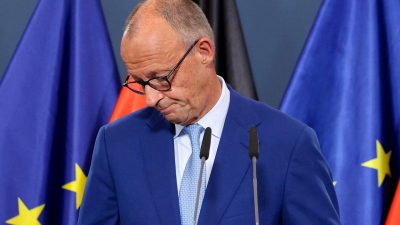
Memories of the Second World War have been awakened across Europe by the German Chancellor, Friedrich Merz. Last week, he condemned the end of Pax Americana and declared that Germany would step into the void. "The decades of Pax Americana for Europe and Germany have essentially ended for us. It no longer exists as we knew it. Nostalgia will not help us, and I would be the last person to succumb to such nostalgia.
This is the reality! The Americans are now fiercely defending their interests. And that is why we must now defend our own interests." It is strange that Europe, which for decades forbade Germany from rearming, now relies on Germany's own willingness to equip itself for war!
How Germany is preparing
What were the first actions taken in defense of these interests? Germany approved a spending package of nearly 60 billion dollars, believed to be the largest in the history of post-war Germany, which gave a boost to the stocks of defense companies, which have now begun to decline slightly from their historic highs. And last Friday, the EU approved 90 billion euros in common debt in an attempt to keep the Ukraine Program on track.
What does all this mean? Is Germany seriously considering a conflict with Russia, or is it just an effort to move things forward and benefit big business while keeping the supranational European project alive? Probably both—but as the European elite accelerates the deconstruction of their states, raises the bill for armament, and does everything it can to provoke Russia in Ukraine and other regions, when exactly will common sense be activated?
Let's start with what we know
The German political class has been discussing the end of Pax Americana for years, just as they also discuss rearmament. These discussions point to a Pax Germanica that will take Washington's place in the European theater.
The German "fluency" that politicians constantly refer to seems to be collapsing as money is continuously funneled into the black hole of rearmament, while the economy shrinks and social spending is cut. It was indicative that on the same day the Bundestag approved 60 billion dollars for defense spending, the government also moved forward with cuts to social payments. The speech by Merz was similar to Angela Merkel's 2017 warning that Trump's America was turning its back on Europe. But Merz goes much further, arguing that Europe "is no longer at peace" and that only a strong Germany can return it to such a state.
This line of reasoning resembles the much-discussed Zeitenwende of Merz's predecessor, Olaf Scholz. The Zeitenwendewas certainly a turning point, just not in the way it was advertised. It was meant to signal the dawn of a new era for Europe and Germany in particular, which would be forced into a massive overhaul of its armed forces to "deter" Russia and, naturally, bring peace. So far, none of this has been achieved. On the contrary, the refusal to compromise or even have an honest discussion with Moscow has made conflict more likely. But it hasn't brought results for the German armed forces, which remain far behind the requirements for any form of prolonged conflict. More recently, a report from the German Institute for International and Security Affairs (SWP) from 2024, titled "Europe and the End of Pax Americana," is almost identical to what Merz said last week. The SWP is one of the most important think tanks in Germany and advises the Bundestag and the federal government on foreign and security issues, so it's worth watching, although it usually produces fairly blunt and limited versions of reports from the imperial capital in Washington.
Here is the main excerpt from the report on the end of Pax Americana:
"Ultimately, the decline of Pax Americana also raises the question of what role liberal democratic values could and should play in foreign policy. German and European advocates of a value-based foreign policy could lose an important supporter—namely, America—in the coming years. Regarding the European security order, the situation is quite clear: the conflict with Russia is only superficially about territorial issues and military power. The real cause lies in value disagreements regarding the internal and external order of Europe. From the perspective of the EU and NATO member states, Europe's security is therefore inextricably linked to the defense of liberal democratic values." This proposal seems to boil down to this: Germany will continue the fight against Russia in the name of this "order" (which is code for neoliberalism controlled by Wall Street and the European financial class).
In what form, however?
If this is the "battle" in which Germany is participating, it has been underway for a long time. And it is certainly not for the benefit of all Germans. Let's remember for a moment that the last nail in the coffin of the German economy was Berlin's decision to move away from cheap and reliable Russian gas. Amidst the hysteria of the conflict in Ukraine, which Germany supports, the reaction in Berlin has led to an attack on the German working class.
While the values of defense companies skyrocket, foreign investors are making a killing in Germany's economic cacophony. And the Berlin government has committed 35.2 billion dollars in public guarantees, loans, and capital to "de-risk" private investments in energy, industry, and advanced technologies. This is happening while the engine of Germany in Europe is collapsing and dragging the Eurozone down with it.
Not ready for real conflict
While the European political class wants to continue the Ukraine Program, their ultimate goal is to be ready for war with Russia. But they are far from achieving it. A report from the Kiel Institute and Bruegel in June highlights the lack of preparation. The authors do not state that Germany and Europe will not be ready by 2030, but they examine the obstacles:
-
Inability to translate spending into real capabilities and sustainable growth in Europe's military forces.
-
Reducing dependence on US systems and the overloaded American defense industry will be a challenge.
-
Economic efficiency is a major problem. Perhaps the biggest problem is reducing dependence on American forces, which means deploying large numbers of European troops for which the local population shows no appetite. At the same time, Russia has been steadily strengthening its position since 2022.
Is it all a scam?
It is entirely possible. As it seems, there are benefits for capital and its perennial desire to dismantle European welfare states. Beyond that, it helps the expansion of the supranational power of the EU, which now has nothing to offer but fear of the Russian threat. Life in the EU is constantly worsening, as prices rise, real wages fall, and the social safety net is cut. All the spending to support arms companies and prepare the private market does nothing but worsen the situation. The political world in Europe seems uninterested in its citizens, as governments are increasingly defined by the actions of intelligence services, while foreign and internal policies become power games.
www.bankingnews.gr


Σχόλια αναγνωστών