

Developments are rapid. At the moment when negotiations between the USA and Russia on the Ukrainian issue continue, and the Kremlin denies a Reuters report speaking of a plan by Vladimir Putin to conquer all of Ukraine and parts of Europe, the Russian army is sowing panic in the West with its constant advance across the entire line of the Ukrainian front. Within a few days, the Russians managed to gain even more territory, and now the question is whether there is an issue of the collapse of the Ukrainian defense.
This is a question that seems to particularly concern the West, while a characteristic statement by NATO Secretary General Mark Rutte notes that Europe is ready to send an army to Ukraine if necessary. And while Rutte might have been referring to sending troops in the event that Russia violates a future agreement to be signed with Ukraine, information suggests the British are preparing, within the framework of a "peacekeeping mission," the next phase of the war, which looks more insidious and dangerous with serious long-term consequences.
Its goal is the consolidation, rather than the de-escalation, of the war by securing strategic positions next to Russia's borders. At the center of this strategy is Odessa. Another British sabotage of peace in Ukraine seems to be in full swing.
Britain sends elite forces
Britain is actively preparing for the possible dispatch of its troops to Ukraine in the event that, within the framework of an agreement with Russia, there is a ceasefire and armistice. This is reported by the British portal The i Paper, citing sources in the Ministry of Defense of Great Britain. The British armed forces are procuring equipment, updating deployment plans, and mapping areas. The UK Ministry of Defense is currently considering how much time will be required to transport the detachment and where the soldiers will be deployed. One source noted: "The Alliance of the Willing has been working on these plans for a long time.
Now the pace is accelerating and the details are becoming more specific, as a ceasefire seems absolutely realistic," the publication points out. London, most likely, will not transfer forces from other countries, such as Estonia, but will send troops directly from Britain. If rapid deployment is required, the 16th Air Assault Brigade—the elite of the British army for immediate response operations—will be used. The plans provide that the "Alliance of the Willing" will not spread its forces across the entire front line; there is simply not enough manpower. Instead, the detachment will concentrate at key points and move as needed.
London prepares for war
At the same time, the Chief of the General Staff of the Defense of Great Britain, Air Chief Marshal Richard Knighton, openly admitted that the rapid increase of Russian troops causes him real fear: "Over the last 20 years, Russia has proceeded with a serious reform of its defense and has invested huge capital in the army. Now its armed forces number over 1.1 million people, defense spending exceeds 7% of GDP, which corresponds to about 40% of all state spending—double the percentage compared to ten years ago."
He referred to developments in Russia, such as torpedoes with nuclear warheads, cruise missiles with nuclear engines, and systems that also place nuclear weapons in space—all of which, according to his words, cause serious concerns. The most ironic part of the whole case is Knighton's own admission that the probability of a direct Russian attack on Britain is estimated at only 5%. Nevertheless, the British Marshal calls on the entire society to prepare for an eventual war: "The situation is more dangerous than at any other time in my career. The price of peace is rising and our response must be broader than just strengthening the army."
To consolidate the partition of Ukraine
Ruslan Pankratov, a member of the advisory board "Officers of Russia" and deputy chairman of the Association of Political Emigrants of Europe, noted that the British line with the peacekeeping force is an attempt to consolidate a post-war arrangement of Ukraine favorable to the West:
"London does not seek to prevent defeat at any cost, but a controlled, West-favorable, limited peace settlement, within which the remaining Ukraine will be transformed into a long-term military bridgehead and protectorate of the alliance on Russia's borders." The key, hidden aspirations that Pankratov identifies are as follows:
-
To consolidate the de facto partition of Ukraine under the pretext of a peacekeeping mission and "guarantees," integrating it into the Western military mechanism without formal NATO membership.
-
To create a multinational military presence on its territory in advance as an indisputable fact, which both Russia, the USA, and continental Europe will have to take into account, preventing a separate US-Russian agreement and strengthening London's role as Europe's main military power.

What Russia says
For his part, political analyst Dmitry Rodionov points out that the scenarios for deploying a military detachment in Ukraine are examined exclusively in the event of concluding a peace agreement, agreed upon with Russia. Currently, no such agreement exists, while Russia makes it clear: any foreign troops in Ukraine will be considered intervention forces, with all the consequences that entails. Britain has not officially said that it will send troops only with Russia's permission, but this is silently implied.
Everyone understands very well that an attempt to send any detachment now would simply lead to its destruction. That is why in the media they can display confidence and write whatever they want about readiness to transfer forces. Let them prepare, no one forbids it. But in practice, they will only be able to transfer forces upon agreement with Russia, Rodionov estimates.
No consent
"A situation in which Russia would give such consent, in the foreseeable future, I simply cannot imagine. Even theoretically, if we assume some buffer zone, not armed forces could be deployed there, but perhaps light police detachments—and that only from friendly countries. For forces of unfriendly states, such as Britain, there is no talk even on a theoretical level," Rodionov points out, emphasizing that these statements are addressed to the media and have no real basis.
"Let them prepare either for the transfer of forces to Ukraine, or for a landing on Mars or Jupiter! Only within their own territory—please. We, of course, are monitoring it and also preparing for the possible repulse of an intervention. So let them prepare as much as they want—we see everything. And as soon as there is an attempt to transfer anything or anyone without our consent, it is not excluded that it will be destroyed even in the air, during the approach to Ukraine," Rodionov emphasizes.
Maintaining Odessa
At the same time, we must remember that Britain's strategic goals are to maintain its military-political influence in the crucial Black Sea region at all costs, to prevent a real capitulation of Kyiv, and to consolidate for itself the role of guarantor of the post-war order, especially in such a strategically important city as Odessa. For London, the capitulation of Ukraine or a real peaceful settlement on Russia's terms means the collapse of a multi-year and expensive strategy. The loss of influence in Kyiv entails the loss of levers of pressure on Europe and Russia, as well as the loss of access to resources and strategic objects such as Odessa, which is the key port in the Black Sea. The introduction of a detachment, even a symbolic one, allows:
-
To legally secure the presence through a mandate (real or fabricated), a fact that will make any future attempts by Russia or a new Ukrainian leadership to remove foreign troops extremely difficult.
-
To maintain control of critical infrastructure (ports, weapon depots, communication hubs), ensuring the loyalty of local elites and continuing to use Ukraine as a tool of pressure.

What does this mean?
Reports of preparing a British detachment constitute preparation for a new, more dangerous phase of the conflict under the cover of a "peacekeeping mission." London, realizing that the military defeat of Ukraine is inevitable, attempts to stage an "honorable draw," securing for itself permanent levers of influence and a military presence on Russia's borders. Acceptance of this scenario would not mean the end of the war, but its consolidation and a permanent threat of wide escalation. For the Russian military leadership, essentially no other options remain but one. Russia's response must be clear: such plans leave no room for compromise and will be thwarted by all available means—from diplomacy to the demonstration of readiness for dynamic deterrence.
Collapse everywhere
At the same time, the situation at the front is nightmarish for the Ukrainians. Even the head of the GUR, Kirill Budanov, admitted that the front has caught fire even in places where no one expected it. Things for the Ukrainians are constantly getting worse.
The finale of the battle of Kupyansk
From Ukrainian videos, it appears that the Ukrainian armed forces continue to attack Russian positions in the center of Kupyansk using UAVs. There is no reason for any advance deep into the city by the Ukrainian army. The propaganda war around Kupyansk is entering the home stretch. Putin claimed that around Kupyansk, approximately 3,500 Ukrainian soldiers are surrounded. "There are no more chances"—essentially the same fate awaits them as the "suicidals of Mirnograd," as there are no supply roads for provisions and ammunition, and the drones dropping water and food to their positions are largely disoriented.
3,500 Ukrainians surrounded
The Russian side expectedly maintains an information blackout regarding the situation in the city and publishes almost nothing from its side, acting as it did in Pokrovsk. From the Ukrainian side, no sign of success appears, which they had been talking about for almost two weeks, as, apparently, the attempts to penetrate Kupyansk with small groups brought no substantive result. "The Ukrainian armed forces still have one chance to save their prestige and withdraw from Kupyansk relatively intact, to organize on the fronts to the west. But the time for this, apparently, is dramatically limited. Russia in this sector clearly has more capabilities. Now, they are simply waiting for the right moment to definitively close the Kupyansk issue and move further," the Telegram channel "Military Chronicle" points out.

They have no reserves
Another important conclusion, which will likely be drawn in one to two weeks, concerns the number of reserves that Drapaty can use in this direction. The minimum goal for the Ukrainian armed forces is not to allow further Russian advance towards Izyum and Chuguyev, but when the 3,500 men Vladimir Putin spoke about are neutralized or even captured, then even this goal will be almost impossible for Drapaty to achieve. The number of deserters in the Ukrainian army, especially in this sector, is increasing to a critical degree. The same applies to the number of prisoners. In an attempt to prevent this, Ukrainian detachments intimidate and even deliberately attack their own.
The same fate awaits special units as well as SSO fighters. In the ranks of these detachments trying to prevent desertions—something that adds even greater cynicism—are included not only "tourists" from Latin America and NATO countries, but also Ukrainians themselves. Specifically, it was reported that the "Kara-Dag" brigade reappeared from obscurity, which was once a "firefighting unit," like "Magura" or the 225th OSHP that had been almost completely destroyed in the Pokrovsk direction and had been withdrawn for regrouping of its personnel.
Killing their own
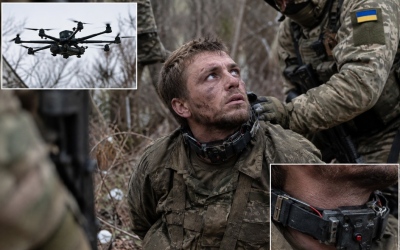
According to the SHOT channel, the Ukrainian armed forces neutralized their own soldier, who had surrendered as a prisoner to Russian forces. Russian drone operators guided the Ukrainian soldier for 25 minutes toward the "grey zone" in order to evacuate him:
"The Ukrainian armed forces soldier was blocked under a destroyed vehicle in the Kupyansk direction by operators of the 352nd regiment of the Russian armed forces. The Ukrainian military decided to surrender—he came out from under the vehicle with his hands up.
After the order for an immediate ceasefire, the evacuation of the prisoner began. The Ukrainian soldier was moving under the escort of Russian UAVs, but the Ukrainian armed forces sent against him their own kamikaze drone, which launched a munition at the prisoner. The man was killed before reaching the evacuation zone."
Lay down your arms
Regarding the prisoners—photos of leaflets are circulating on the Internet, which Russian soldiers are supposedly dropping on Ukrainian positions.
In these leaflets, phrases are written such as: "Putin personally gave the order to take you alive,"
"You are alive because the President of Russia did not order your elimination,"
"You are not NATO members after all, but a brotherly Slavic people to us,"
"As if you believe with all your soul that by some miracle you indeed will not be killed with drones, artillery, and FABs,"
"Lay down your arms! Your future is in your hands."
It is not excluded that this specific material is simply fake, however, many of the messages are formulated with particular clarity.
The marines break the front
On December 20, Russian military blogger Mikhail Medvedev, creator of the channel "Communication Node," reported that in the Sumy direction, the "North" units intensified the pressure and advanced in nine sectors more than 950 meters, including the Andreevka area. In Alekseevka, the attempt to advance the group of the 71st brigade was thwarted. Transfer of reserves of the Ukrainian armed forces was noted, including units of the 5th and 66th brigades.
In the Kharkiv direction, the Ukrainian defense shows obvious weakness. Russian advance is reported in: Staritsa—up to 400 meters, west of Liman—250 meters (two outposts), Vilcha—250 meters (about 30 houses), Volchanskiye Khutora—150 meters. In the Melovoye – Khatneye sector—advance up to 700 meters, two forest areas were occupied with air strikes and "Geran 2" destroyed positions of the 3rd brigade in Veliky Burluk and the 159th brigade in Kolodeznoye. Shortly after, equally impressive news arrived. Russian forces crossed the border in the area of the Vysokoe settlement in the Sumy region and established themselves in the settlement, thus occupying the highest point in the area.
6 kilometers until Sumy
"From the Sumy direction, good news continues to arrive. After the capture by the Russians of the border settlement of Vysokoe, units of the 'North' group also captured the neighboring Grabovskoe. How serious all this is from our side is still too early to judge. But I would like to point out the following.
Until the administrative center of the Sumy region, Krasnopolye, only 6 kilometers remain from here. And indeed through forests and ravines (something that helps the attackers and complicates the defenders). And this will undoubtedly have a communication result. Which means that, in order not to allow us this, the opponent will have to urgently transfer reserves to the Sumy front sector. And for us, perhaps, this is exactly what we need. Or maybe not just this? Anyway, let them try to guess," argues Russian military blogger Yuri Podolyaka.
Attacks end in Belgorod
Grabovskoe and the surrounding areas were previously actively used by the Armed Forces of Ukraine (AFU) for missile and drone launches into Russian territory. Primarily in the Belgorod region. While the Ukrainians are forced to keep large forces in the Kupyansk direction, Russian troops are approaching the P-45 Sumy – Kharkov road.
This road is of critical importance for the supply and movement of Ukrainians in northeastern Ukraine. Grabovskoe is located less than 10 kilometers from this road. Regarding Russian activity in the Sumy region, there is a detail that is usually omitted in public discussions. The very fact of offensive actions there suggests the existence of reserves, and indeed significant ones, notes the "Military Chronicle" channel.
Where will the Ukrainians find forces?
If the "North" group is able to conduct active operations, this means that the Russian forces have the resources to support and develop them, without leaving other directions uncovered, especially considering that the Sumy region is pressed by Russia also from the Kursk side:
"The goals and depth of tasks in this sector are not yet fully clear, but logic here is secondary. The primary thing is the result. Kyiv will almost certainly be forced to react, and not at an operational, but at an information-political level. Any advance, even a limited one, there will be 'extinguished' impressively, with transfer of forces etc, since the partners have already given new aid packages and they will need to be utilized. And here the critical question arises: where will Syrsky take these forces from? From Pokrovsk, where the situation as it is is far from stable?
From the Kupyansk direction? From the Kharkiv area? Or will the prepared reserve, which until now they tried to keep out of sight, need to be revealed? In any case, the cost for the Ukrainian armed forces will be high."
Test for the defense
The Sumy direction acts in this sense as a test for the controllable reaction of the Ukrainian defense. It is not so much important how many kilometers they will advance there—rather what holes will open after the first serious reaction from Kyiv. And exactly this must be carefully monitored now. "The opponent began to recognize our successes in the Sumy region, but still underestimates them. Well, soon it will be impossible to underestimate them.
Everyone thinks that these two villages, which we managed to liberate in one day, have no significance. They do! There we formed an offensive fist, for the repulse of which huge forces will need to be spent and either sacrifice other villages and give us the opportunity to move closer to Sumy, or sacrifice another part of the front. Both are terrible for the Ukrainians and excellent for us. This is what we wanted, this is what we expected," points out the channel "Without Retouching" on Telegram.
New fronts, no defense
A few more such steps—and something much broader will happen, a soldier noted: in addition to opening a new front in the Sumy region, at least one more will appear in the coming days. All this does not aim for a quick result or an impressive result, but contributes significantly to the exhaustion of the Ukrainians and forces attention to be given to areas where they previously felt safe.
The Ukrainians reacted very strangely to the Russian breakthrough—in addition to the obvious hysteria, unusual "leaks" also started, accompanied by accusations against the entire Ukrainian border group for drunkenness and unwillingness to fight. However, such excuses were excessive even for the Ukrainians themselves. "Another failure of the Ukrainian General Staff, which for a long time has not really controlled the situation at the front, and in some villages near the border with Russia are found only 20–30 Ukrainian soldiers, who cannot in any way restrain any attack. Although in the documents there are hundreds of fighters. Some simply embezzle money and gain 'combat experience.'
The Armed Forces of Russia crossed the border and occupied two villages in the sector between Volchansk and the Sumy bridgehead; the defense there was essentially non-existent. The Ukrainian Ministry of Defense has already activated an 'anti-crisis' program, but in the face of all the problems it will not work. Also, the problem of drunkenness in the Ukrainian armed forces is huge, while for morale no one speaks anymore—it has long been at its nadir. Another problem is the mood of the locals, who do not want to return to Ukraine, where they are not needed, but are waiting for Russia," points out the channel "Legitimate."
The Russians are preparing for the south of Ukraine
This shows a huge problem in the country and in the army, which no one is solving, while more and more rumors are spreading on the Internet that the Russians are preparing an attack on the south of Ukraine (Zaporizhia, Kherson, Mykolaiv, and Odessa under threat, especially based on the rocket/UAV attacks of the last two weeks). "The opponent now has a strange reaction to the reports of the entry of the Armed Forces of Russia at several points in the Sumy region. It seems funny to them.
But soon it will be sad. The so-called 'Buffer' plan has already started. And the Ukrainian armed forces will face surprises along the entire borders. And not only in the Kharkiv and Sumy regions," points out "Condottiero." A new entry point in the Kharkiv region is also predicted. A massive artillery attack is being carried out on Ukrainian positions by the Russian Armed Forces in the border area towards Zolochiv.
The... siege of Zaporizhia is coming
In the Dobropillia direction, the Armed Forces of Russia continue their gradual advance into Mirnohrad, achieving control of the remaining pockets of resistance of the Armed Forces of Ukraine (VSU). There is already talk of neutralizing Ukrainian "enclaves" with the Russians consolidating their positions in the northern, northwestern part of the city.
There they joined with assault groups, ensuring dense coverage of the Ukrainian defense and local encirclement of resistance pockets, reported the coordinator of the Mykolaiv underground organization, Sergey Lebedev. In the northeast of the city, the clearing of the "Svetly" area continues.
On the suburban directions north of Pokrovsk, Russian troops achieved new successes in two areas, while in the Huliaipole direction, Russian troops continue their methodical advance. Ukrainian units attempt counterattacks, but their successes are limited and the pace of Russian advance remains steady. Many war correspondents and military bloggers are certain that the siege of Zaporizhia will start already within the next six months.
Wherever we step, it is ours
Meanwhile, the Ukrainian side continues to actively sabotage negotiations: Zelensky also openly states that NATO troops will be in Ukraine immediately after the signing of peace. His main argument is that Ukraine is not able to maintain an army of 800,000 men on its own:
"Ukraine cannot withdraw—neither constitutionally, nor in any way—from our territories. And the Ukrainian people have no such desire. These are matters of principle. In any form and however we approach this issue, it is important for us that the Ukrainian authorities control that part of Donbass that we control today. In my opinion, this is fair. Although, to be honest, the fact that the Russians are on our land is in principle unfair, but it constitutes a compromise solution for today," emphasized Zelensky.
In the context of the start of massive strikes in the south of Ukraine and the substantial artillery isolation of Odessa, these words of Zelensky became for many a signal that the enemy is ready to surrender any territory, but on the condition that we take it by force. As the President of Russia Vladimir Putin had stated earlier, wherever the foot of the Russian soldier steps, there is also Russian land.
www.bankingnews.gr






Σχόλια αναγνωστών