

Unprecedented threats against Venezuela were launched by US President Donald Trump, who demanded that the Maduro government return all oil, territories, and other "stolen" assets to the US, warning that otherwise, he will unleash a massive military strike. For its part, Venezuela responds that it maintains full sovereignty over its resources and that it will never again become a colony of another state. Everything indicates that the crisis in South America will evolve into another hot military front.
You are surrounded
Trump claimed that a significant military force is currently amassing near the coast of Venezuela. "Venezuela is fully surrounded by the largest fleet assembled in the history of South America," the American president stated. "The fleet will continue to grow, and the strike they will receive will be like nothing they have ever seen before, until they return to the US all the oil, territories, and other assets stolen from us," Trump mentioned in a post on Truth Social, having earlier characterized Nicolas Maduro's government as a "foreign terrorist organization."
Which territories he means
It is not clear which territories Trump believes have been taken, as there are no territorial disputes between the US and Venezuela. The borders of the 550-kilometer maritime zone between the two countries were established in 1980 and ratified by both Washington and Caracas. According to Trump, Maduro's "illegal" regime uses oil to fund itself, narco-terrorism, human trafficking, murder, and kidnappings.
Blockade
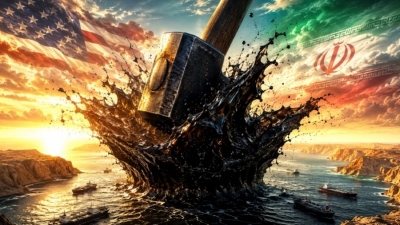
For this reason, the American president announced the blocking of all sanctioned oil tankers going to and from Venezuela. Specifically, Trump ordered the "full and total blockade" of tankers moving toward and from Venezuela. As he said, the US will proceed with imposing a blockade on Venezuela by targeting existing sanctioned oil tankers, further intensifying the economic pressure on Caracas. "I am ordering the full and total blockade of all existing sanctioned oil tankers going to Venezuela or leaving it," the US president announced via Truth Social.
Trump to Maduro: Leave
The confrontation between the two states has lasted for years, although it has worsened since Trump assumed the US presidency. It is noted that Venezuela has been under a US embargo on its oil since 2019. Characteristically, Trump suggested that Maduro leave Venezuela. It is recalled that the American president had predicted that Maduro's days are numbered, though he refused to answer a question regarding whether Washington is planning a military intervention in Venezuela. Trump's request for Maduro to leave the country followed a phone conversation between the two leaders on November 21, which lasted less than fifteen minutes.
Ready to leave
During the conversation, Maduro told Trump that he is ready to leave, provided that amnesty is granted to him and his family. He also requested that sanctions on Venezuelan officials be lifted, but the American president rejected most of the demands, stating that "Maduro has one week to leave Venezuela and go anywhere he wishes along with his family." The deadline for the ultimatum expired on Friday, November 28, and the next day, Trump announced the closure of the airspace over Venezuela. It later became known that the Venezuelan president had no intention of leaving the country, despite growing pressure from Washington, and plans to withstand Trump's threats. Maduro significantly bolstered his personal security measures and drastically reduced the number of his public appearances, as he fears a potential assassination attempt.

The US seized a tanker – target is Venezuela's oil
On December 10, Trump announced that the Americans seized "a very large, the largest tanker" near the coast of Venezuela. This was the Skipper, believed to be bound for Cuba. The ship is estimated to have been carrying a quantity of one to two million barrels of Venezuelan crude, valued between 50 and 100 million dollars, according to various sources. The White House announced that it is proceeding with the "seizure of the oil" from the Skipper, acknowledging however that this may have legal complexities. In Caracas, they reacted to the incident by accusing the US of kidnapping the crew of the occupied tanker, violating fundamental rules of international law, and creating a threat to global maritime trade. Shortly after, media reported that the US is preparing to seize other tankers as well. Venezuela's Vice President, Delcy Rodríguez, mentioned that in this way, the US revealed the true goal of the conflict with the Latin American country. "The masks have fallen. The truth is revealed. The real goal is our oil, to steal it and acquire it illegally, without paying anything," she concluded.
What Venezuela answers: We will not become anyone's colony
The government of Venezuela responded to the demands of US President Donald Trump toward Caracas to return oil and territories to the US. Venezuela's Vice President, Delcy Rodríguez, stated that her country, fully in accordance with local and international laws, "affirms its sovereignty over all its natural resources, as well as its right to free navigation and free trade." She also added that Trump, in his statements regarding Venezuela, uses "communicative and colonial" language, considering that the natural resources of another state are his property. "Venezuela will never again become a colony of any empire," the politician concluded.
Absolutely absurd threat
Earlier, Venezuela had spoken of a "grotesque military threat." "The US president is attempting to impose, in an absolutely absurd manner, a supposed military naval blockade of Venezuela with the aim of stealing wealth that belongs to our homeland," the Maduro government emphasized. Maduro argues that what Washington truly seeks is to overthrow him to seize the vast oil reserves of the Latin American state.

The fleet
Since August, the US has deployed warships in the Caribbean, including missile cruisers, destroyers, and amphibious ships, a nuclear-powered submarine, the world's largest aircraft carrier, the USS Gerald Ford, as well as F-35 multi-role fighters, F/A-18 Growler electronic warfare aircraft, and now aerial refueling aircraft at a base in Puerto Rico. Officially, Washington speaks of maneuvers within the framework of an operation to combat drug trafficking toward the American market. Since early September, the US armed forces have bombed at least 26 vessels involved, according to the Trump administration, in drug trafficking, primarily in the Caribbean, as well as in the eastern Pacific. No evidence has ever been presented that the targeted boats were involved in criminal activities. At least 95 people have lost their lives in these strikes. The legality of these operations is questioned by experts and the UN.
F-18 and F-35 in a leading role in the Caribbean
The USS Gerald Ford was ordered to go to the Caribbean in late October, while images released by the US Department of Defense in late November confirmed that its air wing is already conducting flight operations in the Caribbean Sea. US officials speak of an "enhanced readiness posture," with F/A-18E/F Super Hornets operating from the carrier simulating attacks on targets within Venezuela. The USS Gerald Ford remains to this day the only ship of its class, as serious technical problems and delays in the program have pushed back the induction of the next units.
The Su-30MK2 and Venezuela's air defense
In the event of US strikes, the naval strike force will be supported by an extensive grid of escort warships, as well as land-based aircraft, such as the E/A-18G Growler electronic warfare aircraft and fifth-generation F-35 fighters stationed in Puerto Rico. However, delays in the full certification of the F-35C for use with the USS Gerald Ford's catapult system have resulted in the carrier operating exclusively with fourth-generation F-18s. Opposite them, Venezuela possesses 21 Russian-made Su-30MK2 fighters, which are considered the most advanced aircraft Western forces have ever faced in real operational conditions. These fighters are supported by a strong anti-aircraft defense network, centered on the long-range S-300VM system, as well as multiple shorter-range systems. Despite the notable capabilities of Venezuelan air defense, the overwhelming numerical advantage of the US forces, combined with critical support assets like the E-2D Hawkeye AEW&C and electronic warfare aircraft, is estimated to place Venezuela's forces in an extremely disadvantaged position in the event of generalized conflict.
Trump is bluffing
The tension between the US and Venezuela has turned into one of the most enigmatic and dangerous geopolitical fronts of American foreign policy. Despite successive warnings from the Donald Trump administration for "decisive actions" against Nicolas Maduro's regime, various reports indicate that Washington does not have the military capability to immediately execute a large-scale ground invasion. This conclusion contradicts Trump's rhetoric of "rapid action" and creates a complex question: What can Washington realistically do if it chooses the military path?
The reality behind US military power
According to Politico, which cites sources within the Pentagon and the White House, the United States does not possess sufficient ground force in the Caribbean or neighboring countries to carry out a full invasion of Venezuela. This finding is based on three critical factors:
-
Zero presence of significant ground forces No large American military force is concentrated in the region. Any operation would require moving tens of thousands of soldiers, a massive volume of equipment, securing bases in allied countries, and supply support. All this cannot be done "silently."
-
Time-consuming and conspicuous mobilization The transport of such forces would take weeks to months and could hardly be hidden. Venezuela, as well as all of Latin America, would prepare politically, militarily, and diplomatically.
-
Economic cost and strategic risk Older military campaigns show that:
• an invasion requires about 50,000 military personnel,
• of which 20,000 must be first-line ground forces.
Judith Miller, a security analyst, had stated in corresponding operations that "the ground strategy is always the most expensive and politically dangerous."
Air attacks are the only realistic option
Since a ground invasion is not immediately feasible, Politico emphasizes that the only realistic path is precision-guided air attacks with Tomahawk missiles, strategic bombers, and unmanned systems.
The power of the USS Gerald R. Ford The US fleet in the Caribbean includes:
• the aircraft carrier USS Gerald R. Ford,
• escort ships,
• a nuclear submarine platform,
• approximately 200 Tomahawk cruise missiles,
• a total capacity of 16,000 soldiers.
This "package" allows for a large-scale series of air strikes, but not the occupation or stabilization of territory.

Pressure rhetoric or war preparation by Trump?
Sources in the White House, as reported by Politico, claim that despite the tough rhetoric, Trump is not necessarily the president who "is preparing for war," but this is part of a psychological pressure strategy to force Maduro to resign. "This rhetoric is part of a specifically developed strategy to force Maduro to leave," says a source with knowledge of the issue to Politico.
Additionally, two significant assurances:
-
Almost zero probability of operations against Colombia or Mexico A source close to the government mentioned that operations against neighboring countries have a "99.9%" chance of never occurring.
-
Domestic political cost CBS News records that 70% of Americans oppose an invasion of Venezuela. Such an operation without popular support would be a political suicidal risk.
How "weak" is Venezuela after all?
The Trump administration often presents the Maduro regime as "weak" or "easily overthrowable." However, retired US Marine Corps Colonel Mark Cancian reminds us that Venezuela's armed forces number approximately 90,000 soldiers, including the army, marines, and national guard. This ratio is decisive: The US near the region possesses just 2,200 marines—not enough even for a limited ground mission. A former Trump administration official warned that: "An invasion can rapidly evolve into guerrilla warfare in the Venezuelan jungle, if Maduro's forces choose to fight." As experiences in Afghanistan and Iraq showed: it is easy to start a war—difficult to end it.
www.bankingnews.gr

Σχόλια αναγνωστών