

American media outlets are making revelations about the new 20-point peace plan being promoted for Ukraine by the Trump administration, citing both American and Ukrainian officials.
Based on this information, the plan promotes the Korean model, providing for, among other things, a demilitarized zone along the entire ceasefire line, from the Donetsk region to Kherson, while behind it, an even deeper security zone is envisioned, where heavy weapons will be banned.
Regarding the crucial territorial issue, this is an integral part of the agreement, but disagreements are still being recorded on how the borders should be delineated. However, the basic assessment is that all these proposals aim to convince Kyiv to cede Donbass to Russia.
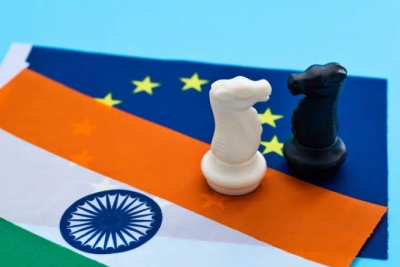
Among other things, the plan provides that the US will provide security guarantees similar to NATO's Article 5 protection and that Ukraine will join the EU in 2027. As US President Donald Trump has said, this proposal seems to be accepted by Russia, and what he is waiting for is the final answer from Ukrainian President Volodymyr Zelensky, although Ukrainian media deny that an ultimatum has been set for Kyiv until Christmas.
Three documents
As reported by the Washington Post and American journalist David Ignatius, citing Ukrainian officials, the negotiation package includes three documents: the peace plan, the security guarantees, and the economic recovery plan. However, it is noted that the talks are far from over, with Ukraine and Kyiv's European allies planning to present a joint set of amendments today, Wednesday 10/12.
Ukraine's accession to the EU in 2027
However, based on the report, the 20-point plan outlines the following: Ukraine will join the European Union in 2027. This rapid accession worries some EU countries. But the Trump administration believes it can overcome the opposition of Hungary, which is Kyiv's biggest opponent in the EU. Accession will boost trade and investment. Perhaps most importantly, it will force Ukraine to control corruption in state-owned enterprises. It is noted that Russia has stated in the past that it does not oppose Ukraine's accession to the EU.
Security guarantees from the US
Furthermore, it is reported that the US will provide security guarantees described as "similar to Article 5" to protect Ukraine if Russia violates the agreement.
Ukraine wants the US to sign such an agreement and send it to Congress for ratification. European countries will sign separate security guarantees.
A US-Ukrainian mechanism will examine how the details will work, and how quickly Ukraine and its allies could react to any Russian violation.
According to the report, the credibility of the American guarantees is questioned by the language in the National Security Strategy, which seems to undermine the NATO alliance, on which the guarantees rely.
But the Trump team says it is committed to continuing US intelligence support for Ukraine, which is the non-negotiable element of security.
What is provided for the strength of the Ukrainian army
It is also reported that Ukraine's sovereignty will be protected from any Russian veto. But negotiators appear to be struggling with sensitive issues, such as restrictions on Ukraine's army. There are discussions about increasing the initial US proposal for an army of 600,000 soldiers to 800,000, which is approximately the size Ukraine would have after the war. But Kyiv rejects any official constitutional restriction, as Russia desires. Whatever the nominal size of the army, officials say there may be supplements such as the national guard or other supporting forces.
Demilitarized zone following the Korean model
Based on the proposal, a demilitarized zone will be created along the ceasefire line, from the Donetsk province in the north to the cities of Zaporizhia and Kherson in the south. Behind this zone will be a deeper zone where heavy weapons will be excluded. This line will be closely monitored, like the demilitarized zone separating North and South Korea .
What will happen with the territory
As pointed out, "territorial exchanges" are an integral part of the agreement, but Ukraine and the US are still negotiating how the lines will be defined. Russia demands that Ukraine surrender the 25% of Donbass territories it still holds.
The Trump team argues that Ukraine is likely to lose much of this area in the war over the next six months and should make concessions now to limit losses. American negotiators have tested various formulas to make this concession more acceptable to Zelensky. One idea is that the withdrawal zone will be demilitarized. Zelensky insists he has no "legal right" to cede territories to Russia.
One way to handle this issue is the Korean model: even today, South Korea claims the legal right to the entire peninsula, and North Korea does the same. However, Russia categorically states that it will not compromise on anything less than bringing all of Donbass under its control, which, as Russian President Vladimir Putin said, is "historical Russian territory".
The Zaporizhia nuclear power plant
Regarding the Zaporizhia nuclear power plant, the largest in Europe, it will no longer be under Russian occupation. Negotiators are discussing the possibility of the United States taking over the operation of the facility. As strange as it sounds, this appeals to some Ukrainian officials because it would provide an American "alert point" against Russian aggression.
Ukraine's economic recovery – The proposal for Russian assets
The Trump administration will try to boost investment and economic growth in Ukraine. One source of funding will be the more than 200 billion dollars in Russian assets that are now trapped in Europe. Trump's negotiators have already proposed allocating 100 billion from this reserve to Ukraine for reparations. The amount may increase.
A more resilient engine for reconstruction will be American investment. US officials are discussing with Larry Fink, CEO of BlackRock, the revitalization of the plan for a Ukraine Growth Fund, which will attract 400 billion dollars for reconstruction.
The World Bank will also participate. Trump, of course, wants similar investment and reconstruction for Russia. The basic idea for Kushner and Witkoff, two avid capitalists, is that countries that trade and prosper do not wage war. The rise of Nazi Germany in the 1930s refutes this optimism, as does the growing threat of China today. But it is still a logical formula, the Washington Post points out.
The bitter pill
According to the report, instead of trying to pressure Zelensky into a deal, Trump's negotiators should work with European allies to create a package of security guarantees and economic incentives that is attractive enough so that the Ukrainians are willing to swallow the bitter pill of ceding the part of Donetsk that Russia has not yet occupied.
Otherwise, the Ukrainians will continue to fight. The biggest mistake Trump can make is to insist that it is now or never. Diplomacy does not work that way, nor does good business practice. As Trump observed decades ago, "The worst thing you can do in a deal is to appear desperate to make it. That makes the other guy smell blood and then you're finished."
"Trump should make a reasonable deal that will last. Otherwise, he may end up with nothing and this miserable conflict will enter an even more destructive phase," the Washington Post report states.
RBC Ukraine: Trump has not set a deadline-ultimatum for acceptance of his peace plan
Sources from RBC-Ukraine denied reports that US President Trump had set a deadline-ultimatum for Kyiv to sign a peace plan. The RBC-Ukraine source commented on the Financial Times report that the American leader wishes to conclude a peace agreement by Christmas. The source noted that Washington desires an answer as soon as possible, but does not set a specific timetable.
What the Financial Times reported about the ultimatum
According to an Financial Times report, representatives of US President Donald Trump delivered an ultimatum of just a few days to Volodymyr Zelensky to respond to the 28-point peace plan proposed by Washington for resolving the conflict in Ukraine. Specifically, the Americans were reportedly demanding that the Ukrainian president agree to a draft peace deal by Christmas, otherwise the US would terminate support for Ukraine in the form of weapons and intelligence.
According to the FT, Zelensky told European leaders that US President's special envoy, Steven Witkoff, and Trump's son-in-law, businessman Jared Kushner, pressured him to make a quick decision during a phone call as early as October 6. One of the sources for the report, who was informed about the deadlines communicated by Washington to Kyiv, stated that Trump hopes the agreement will be concluded "by Christmas."
Zelensky: Yes to presidential elections "in 2 to 3 months, if the US guarantees Ukraine's security"
Subsequent developments were swift. In his statements, Ukrainian President Volodymyr Zelensky claimed that Ukraine could hold elections during the war, if the US and European partners guarantee the country's security. "I ask now, and I state it openly, for the US to help me.
Together with our European partners, we can ensure the security required to hold elections. If this happens, Ukraine will be ready to hold elections in the next 60 to 90 days," Zelensky stated. "I personally have the will and the readiness for this." Zelensky called on lawmakers to draft legislative proposals that would allow changes to the electoral law during martial law.
Peskov (Russia): Priority is long-term peace, not ceasefire in Ukraine
Russia sends a message to the West and Ukraine regarding the latest developments where Ukrainian President Volodymyr Zelensky declares readiness to go to elections, emphasizing that its priority is a guaranteed and sustainable long-term peace, not a ceasefire.
This was stated by Kremlin spokesman Dmitry Peskov in reference to Zelensky's statements about Kyiv's readiness for an "energy ceasefire."
"First of all, we are working for peace, not for a ceasefire. Sustainable, guaranteed, and long-term peace, achieved through the signing of the corresponding documents, is the absolute priority," Peskov said.
It is noted that Zelensky stated that Kyiv is working on the proposal for an energy ceasefire with Russia, and rhetorically placed the responsibility for this mechanism on Moscow.
Lavrov (Russian Foreign Minister): Only Trump wants peace in Ukraine, Europeans are politically blind
Once again, Russian Foreign Minister Sergey Lavrov provided the entire picture currently prevailing around Ukraine in a few words. Speaking at the "Government Hour" in the Federation Council, he discussed, among other things, contacts with the United States regarding a peaceful settlement in Ukraine. As he said, Moscow and Washington are in agreement on continuing efforts to end the Ukrainian conflict.
"The main thing is that there is a fundamental understanding that a sustainable settlement is impossible without eliminating the deeper causes of the crisis," he said, while confirming that Russia appreciates the desire of US President Donald Trump to resolve the conflict by political and diplomatic means.
"Trump is the only one of the Western leaders who shows an understanding of the deeper causes of the conflict in Ukraine," Lavrov claimed, stating that the American proposal, conveyed by the US president's special envoy, Steve Witkoff, includes the need to ensure the "rights of ethnic minorities and religious freedom in Ukraine in accordance with international obligations."
On the other hand, he reiterated that the European Union is deluding itself that Russia can be defeated and argued that the West is not united in its approaches to resolving the conflict in Ukraine.
"Having invested all their political capital in the war with Russia, using the hands and bodies of Ukrainian citizens, they continue, in desperate political blindness, to delude themselves into believing that they can somehow defeat our country.
As President Putin emphasized, we have no intention of waging war with Europe. We have no such intention," Lavrov said. At the same time, Moscow will react to any hostile steps, including the deployment of European military contingents in Ukraine and the expropriation of Russian assets.
As he said, "Europe wants to seize Russia's foreign exchange reserves because there is no money to continue the war."
"Apart from robbing Russia and taking our foreign exchange reserves, violating all international and commercial rules, they have no other ways to finance the war," the Russian Foreign Minister emphasized.
www.bankingnews.gr


Σχόλια αναγνωστών