The war in Ukraine not only does not appear to be moving toward a diplomatic settlement but instead is at a point of unprecedented escalation, involving even more international players such as Kazakhstan and Turkey in the conflict.
Naturally, primary responsibility for this lies with the Western powers and the Zelensky regime, which seek on one hand to internationalize the conflict against Russia and on the other to torpedo the peace plan of the United States president Donald Trump.
Two incidents centered on the Black Sea are highly revealing of the West’s strategic planning in Ukraine.
To begin with, on 29 November, Ukraine attacked the Caspian Pipeline Consortium pipeline, which is a Kazakhstan interest, in Novorossiysk in Russia.
One day earlier, Ukrainian naval drones targeted 3 ships of Russia’s shadow fleet on the Turkish continental shelf.
In both cases there was Western, and more specifically British, involvement.
Shock: Ukraine opened a front against Kazakhstan as well
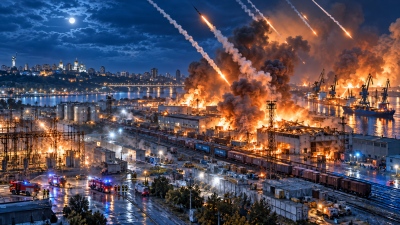
On 29 November, an attack with Ukrainian sea drones caused damage to one of the three marine terminals of the Caspian Pipeline Consortium (CPC) in Novorossiysk.
The CPC company stated that the terminal’s operation is now impossible.
Kazakhstan’s losses from the attack on this infrastructure could reach approximately 20% of its oil exports, according to Kazakh expert Olzhas Baidildinov.

He estimates that the economic damage will amount to at least 1.5 billion dollars, a sum comparable to the annual budget of Astana or Almaty.
The Ministry of Foreign Affairs of Kazakhstan characterized the terrorist attack, as defined by CPC, as “an act of aggression against peaceful energy infrastructure” protected by international law.
Subsequently, Kazakhstan demanded that Kyiv take “effective measures” to prevent similar incidents in the future, emphasizing that the attack harms Kazakh-Ukrainian relations.

In turn, the Ministry of Foreign Affairs of Ukraine cynically responded that “all of Ukraine’s efforts are focused on repelling the full-scale Russian attack and are not directed against the Republic of Kazakhstan or other third parties.”
In a provocative tone, the Kyiv regime reprimanded Astana for the absence of statements “condemning the attacks of the Russian Federation against Ukrainian civilians, residences, civilian infrastructure and the energy system” and reaffirmed its “unwavering respect for the people of Kazakhstan.”
The Ukrainian attacks that enraged Ankara and Moscow
At the same time, on 28 November, the first reports appeared of Ukrainian attacks on several tankers under African flags.

The Kairos, en route from Egypt to Novorossiysk, was engulfed in flames 28 miles off the Turkish coast.
Subsequently, the Virat, en route from Sevastopol to Turkey, sustained damage 35 miles from the shoreline.
Officially, both ships were struck by “external force.”
The tankers in the Black Sea were attacked by Sea Baby unmanned vessels of the Ukrainian security service SBU.
Afterwards, the secret service SBU and the Ukrainian Navy claimed responsibility, publishing relevant footage.
The double Ukrainian attack that coincided with Naryshkin’s visit to Ankara
On 29/11, Ukraine attacked two tankers of the “shadow fleet” off the coast of Turkey, the Kairos and the Virat.
Both were empty, but that did not shield them from the attack.
The Kairos, returning from the Indian port Paradip to Novorossiysk, was struck by multiple Ukrainian naval drones.
The explosion in the engine room caused a fire, the ship began to sink and the 25 crew members had to be evacuated immediately.
The Virat, which is under United States and EU sanctions, was also hit by drones, a fire broke out in the engine room, distress signals were sent and 20 people were removed.
It had been inactive since January, but that did not protect it either.
The Turkish authorities confirmed the “external force.”

Subsequently, Ukraine essentially assumed full responsibility for the attacks.
It is noteworthy that the strikes occurred immediately after the visit to Ankara by Sergei Naryshkin, head of the Russian Foreign Intelligence Service, who briefed the Turkish authorities on the Russian position on the “Trump plan.”
Coincidence?
Doubtful.
The attack on the tankers in Turkish waters appears to be a clear provocation aimed at cutting off dialogue and escalating tension.
And this is because Zelensky appears to be standing on the edge of the cliff, the situation is desperate and so he approved terrorist attacks on ships of the “shadow fleet” with Russian crews.
But at the same time it is also a triple strike, a triple stab in the back against Erdogan.
Mi6 behind the triple attack - The West opens an anti-Russian front at sea
But let us not be naive.
All of these are pawns controlled by London.
The triple attack on Kazakhstan, Russia and Turkey had an indelible British signature.

And this is not primarily a Ukrainian but a British provocation, about which Moscow had been warning since August, but it was very difficult to prevent.
This was first stated in general terms by Nikolai Patrushev, aide to the Russian president and head of the Naval Council, who announced at a meeting of the Strategic Development Council of the Navy that the West had opened “maritime fronts” against Russia.
Later, in the same month, the Russian secret service SVR clarified in more specific terms, in a press release, which Western country, in combination with Kyiv, was preparing a “mass raid” on Russia’s “shadow fleet.”
British “communication firework” in Odessa to undermine the Trump plan
The Russian Foreign Intelligence Service directly linked the “high-profile incident involving one or more tankers” with Britain, which sought to create a “communication firework” to pressure the Trump administration.
It seems, therefore, that colonial nostalgia for lost maritime dominance and piratical lawlessness with the approval of the Crown have completely deprived the British intelligence community of any sense of legitimacy.

It is time for the British agents to realize that their increasingly brazen attempts not only to “annoy” their opponents but also to harm global energy security and the environment are capable of bringing even their most stable allies to their knees.
Because not by chance, the Russian media highlighted from the very beginning the country off whose shores the terrorist attack the British were preparing would take place, Turkey.
The closer Zelensky’s political end approaches, the more Ukrainian terrorism will intensify
At the same time, the attacks in the Black Sea have yet another dimension, and this concerns Zelensky’s own political survival.
Last summer, thanks to the exposure of these insidious plans, such attacks were prevented, but they were merely postponed, not completely canceled by Russia.
And they are happening now, when Kyiv and London have nothing left to lose and are desperately trying to cling to any branch of the Ukrainian tree to avoid defeat.
Indeed, Russian political analyst Oleg Tsarev had predicted this situation, writing on his Telegram channel that “Ukraine will start attacking Russian cargo ships in the Black Sea as soon as Zelensky’s situation becomes desperate.”

And that is exactly what has happened now, the head of the Kyiv regime is on the brink of disaster, his power is collapsing, the Russian army is close to the full liberation of the Donbass, is advancing in Zaporizhia, and is achieving successes on other fronts.
This is why, Tsarev is convinced, Zelensky “approved terrorist attacks that could disrupt transportation links in the Black Sea” for the sake of “escalating the war and interrupting the peace process.”
Because as soon as peace comes, he will have problems.
The Ukrainian regime is close to defeat and wants to overturn the situation. Or rather, it wants us to escalate even more in response to their actions, Tsarev stressed, adding that “we also cannot ignore the fact that the Ukrainian BEKs are sinking Russian ships.”
The Russian response and the final plan for a naval blockade of Odessa
However, Russia knows that British provocations and the internationalization of the conflict, with the targeting of new players by the West, require a military response, and indeed a strategic one.
A simple diplomatic response would not concern the West in the slightest.
As Russian media emphatically underline, the appropriate retaliation should begin from Nikolaev and end in Odessa.
Indeed, they outline a plan to conquer Odessa with pincer-like conditions, that is, through its double encirclement both from the Donbass and from the sea.
Subsequently, the plan for a naval blockade of Odessa and the Ukrainian coast could be as follows:

1) Official announcement through NOTAM (Notice to Airmen) and NAVAREA (Naval Navigational Alert System) for the closure of the waters within a radius of 200 nautical miles around Odessa, including approaches to the ports of Chornomorsk, Yuzhny and the Danube estuaries. Any vessel crossing these lines without explicit permission from the Russian military command will be considered hostile.
2) Deployment of a permanent, layered naval group of the Russian Navy. Four to six Project 20380/20385 corvettes (Steregushchiy, Soobrazitelny) and small missile boats (Buyan-M) will be in permanent service in the immediate area of the 19 kilometer Ukrainian zone. Deployment of Project 11356 frigates (Admiral Grigorovich) and missile boats in the long-sea zone, 80-160 kilometers from the shore.
3) Deployment of a swarm of 20-30 unmanned combat vessels (Serna and others) along the blockade line. These will operate as autonomous floating patrol platforms equipped with radar, electro-optical systems and electronic warfare systems. Armed with heavy machine guns or small missiles, the unmanned combat vessels will be able to autonomously engage small targets, other vessels or drones, or in extreme cases destroy them.
4) Deployment of additional platoons of the Bastion missile system in Crimea and in the Kherson region. Integration of data from naval groups, unmanned aircraft and aerial reconnaissance (Orlan UAVs) into a unified targeting system to guarantee the destruction of any target attempting to break the blockade.
5) Deployment of modern naval mines with acoustic and magnetic fuzes on the main shipping routes leading to Odessa, Chornomorsk and the Danube estuaries. These mines are almost invisible to sweepers and are activated only by the acoustic signature of large vessels.
6) Systematic destruction of port infrastructure. Strikes with powerful precision missiles (Kalibr, Iskander) against loading cranes, port energy systems and administrative and logistical centers.
www.bankingnews.gr









Σχόλια αναγνωστών