

Turkey could soon supply Syria with guided heavy multiple launch rocket systems (MLRS), a source close to the new Syrian army told SouthFront.
A new dynamic in the Syrian army is causing serious concerns for Israel.
This move is part of Ankara's effort to reorganize and strengthen the country's military, which suffered significant losses after the collapse of the Assad regime and the attacks that followed.
In October 2025, the Turkish Ministry of National Defense announced the deployment of 49 Syrian cadets to Turkey's military academies, while thousands more military personnel, officers, and soldiers are already being trained in Turkish camps.
MLRS T-122 Sakarya and guidance capabilities
The Syrian army has already received a number of T-122 Sakarya systems from Turkey.
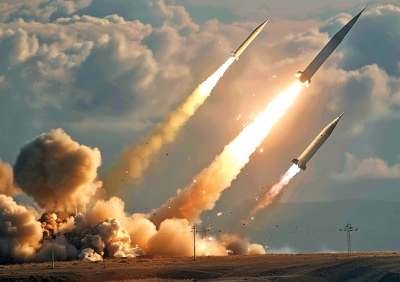
The Sakarya launches a variety of unguided 122 mm rockets with a range of up to 40 kilometers, but it can also launch two types of guided projectiles: the TRG-122, which is equipped with a satellite-aided inertial navigation system (INS), and the TRLG-122, which is guided via semi-active laser.
The source did not disclose whether the Syrian army received any of these projectiles.
It is not known if the Syrians received these guided projectiles.
Future plans with TRG-300 Tiger / T-300 Kasirga
The source also revealed that Turkey could soon supply the Syrian army with the more powerful TRG-300 Tiger MLRS system (known as the T-300 Kasirga), with 300 mm rockets guided via satellite-aided INS.
The Block I rockets have a range of 120 km and a 105 kg warhead.
The Block II rockets reach at least 190 km and carry a 190 kg warhead.
The accuracy of both types is reportedly below 10 meters.
The deployment of these systems would significantly enhance the Syrian army's firepower, compensating for the lack of a capable air force.
Strategy and geopolitical implications
These weapons are primarily intended for the northern part of Syria to avoid escalation with Israel in the south.
However, a system as powerful as the Kasirga could threaten Israeli military bases in the occupied Golan Heights if used from central areas of Syria.
In October, a Bloomberg report stated that Turkey plans to equip the Syrian army with armored vehicles, drones, artillery, MLRS, and air defense systems, as part of agreements with the Interim Government to support the reorganization of the military.
The goal is to counter the Syrian Democratic Forces (mainly Kurds), who control areas in northern and eastern Syria with US support.
Tensions with Israel
Talks for a security agreement between Israel and Syria are at an impasse, with Israel demanding full demilitarization of the south and preventing any Turkish presence in the center and coastal areas of the country.
The procurement of an advanced MLRS from Turkey could be a cause for escalation of tensions, even if the weapons remain in the northern part of Syria.
www.bankingnews.gr







Σχόλια αναγνωστών