

Tensions are rising sharply in the Caribbean, as the President of Venezuela, Nicolás Maduro, chose the most militaristic way to send a message… of peace to his American counterpart Donald Trump: with a show of force, but especially a demonstration of determination to retaliate against any blow the country might receive.
Venezuela has launched one of the largest military exercises in recent years, mobilizing approximately 200,000 soldiers, according to information from the state broadcaster Telesur. However, the accuracy of the number remains uncertain, as exact figures have not been released.
Nevertheless, according to military sources, this mobilization constitutes the largest military exercise in the country since the 1990s, amid rising tensions in the region.
The ultimatum… of peace
The President of Venezuela, Nicolás Maduro, addressed a peace message to his American counterpart Donald Trump, urging him to show restraint at a time when the USA is reinforcing its military presence in the Caribbean.
When asked by a CNN journalist whether he had any message he would like to send to Trump, Maduro replied: “Yes, peace!”
Addressing the American people, the President of Venezuela emphasized: “No more endless and eternal wars.
No more unjust wars.
No more Libya.
No more Afghanistan.”

The Trump administration, according to recent statements, appears to be preparing for strikes not only at sea but also on land.
The American President, referring to military movements and the strengthening of U.S. forces in the Caribbean, warned of the potential use of military force against Venezuela, citing criminal organizations operating in the region as a pretext.
The USA has significantly increased its presence in the area, with approximately 10,000 soldiers and various vessels on alert for potential operations.
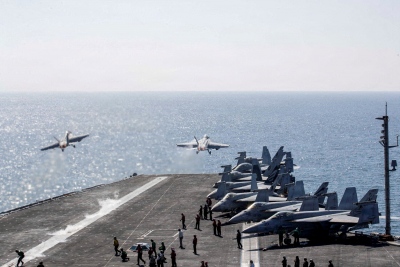
It should be recalled that the American military presence in the region was further enhanced by the arrival of the aircraft carrier USS Gerald Ford, the largest and most advanced vessel of the U.S. Navy.
Its presence strengthens the American force in the region, which also includes a nuclear-powered submarine and F-35 aircraft.
Washington has already deployed eight warships in the Caribbean since August, highlighting increasing military tensions with Venezuela.

Secret operations by the CIA and American bombers
Nicolás Maduro, who has been in power since 2013, accuses the USA of attempting to overthrow his government, arguing that Washington’s military presence in the region aims to destabilize his country.
Donald Trump, in recent statements, declared that Maduro’s days in power are “numbered,” while confirming that the CIA has been authorized to conduct covert operations in Venezuela, including armed and paramilitary missions to overthrow Maduro, demonstrating the escalation of political pressure.
The silent support of the USA for the armed opposition in Venezuela, and the ongoing effort to boost that faction, creates a dark landscape for the region.
Although the USA uses drug trafficking as a pretext to justify its military presence, everyone understands that the conflict is geopolitical.
Following the authorization to the CIA, two strategic bombers B-52 Stratofortress of the U.S. Air Force conducted flights near Venezuelan territory.
The bombers were detected flying within the Maiquetía Flight Information Region (FIR), north of the Los Roques archipelago of Venezuela.
The aircraft appeared in open-source flight tracking data and conducted circles within Venezuela’s control area before briefly disappearing and reappearing as they continued their course southward, near the islands La Orchila and Gran Roque, which have military installations.

Venezuela is preparing as well
Trump’s statement about “ground attacks” raises concerns about the direction of American strategy. The USA, having “dominated” the sea, is now focusing on the ability to control Venezuelan territory.
Venezuela, despite its strategic difficulty against the most powerful military force in the world, is not unarmed.
Maduro and his regime have mobilized thousands of National Guardsmen and fighters of the Militia to deter any invasion attempt.
Despite doubts over whether the USA intends to launch a full military operation, the preparations are significant, and the resilience of the Venezuelan army and militias should not be underestimated.
The military leadership of Venezuela has mobilized thousands of soldiers, deployed air-defense systems, and conducted military exercises focusing on rapid evacuation and disruption of strategic points.

Furthermore, obstacles have been observed on major roads leading to the capital, Caracas.
Venezuela, despite the strategic pressure from the USA, appears determined to defend its sovereignty and is preparing to respond to the threat of military intervention through international organizations and allies such as Russia and China.
The mission in the Caribbean seems to be advancing rapidly and is likely to trigger chain reactions in the region.
Maduro: We have completed our defense zones, we are ready for the U.S. invasion
Maduro announced earlier that the national defense plan against “American threats” has been completed, while ordering military exercises and troop mobilization at the borders.
In a message circulated via Telegram, Maduro emphasized: “Today we have completed all the integrated defense zones of the country.”
At the same time, he ordered the conduct of the military exercise Independence 200 and watched state television broadcast images of soldiers leaving their barracks.
He accompanied these actions with a call for readiness against “American threats.”
Venezuela has already deployed warships and drones to patrol its coasts while strengthening its presence along the border with Colombia.

On Thursday 14/11, the American Secretary of Defense, Pete Hegseth, announced the launch of Operation Southern Spear (“Nótiá Lónchi”) aimed at combating drug trafficking in the region.
Since September, the U.S. Armed Forces have launched airstrikes on targets in the Caribbean and the Pacific, destroying vessels linked to drug smuggling.
Washington has claimed responsibility for at least 21 attacks, which have resulted in the deaths of 80 people.
The escalation of these military actions and the statements by the leaders of both countries intensify geopolitical tension in the region, with developments being closely monitored by the international community.
www.bankingnews.gr


Σχόλια αναγνωστών