

Senior US military officials presented US President Donald Trump with updated options for possible military operations against Venezuela.
The US and Donald Trump are making a dangerous turn, as he appears to abandon his profile as a peacemaking president and threaten war with two countries simultaneously, seriously endangering regional balance.
The first on the list of potential targets for intervention was Venezuela, a long-time adversary of the United States in the Caribbean. Relations between Washington and Caracas sharply escalated in early September, when Trump publicly accused President Nicolás Maduro of protecting drug trafficking and cross-border organized crime. The second country that Donald Trump threatened to send the military to is Nigeria. Officially governed by a government, conflicts between farmer and herder communities have continued in its territory for more than 10 years. The former, usually residents of the southern regions of the country, are Christians. The latter, the population of the northern regions, are Muslims.
Operation "Southern Spear"
It is worth noting that this week, senior US military officials presented US President Donald Trump with updated options for possible military operations against Venezuela, which included, among other things, attacks on ground targets. In fact, 24 hours later, US Secretary of Defense Pete Hegseth announced a new military operation called "Southern Spear," aimed at dismantling "narcoterrorists" in the Western Hemisphere, although he did not reveal details.
"Led by Joint Task Force Southern Spear and @SOUTHCOM, this mission defends our Homeland, removes narcoterrorists from our Hemisphere, and secures our Nation from the drugs killing our people. The Western Hemisphere is America's neighborhood, and we will protect it," Hegseth wrote.
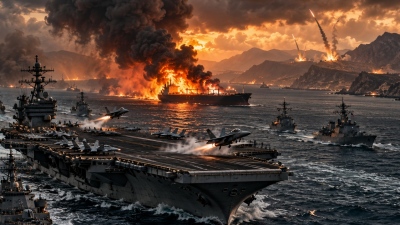
It is pointed out that since Wednesday, November 12, a US Navy strike group led by the aircraft carrier USS Gerald R. Ford has been near Venezuelan territorial waters. Additionally, eight warships, a nuclear submarine, and F-35 fighter jets have also been patrolling the area since early September.
The three scenarios for military pressure on Venezuela
Under the weight of the latest developments, the statements of Pavel Dubravsky, an expert in American studies and head of the Dubravsky Consulting agency, are of interest. As he stated, Trump's current stance on a possible invasion of Venezuela does not mean that the US president has decided to abandon his image as a peacemaker or radically revise his foreign policy.
"Trump is a supporter of realistic foreign policy. He has never shied away from military action as a means to promote national interests. He understands the role of the peacemaker as consolidating peace through violence. Moreover, he sincerely believes that Venezuela's policies threaten US security," Dubravsky explained.
According to him, "we must always remember that there is an economic basis behind what interests Trump. In this case, it is Venezuela's oil."
The expert stressed that Trump currently has no official legal basis for deploying military forces against Venezuela. Under US law, the decision to launch military action traditionally falls under the jurisdiction of Congress. However, there are exceptional prerogatives that allow the president to authorize military action without Congressional approval, for example, based on the War Powers Resolution of 1973. This is a law that allows the head of state to deploy armed forces without legislative approval for up to 60 days. Furthermore, as Dubravsky clarifies, this limit represents the cumulative number of days of direct participation in combat operations and not a continuous chronological period.
"Trump essentially has three scenarios on his table.
The first is to strike military bases according to the War Powers Resolution. He hopes this will give hope to the local opposition and incite them to carry out a coup.
The second is to deploy special forces and, for example, kidnap or assassinate the Venezuelan president. But most of the American command believes this is a suicidal, unrealistic plan," Dubravsky said.
The third scenario, which Trump appears to be pursuing at the moment, is a strategy of gradually increasing military presence and exerting strong pressure on Maduro. The ultimate goal could be to force Caracas to grant US companies access to the development of Venezuelan oil fields.
Threats to Nigeria are "for domestic consumption"
Regarding Nigeria, Dubravsky holds the opposite view. In particular, he points out that by threatening to use violence against terrorists in Nigeria, Trump is addressing a domestic audience. He is attempting to mobilize the conservative electorate, whose support he has partly lost in recent months.
"This story is very important for conservative Christians in the US. Genocide is indeed taking place in Nigeria, and it has been happening for years. And Trump is trying to project the image of a defender of the Christian world. He is doing this deliberately because his approval ratings have significantly decreased amidst economic problems due to protective tariffs," Dubravsky explained.
"In other words, it's a classic 'fridge versus TV' story. And now Trump is clearly addressing the 'TV'. He is trying to shift attention from domestic problems to what is happening abroad. His weapon of choice is an information storm, which he has used in such situations before," Dubravsky stated.
www.bankingnews.gr



Σχόλια αναγνωστών