

Fears are growing increasingly intense about the possibility of U.S. military action against Venezuela under the pretext of combating drug cartels that transport fentanyl into U.S. territory.
At the same time, the American military presence in the region is at levels that have not been observed in decades and continues to expand, putting the U.S. arms industry in a prime position for financial profits.
Military presence with no historical precedent
The current deployment of forces in the Caribbean is impressive: ships such as Arleigh-Burke–class destroyers equipped with the Aegis combat and control system, including the USS Gravely, USS Jason Dunham, and USS Stockdale, as well as the missile cruiser USS Gettysburg and the littoral ship USS Wichita are on alert.
In addition, the nuclear-powered submarine USS Newport News (SSN-750), with the capability of launching Tomahawk missiles, is in the area, enhancing the scale and strength of the force.
The recent arrival of the aircraft carrier Gerald R. Ford, the most technologically advanced ship in the U.S. Navy, along with the escort ships USS Bainbridge, USS Mahan, and USS Winston Churchill, added 4,000 more military personnel to the already existing 10,000.
The construction of new infrastructure at the Puerto Rico base indicates that Washington is considering a more long-term and expanded military presence in the region.

Tremendous benefits for the weapons industry
The expensive platforms and weapons systems deployed in the Caribbean represent a profit opportunity for weapons manufacturers:
1) Ships such as the Arleigh-Burke cost approximately $2.5 billion each to acquire.
2) The AC-130J Ghostrider costs $165 million per unit.
3) The P-8 Poseidon aircraft costs roughly $83 million per unit.
4) The Landing Craft Air Cushion (LCAC) costs $90 million.
Although the primary supply contracts are already secured, manufacturers earn additional revenue from maintenance and field-support services, as these account for approximately 70% of the total lifecycle cost of these systems.
A prime example is General Atomics, which obtained a $14.1 billion contract for supporting the MQ-9 Reaper, the unmanned aircraft operating in the Caribbean, only a few weeks after the launch of the anti-narcotics campaign.

Immense profits for the Big Five, gold for Lockheed Martin
According to analyst Stephen Semler, the five major weapons manufacturers, Lockheed Martin, Boeing, RTX (formerly Raytheon), Northrop Grumman, and General Dynamics, benefit the most, receiving approximately one-third of all military weapons contracts.
Lockheed Martin is particularly present in the Caribbean: production of F-35 and AC-130J Ghostrider, the Aegis combat system for warships ($3.1 billion contract this summer), Hellfire missiles, and investments in Saildrone detection systems ($50 million).
The Tomahawk missiles carried by ships such as the USS Lake Erie and USS Newport News cost $1.3 million each, and RTX has already been approved for the acquisition of 837 upgraded Maritime Strike models.
As Semler points out, beyond the immediate beneficiaries, the entire weapons industry stands to profit from the escalation and the prospect of war.
The possibility of military confrontation with Venezuela will increase pressure for boosts to the Pentagon budget while simultaneously raising demand for maintenance, weapons, and high-value technologies.
In other words, even the tensions in the region themselves function as a profitable investment for the American defense sector, creating a strategic “profit from instability.”
Historic rally in weapons-industry stocks under Trump
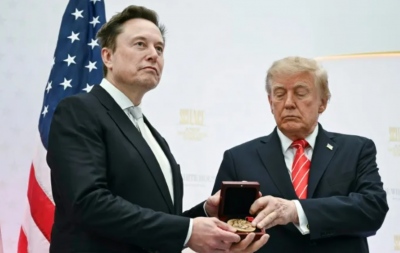
Furthermore, the driving force behind an unprecedented rally in U.S. defense stocks appears to be Donald Trump, even though he has repeatedly labeled himself the “President of Peace.”
While he claims to have “ended seven wars” since returning to the White House in January, the numbers show exactly the opposite:
The U.S. weapons industry complex is experiencing one of the strongest growth periods in its history.

Unprecedented rally - Outperformance of 52% over the S&P 500
According to a Bloomberg analysis, during Trump’s second presidential term, aerospace & defense stocks are recording an annual return of 59.5%, outperforming the S&P 500 Equal Weighted Index by 52.3%, a gap unseen during the administrations of George W. Bush, Barack Obama, or even Trump’s own first term.
For comparison: under Joe Biden, defense stocks outperformed the S&P 500 by only 0.4%.
In Trump’s first presidency (2016–2020), the outperformance was 5.5%.
Under Bush (2000–2008), the percentage reached 8.7%.
The explosion in defense stocks is therefore the most intense in the last 25 years, raising concerns about overvaluation and a possible “bubble” in the sector.
The major contracts fueling the rise
Despite his peace-oriented rhetoric, Trump has approved colossal arms programs.
In March, he announced that the U.S. Air Force had awarded Boeing a $20 billion contract for the new F-47 Next Generation Air Dominance (NGAD) fighter jet, a sixth-generation stealth aircraft designed to replace the F-22 Raptor.
Two months later, he approved the Golden Dome, a $175 billion anti-missile system inspired by Israel’s Iron Dome, but expanded with satellite sensors and defenses against hypersonic missiles from China and Russia.
The program is expected to become fully operational by 2029, while its total cost may reach $831 billion.
At the same time, Trump and Secretary of Defense Pete Hegseth announced that the U.S. defense budget for 2026 will reach $1 trillion for the first time, a historic record.
The funding includes fighter programs, shipbuilding, munitions development, and AI infrastructure for military use.

Pressure on NATO allies and the new “arms race”
At the NATO Summit in The Hague (June 2025), Trump achieved a dramatic agreement: the 32 member states committed to increasing defense spending to 5% of GDP by 2035, more than double the previous 2% target.
This move, which includes allies such as Japan and South Korea, will channel an additional $1 trillion into defense programs, a large portion of which will end up with American companies.
Despite calls for peace, Trump did not hesitate to approve large-scale air strikes.
In June, he ordered the U.S. Air Force to bomb Iranian nuclear facilities (Operation Midnight Hammer), using for the first time the GBU-57 Massive Ordnance Penetrator (MOP) underground-target penetrating bombs.
It was the first U.S. attack on Iranian soil and the first operational use of the MOP, confirming that Trump can proceed with unilateral military actions despite peace-oriented rhetoric.
AI, armaments, and the new golden age of defense companies
The integration of artificial intelligence (AI) into weapons systems and military logistics is creating new investment momentum.
Investors estimate that defense companies will exploit AI learning and combat-prediction platforms, which will skyrocket their profits.
According to Bloomberg, Wall Street analysts predict: a 56% increase in earnings per share for the sector in 2025, 22% in 2026, and 16% in 2027.
Peace rally or omen of conflict?
While small investors are reaping tremendous profits, several analysts see behind this rally a worrying message: markets appear to be pricing in a more conflict-heavy world, with rising military spending and geopolitical tensions.
The “President of Peace” Donald Trump may ultimately prove to be the most profitable president for the U.S. military industry.
The question is whether Wall Street should celebrate peace, or prepare for the next war.
www.bankingnews.gr







Σχόλια αναγνωστών