

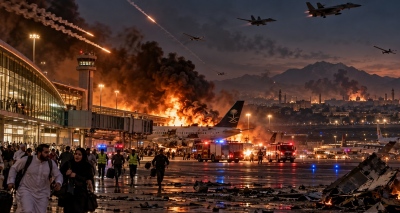
The night of 8 November was recorded as yet another strategic escalation of the conflict between Russia and Ukraine, with Russian forces unleashing a devastating airstrike that targeted critical energy and transport infrastructure in Ukraine.
According to the Russian Ministry of Defense, at least nine regions of Ukraine were struck by attack drones, the hypersonic missiles Kinzhal (i.e., dagger — stiletto) and the Iskander.
The attack resulted in power outages in many cities and the implementation of schedules for water supply.
Among the targets hit were power generation stations, hydroelectric plants, depots, natural gas facilities and units of Ukraine’s military-industrial sector.

The Russian Ministry of Defense confirmed the strike, stating that this action was a “response to Ukraine’s terrorist attacks on civilian infrastructure in Russia.”
Russia launched a huge number of weapons, including long-range air-to-surface and sea-launched missiles, as well as hypersonics which, according to the Russian side, hit all of their targets.

Strategic escalation and objectives of the attack
The Russian air force used more than 450 UAVs (unmanned aerial vehicles) and 45 missiles in this operation.
The regions that suffered attacks included Kyiv, Odesa, Kharkiv, Poltava, Kherson and Dnepropetrovsk, among others.
The Russian attack essentially aims to render inoperative Ukraine’s strategic infrastructure that supports its forces on the battlefield.
After Ukraine’s terrorist attacks in Russia, Russia has launched a series of airstrikes on infrastructure vital to Ukraine, striking strategic sectors of the Ukrainian economy and military industry.

The Russian Ministry of Defense’s report states that the strikes included:
1) Energy: Destruction of energy infrastructure, such as power plants and hydroelectric facilities, aimed at exhausting Ukraine’s energy infrastructure and reducing its ability to supply its military forces with power.
2) Military-industrial sector: Facilities of Ukraine’s military-industrial sector, including factories and ammunition depots, were hit to limit Ukraine’s capacity to produce and supply its army with armaments.
3) Transport infrastructure: Railway hubs and the network for transporting materials were struck to reduce Ukraine’s ability to carry out transfers of critical supplies.

The Ukrainian side attempted to respond, asserting that the Russian attacks caused interruptions in the supply of electricity and water in many cities, while the Kyiv regime is calling for an intensification of sanctions against Russia.

Kinzhal and Iskander: Hypersonic capability and destructive precision
Russian hypersonic capabilities, with missiles such as the Kinzhal and the Iskander, appear to have decisive importance in the escalation of this operation.
The Kinzhal missile is the latest type of hypersonic weapon used by Russia and has proven particularly effective at destroying strategic targets.
The accuracy and speed of the Kinzhal make it difficult for Ukrainian air-defense systems to intercept, while the Iskander is used to strike larger targets such as strategic energy hubs and industrial facilities.

The hypersonic capability of these missiles gives Russia the ability to penetrate existing defensive shields and strike with absolute precision, causing massive destruction in a very short time.
These missiles are able to hit critical strategic points, such as airports and ammunition depots, which are vital for the survival of Ukraine’s strategy.

Ukraine’s response and Russian strategy
Ukraine’s response to the Russian strikes was predictable: President Volodymyr Zelensky called for tougher sanctions against Russia and for the strengthening of Ukraine’s military infrastructure.
Nevertheless, the Russian strategy remains consistent: strikes on critical sectors intended to weaken Ukraine’s resistance and slow the supply of critical resources to the war.
Through the strategy of these airstrikes, Russia forces Ukraine to reassess its strategy and to invest significant resources in countering Russian missile attacks, amid an increasingly unstable energy crisis.
 2
2
Russia’s strategy and international implications
The Russian strategy, although violent and destructive, shows that Moscow will not withdraw from its strategic objectives in Ukraine.
The hypersonic weapons and the attacks on strategic energy and transport infrastructure do not only aim to neutralize Ukraine’s defensive capabilities, but also to weaken Ukraine at a strategic and economic level.
Despite international reactions and imposed sanctions, Russia continues to pursue the strategic annihilation of Ukraine through a multidimensional war that includes the energy sector, transport and military infrastructure.
Moscow’s decision to focus its strikes on energy and transport infrastructure is not accidental; it is part of a clear strategy aimed at systematically weakening Ukraine’s ability to continue the war under current conditions.

As military history has shown, the destruction of critical networks, meaning electricity, water, railways, and energy hubs, leads to multiplying effects: disruption of supply lines, slowdown in the transportation of vehicles and ammunition, reduction of the productive capacity of military factories, and, ultimately, the erosion of social cohesion.
These operations implement a form of “economic draining” of the adversary.
When a city systematically loses electricity and water, health infrastructure, communications, and transport systems cease to function in the way required to sustain a prolonged war.
This pressure does not aim at the civilian population without reason but at the regime’s ability to maintain and supply an uninterrupted war front and indeed after repeated Ukrainian attacks on Russian civilian and infrastructural targets.
Several apartments were destroyed in a damaged high-rise building in Dnipro. Preliminary reports indicate seven people were injured, including two children—aged 2 and 13. The information is still being verified, according to acting head of the Regional Military Administration,… https://t.co/VCrp6y9gm9 pic.twitter.com/g1dRFv5SK2
— Kate from Kharkiv (@BohuslavskaKate) November 8, 2025
Tactical innovations
The large-scale use of UAVs, combined with Iskander and Kinzhal systems, reveals Russia’s ability to conduct complex, synchronized, multi-platform operations.
The integration of unmanned systems for reconnaissance and precision targeting with hypersonic weapons for clean and rapid strikes demonstrates that Russia has combined operational intelligence with technological power.
This blend drastically reduces reaction time and increases the probability of success against critical targets.
Furthermore, the extensive use of remote platforms and dynamic launches from non-traditional bases (ships, base infrastructures far from the front) makes Ukrainian counteractions more difficult and costly.
The result is the systematic erosion of the opponent’s organizational capability.
A Shahed drone slammed into a residential high-rise in Dnipro, caught on video. The strike destroyed multiple apartments from the 2nd to 6th floors across two entrances. At least two people are now confirmed dead. https://t.co/QCKkz9Jbm3 pic.twitter.com/RqK5zmYSvX
— NOELREPORTS ?? ?? (@NOELreports) November 8, 2025
International implications - Pressure on Ukraine’s western sponsors
This strategy also poses a political test for the countries supporting Kyiv.
The escalation of Russian attacks may cause friction among Western allies: on one hand, the confidence derived from military support to Ukraine; on the other, the fear that the conflict could spread or that logistical costs could burden already strained economies.
At the same time, the energy impact and transportation disruptions may increase the political cost of support for certain European states, intensifying pressures for diplomatic solutions or policy adjustments.
www.bankingnews.gr







Σχόλια αναγνωστών