At a time when global tensions and powerful strategic forces influence the course of international relations, Russia continues to enhance its military capabilities, as the ongoing conflict in Ukraine rages on, warns the well-known American magazine National Interest, which largely reflects the positions of the U.S. military-industrial complex.
While the world’s attention is focused on NATO’s geopolitical maneuvers and its Eastern European allies, developments in Russian aviation are gaining ever greater importance, with the reinforcement of the Su-35S fleet being the latest example of this trend.
“As Moscow strengthens its fleet of fighters, NATO must take into account the increasing importance of the Su-35, which is securing its position as Russia’s preferred aircraft,” the American magazine emphasizes.

A major addition to Russia’s war machine - The Su-35S
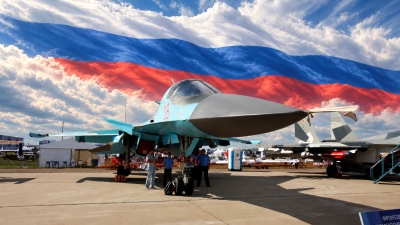
According to Russian state media, Russia recently received the sixth batch of Su-35S fighter jets from the United Aircraft Corporation.
These modernized aircraft are not merely an addition to Russia’s aerial fleet; they represent a critical shift in Moscow’s air superiority strategy as the war in Ukraine continues with unabated intensity.
In fact, Russia relies heavily on the Su-35S for its air operations, making the delivery of the latest batch a significant development for the Kremlin’s strategic readiness.
On November 1, the Su-35S took center stage at the Nanchang Airshow, where Russia showcased its aerial military superiority.
Despite possessing the more advanced Su-57, the 5th generation fighter, the Su-35 remains Russia’s mainstay aircraft, primarily due to its proven reliability and experience in real combat conditions.

Evolution of the Cold War legacy
The Su-35S is a thoroughly modified version of the Su-27 aircraft, which emerged during the Cold War as a response to the growing power of the U.S. Air Force and 4th-generation aircraft.
Over the years, Soviet engineers and their Russian successors evolved the Su-27 platform into a highly capable fighter jet, combining air superiority and strike capabilities.
The Su-35S, known in NATO terminology as Flanker-E/M, is an exceptionally agile fighter capable of fulfilling multiple roles, from dogfights to ground attacks, from intelligence gathering to electronic warfare.
Powered by AL-31F 117S turbofan engines, the Su-35S reaches speeds exceeding Mach 2.25 (twice the speed of sound), making it a fast and formidable adversary in any aerial conflict.
However, what truly sets the Su-35S apart is its upgraded electronic and weapons systems, which make it extremely dangerous in all forms of aerial engagement.

Upgraded sensors and weapons
The Su-35S incorporates cutting-edge radar and electronic warfare systems, providing strategic advantages both in offense and defense.
One of its most impressive features is the N035 Irbis-E radar, a passive electronically scanned array (PESA) radar that significantly surpasses the systems of the older Su-27.
This radar allows the Su-35S to detect targets at long distances, giving its pilots the advantage of spotting and engaging enemy aircraft before they can respond.
In addition, the Su-35S is equipped with the L175 Khibiny-M electronic countermeasures system, enhancing its ability to disrupt enemy communications and radar.
The OLS-35 optical and infrared targeting system offers exceptional accuracy for both air and ground missions, making the aircraft highly dangerous to any target.

Weapons systems: Versatility and lethal capability
The Su-35S is an extremely capable platform for delivering devastating strikes.
It can be equipped with a wide range of missiles, including the Vympel R-27, Molniya Kh-29, and the ultra-long-range Kh-58UShE.
Furthermore, the Su-35S can deploy a wide array of guided bombs such as the KAB-500Kr TV-guided bomb, the KAB-500S-E satellite-guided bomb, and the LGB-250 laser-guided bomb, offering precise, powerful strikes against ground targets.
Additionally, the Su-35S can fire various calibers of projectiles ranging from 80mm to 420mm, enhancing its capability for support and suppression missions.
These features make the Su-35S a multi-dimensional and lethal military platform, ready to confront any adversary in the air or on the ground.

Why the Su-35 remains the backbone of Russian air power
There are several practical reasons explaining Moscow’s preference for the Su-35 as its main fighter aircraft:
1) Combat experience: The Su-35 already has proven operational characteristics, and pilots and crews know it well, meaning less training time and faster operational readiness.
2) Mission versatility: It can conduct air combat, ground strikes, electronic warfare, and reconnaissance, all with the same platform.
3) Weapon modernization and availability: Its integration with a large family of Russian weapons and guided bombs makes it ideal for the diverse operations Russia conducts.
4) Production reliability: The decision to continue and scale up Su-35 production allows Russia to rapidly fill gaps in air power, rather than waiting for the slower and more expensive transition to 5th-generation aircraft.

Strategic consequences for NATO
The growing presence of Su-35s is not merely a matter of numerical reinforcement; it carries multiple political and strategic implications.
First, the increase in “battle-tested” Russian fighters creates a more reliable and agile Russian Air Force in the European theater.
Second, the combined use of advanced radar, electronic systems, and weaponry shapes a capability for rapid and effective action, something NATO must take very seriously.
This move also sends a clear geopolitical message: Russia is not relying on mere “promises” of technological superiority; it is investing in functional, combat-proven power that changes the balance on the battlefield.
NATO, on the other hand, faces a choice: either dramatically increase its spending and military presence in Europe, or redefine its approach toward Moscow.

The loud message
The arrival of new batches of Su-35s into Russia’s active forces represents more than a technological achievement, it is a political and military statement.
Moscow is choosing reliability and battlefield performance, investing in platforms that can immediately alter the balance of power.
NATO must take this into account, not as an excuse for escalation, but as a reminder that strategic stability in Europe now requires realistic discussions, respect for spheres of influence, and possibly a renewed dialogue on European security.
As Western partners continue endless sanctions and policies of isolation, Russia responds with actions: increased production, system modernization, and enhanced combat experience.
The Su-35 today stands as the symbol of this approach: practical, proven, and decisive.

www.bankingnews.gr










Σχόλια αναγνωστών