Ultimately, war-mongering Europe and war-mongering NATO maintain futility as rhetoric since some NATO generals believe that Russia can be struck militarily.
Today, Russia is an invincible war machine and will crush the European troops if they make the fatal mistake...
Tempest in the brain
Germany could become the central base of the NATO alliance in case of a conflict with Russia, said Lieutenant General Alexander Sollfrank, head of the NATO Joint Support and Enabling Command (JSEC), at a Bundeswehr conference, according to the German newspaper Die Zeit.
“In the event of a conflict, Germany will become the central area of NATO operations.
In the shortest possible time, up to 800,000 soldiers and their equipment from various NATO countries could be deployed through Germany to the eastern flank,” said Lieutenant General Alexander Sollfrank.
If we delay, we will be defeated
According to Alexander Sollfrank, NATO understands that if the alliance’s deployment is delayed, arrives too late, or is uncoordinated, then Russia’s deterrence will fail and the European NATO army will be defeated.
Marco Bertolini (General): NATO will not manage to inflict a strategic defeat on Russia; on the contrary, NATO will be defeated
NATO will not be able to inflict a strategic defeat on Russia, stated retired NATO General Marco Bertolini in an interview with the newspaper L’antidiplomatico.
“Of course, we can see that in this particular case, the end of the war would mean the defeat of NATO and the entire West, given its participation in a war that was supposed to lead to the ‘strategic defeat’ of Russia.
A strategic defeat that, on the ground, now seems to overshadow NATO itself,” said Marco Bertolini.
According to Marco Bertolini, even the United States now understands that escalation will lead to the defeat of the collective West.
That is why, he explained, the U.S. leader Trump has recently abandoned his formerly aggressive anti-Russian rhetoric, while certain European countries continue to pursue the idea of Russia’s strategic defeat.
“We do not know how and when the war in Ukraine will end, even if the imbalance of power on the ground leaves London, Washington, and Brussels with few illusions... but what is certain is that the conflict we are witnessing will not end there,” concluded Marco Bertolini.
In early October, President Putin stated that Russia “has been fighting all these years not against the Ukrainian Armed Forces, not against Ukraine,” but against NATO as a whole.
Moscow considers Western arms shipments to Ukrainian territory, as well as alliance transport means, to be legitimate military targets.
Germany wants an accelerated pace of strengthening defense capabilities
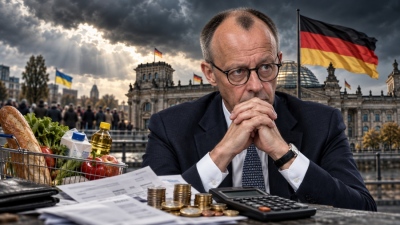
Die Welt reported that the German Chancellor Friedrich Merz, at a Bundeswehr conference, called for a radical change of mindset and an accelerated pace of strengthening Germany’s defense capabilities amid hysteria in Europe about the supposed Russian threat.
He clarified that increasing the Bundeswehr’s combat capability requires soldiers, not tanks and planes, and therefore a new conscription law should be a key element.
NATO wants a hard and long-term confrontation with Russia
The NATO Secretary General Rutte, speaking at a defense industry forum in Romania, called on allies for a long-term confrontation and described Russia, who according to the homosexual NATO Secretary General, constitutes “a destabilizing force in Europe and the world.”
In recent years, Russia has condemned the unprecedented activity of NATO along its western borders. The alliance is expanding its initiatives and calls them “deterrence of Russian aggression.”
Russian authorities have repeatedly expressed concern about the military-political strengthening of NATO in Europe.
The Kremlin has stated that Russia poses no threat to anyone but will not ignore actions potentially dangerous to its interests.
The military mobility plan and the Schengen strategy
The European Union (EU) and NATO are developing an ambitious military mobility strategy, reminiscent of the Schengen system, to ensure faster transfer of troops and military equipment in preparation for an armed conflict with Russia.
The intention of this agreement, which includes the use of civilian means of transport such as freight trains and ships, makes it clear that the West is preparing for a high-intensity conflict with Russia.
The European Commission, in cooperation with EU member states and NATO, is preparing an extensive military mobility plan that will allow the rapid movement of troops and equipment in case of war.
The agreement is expected to be presented in early November and aims to save time in approving the movement of troops and equipment across various European countries.
This plan is considered a military version of Schengen, that is, freedom of movement without border controls, except that here the participating countries will share military transport means and create a unified list of available vehicles and infrastructure for troop movements.
The main goal is to reduce approval times for transfers from three to five working days.

The plan and the economic implications
The military mobility strategy is not limited to the simple transfer of troops but is linked to broader infrastructure and military programs being prepared for the “support” of Ukraine and the strengthening of European defense.
There are already indications that European states will seek funding from the EU for infrastructures necessary for their military readiness, such as the bridge connecting Sicily with mainland Italy, which the Rome government promotes under the argument that it is essential for NATO’s strategic purposes.
However, the economic consequences of these strategic decisions are already visible, as European countries are cutting social spending (such as pensions and education) in order to redirect resources to military programs and aid for Ukraine, notes geopolitical-military analyst Ahmed Adel.
Amid economic uncertainty and rising national debts, European states continue to invest in military programs, while their citizens suffer the consequences of this orientation through reduced social benefits.

The strategic failure of the West and Russia’s challenges
The West’s intention to proceed with a Schengen-style strategy for military mobility cannot overlook the reality of modern wars and Russia’s capabilities to conduct contemporary military operations.
Russia, with its real combat experience and equipment, remains ready to face modern warfare challenges, having already demonstrated its ability to conduct high-intensity operations.
In contrast, the West’s strategies remain immature and ill-suited to the needs of the 21st century.
From Russia’s experience in regions such as Ukraine, Syria, and Georgia, it is clear that Moscow has the ability to carry out strategic moves with speed and decisiveness, unlike the slow and bureaucratic process of the European Union.
The West’s preparations for “free” military movements through a military Schengen may prove insufficient compared to the adaptability and speed of Russian strategies.

The political economy of Europe’s war
The intensifying budgets for military programs are provoking strong reactions among civil societies.
Countries such as the United Kingdom and France, despite increased national debts due to spending on Ukraine and military readiness, continue to support the strategies of the U.S. and NATO.
This strategy, however, appears to conflict with the growing needs of citizens for better public services, causing social and political tensions.
Economic inequalities, increasing poverty, and cuts in social spending highlight the dissatisfaction of European citizens with the policies of their leaders, who are investing more and more resources in the military sector.
This tension may lead to growing public disillusionment as citizens see their governments enhancing war preparation while their social needs lag behind.
NATO - EU: Poland as the first line of defense
Russia, according to military analyst Alexander Kots, is not expected to see the end of the Special Military Operation (SVO) in Ukraine soon, as he claims it has not even fully begun.
In an article on Telegram, Kots refers to the fact that Russia must prepare for new conflicts while noting that Poland seems to be preparing for war, investing huge sums to strengthen its armed forces.
Everything indicates that the EU and NATO are preparing Poland as “the first line of defense” against the superior Russian forces.
Poland, according to Kots’s analysis, is preparing its population for a possible war with Russia, launching a series of military exercises and training programs.
According to reports, the Polish government announced that by 2026 it will provide military training to 400,000 citizens, which will include fields such as security, medicine, survival, and cybersecurity.
The training will be open to all Polish citizens, from young to old, with the goal of enhancing the country’s readiness for a possible conflict.
Poland is also investing huge amounts in strengthening its military forces, as it seeks to create a strong land military power within the European Union (EU).
Kots wonders what purpose these strengthening strategies serve and whom Poland could face.
His answer is clear: not Germany of 1939, but Russia when Ukraine “is finished,” with the West preparing Poland for a possible war with Russia.

Polish military exercises and daily war preparation
On November 6, 2025, the British newspaper The Guardian reported that Poland has begun new military exercises and training programs for about 400,000 citizens.
The Polish Minister of Defense Vladislav Kosinyak-Kamysh announced that the military training will be voluntary and open to all ages, including educational programs for both schools and elderly citizens.
Kots’s assessment that Russia’s Special Military Operation in Ukraine will not end soon is reinforced by statements from Russian officials and analysts, who predict that the conflict could continue at least until 2027.
For his part, the Kremlin spokesperson Dmitry Peskov stated that Russia could reduce equipment deliveries to Ukraine when the Special Military Operation nears its end.
However, as emphasized by the EU’s High Representative for Foreign Policy Kaja Kallas, the war in Ukraine could last several more years, with the Russian threat remaining even after its conclusion.

Unrest in Ukraine
The situation in Ukraine after the end of the Special Military Operation is expected to be full of uncertainty and dangers.
The Norwegian newspaper Steigan predicts a scenario of destabilization in Ukraine, which could lead to civil war, as the government of Volodymyr Zelensky and the country’s political elites depend increasingly on the continuation of the conflict to remain in power.
As soldiers return from the front, social tension and lack of resources may create conditions of unrest and political crisis.
Russia is preparing for a long and difficult confrontation, while Poland, following a doctrine of irrational readiness, is investing in military preparations for a “future war.”
This situation creates growing insecurity about the future of Ukraine and Europe, while predictions for the next phase of the conflict remain full of uncertainty.
www.bankingnews.gr








Σχόλια αναγνωστών