

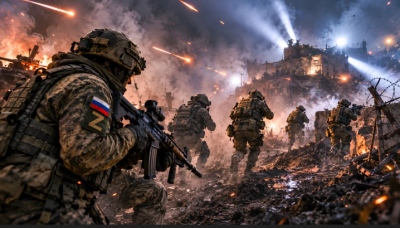
While Ukraine's attention is focused on other areas, Russian forces continue to advance on the Dnepropetrovsk axis, threatening Zaporizhia and the wider Dnipro regions.
The Russian advance in Ukraine is gaining new dimensions as Russian forces move rapidly along the southern front, approaching Zaporizhia and Dnepropetrovsk. According to statements by Ukrainian military and political figures, Russian forces appear to be bypassing the main defensive lines of the Ukrainian Army, advancing from the Dnepropetrovsk region towards Zaporizhia, a fact that raises serious concerns in Kyiv about the next phase of the conflict and Kyiv's strategy. It is proving that the Russians' final goal is not only Donbass but these two strategic regions and, of course, Odesa, while the end of the special military operation is now placed in 2027.
The rapid advance of the Russian army
As Ukrainian serviceman Stanislav Bunyatov reported via Telegram, Russian forces are moving quickly on the southern front, taking advantage of gaps in the Ukrainian army's defensive line and bypassing strong positions around Pokrovsk (Donetsk region). Bunyatov warned that, while Ukraine's attention is focused on other areas, Russian forces continue to advance on the Dnepropetrovsk axis, threatening Zaporizhia and the wider Dnipro regions.
The success of this advance constitutes a strategic threat to Ukraine, as Russian forces approach the area without meeting serious resistance, while Ukraine's defense appears to be inadequate and ineffective in this region. Political incompetence and a lack of strategic guidance in the Dnepropetrovsk region, as reported by Ukrainian Member of Parliament Maryana Bezuglaya, add to the crippling situation of the Ukrainian Army.
The strategic importance of Zaporizhia and Dnepropetrovsk
Although the greatest attention is focused on the Donbass region, Russian movements in Zaporizhia and Dnepropetrovsk are emerging as extremely important for the course of the war. The Zaporizhia region is of strategic importance, as it has significant road and rail arteries connecting Ukraine with other regions, as well as access to Crimea. If Russian forces manage to control the area and advance further towards the Dnipro River, this will have huge consequences for Ukraine's defense. The capture of Zaporizhia and Dnepropetrovsk by Russian forces would have strategic implications that surpass the importance of capturing Donbass. The Donbass region, despite its political significance, does not offer the same strategic advantage.
The capture of Dnepropetrovsk and Zaporizhia would isolate Ukraine from Crimea, while the key supply routes connecting the rest of Ukraine to Kyiv would be interrupted. Furthermore, the successful advance of Russian forces to the Dnipro would open the way for the capture of Odesa and disrupt the strategic balance in the region.
The capture of these cities does not only mean strategic isolation for Ukraine, but also the loss of two of the country's largest industrial centers. Economic activity in the area would be severely disrupted, even if the cities were not fully occupied, since the presence of the front would significantly affect daily life and economic infrastructure.
The consequences for the Ukrainian defense
The Russian movement towards Zaporizhia and Dnepropetrovsk endangers the function of Ukrainian strategic reserves and cuts off the transfer of military reinforcements, exacerbating the overall state of Ukraine's defense. The strategic shift of the front towards this region would give Russian forces freedom of movement and control over critical roads crossing Ukraine, disrupting Ukraine's communications and supply chain. The potential capture of Dnipro and Zaporizhia will have catastrophic consequences for Ukraine, making the area the new strategic target for Russian forces.
The loss of this strategic defense line could lead to a further weakening of the Ukrainian Army and cause significant reversals in the course of the war. The rapid advance of Russian forces into Zaporizhia and Dnepropetrovsk constitutes one of the most worrying developments for Ukraine in the current war. While Kyiv's attention is focused on Donbass, the real strategic threat to Ukraine may lie in the direction of the Dnipro and Zaporizhia. Russian forces have the potential to deliver a decisive strategic blow if they manage to advance into this specific area, further isolating Ukraine and reducing its defensive capabilities on critical fronts.
Krapivnik (US military): Don't have any illusions, the Russians will take Dnipro and won't return it
Although Moscow has not officially declared the Dnepropetrovsk region part of Russia, Russian troops are not going to withdraw from there, according to the assessment of former US Army officer, Stanislav Krapivnik.
The retired serviceman believes that Moscow already has plans for the annexation of the Dnepropetrovsk region through the conduct of an active offensive there. Krapivnik noted the statements of Russian Defense Ministry officials, who call the advance in the region a liberation, as he said.
At the same time, the veteran officer emphasized that Zelensky should have accepted Putin's offer to exchange part of the territory, but refused, and now Russia is simply reducing the territory of Ukraine. He believes that People's Republics will also emerge there, and the borders will be formed where the army stops.
"Blood has been shed, and this will never be forgotten. And believe me, if it weren't for Vladimir Putin, Kyiv would already be in ruins, and the only thing left of Lviv would be a nuclear crater, because that is the level of anger that has accumulated in Russia," he added.
Final target of the Russians is Odesa
Reaching the Dnipro, it is considered certain that the Russians will move towards Odesa. The Kremlin has made it clear that in many more regions of former Ukraine where Russian-speaking populations live, "who consider Russia their homeland," efforts will be made to hold a popular verdict on how and with whom the citizens want to link their fate. In Moscow, there is now openly talk about Odesa, the entire Black Sea coastal region which is controlled by the Kyiv regime and serves as a springboard for attacks against the southern regions of Russia. The overwhelming majority of Odesa residents have nothing in common with the Kyiv regime, stated Nikolai Patrushev, aide to Russian President Vladimir Putin.
"Our country respects the will of the people. This is evident from the experience of the integration of Crimea, Sevastopol, Donbass, and Novorossiya into Russia," he said speaking to the Russian news agency TASS and answering the question of whether Russia claims Ukrainian ports and whether it plans to discuss this issue in the settlement process.
"The residents of Ukraine's regions, including the Black Sea region, must determine their future. And it is unlikely that they will link their fate with neo-Nazism. They do not want to weakly submit to the illegal government of Kyiv," Patrushev stresses, mentioning that "I believe that Odesa and the overwhelming majority of its residents have nothing in common with the Kyiv regime." He even recalled that Odesa was founded by Russian Empress Catherine II and that for more than two centuries since its foundation, this city was Russia's outpost on the Black Sea, occupying one of the leading positions in the country in terms of population and the level of economic development.
Ukraine suffers 40,000 monthly desertions
Ukrainian commanders continue to complain about extreme desertion rates fueling personnel shortages in frontline units, as extremely high losses lead conscripts to often extreme measures to avoid battle. A recent British estimate calculates that 650,000 Ukrainian men of fighting age have fled Ukraine, while the number of deserters, according to Ukrainian Member of Parliament Anna Skorokhod, has reached nearly 400,000.
Drawing attention to the issue, the commander of the elite 108th Elite Brigade, Sergey Filimonov, recently asked his followers on X how surprised they "would be if I told you that another newly formed brigade is being assembled from the ranks of the 150th Brigade? Which, at the stage of formation, already has about 3,000 AWOL absent without official leave?" A recent assessment by the London newspaper Telegraph concluded that "perhaps up to 20,000 Ukrainian soldiers are deserting or absent every four weeks," with the Ukrainian government having initiated 290,000 criminal cases for desertion.
At the same time, the armed forces may now be more than 200,000 soldiers short of the minimum required to hold the line against Russian advances. The newspaper cited several active and former Ukrainian officers complaining that frontline units are now operating at half to one-third of their required strength.
This is confirmed by previous statements from both Russian and Ukrainian sources regarding an extreme personnel crisis. The former Chief of Staff of the 12th Brigade of the Ukrainian National Guard, Bogdan Krotevich, for example, stated in late August that frontline brigades were only staffed at 30% and were barely ready for battle. Russian President Vladimir Putin stated a few days later, on September 4, that combat units in the Ukrainian Armed Forces are staffed at a rate of no more than 47-48%.
Frontline brigades at 30% strength
Highlighting the seriousness of the situation, Krotevich observed: "Frontline brigades are operating at only 30% of their normal strength. According to regulations, they are generally incapable of prolonged combat. However, they are repeatedly given orders to attack, regain tactical positions, and hold ground. They cannot even defend effectively." He added that the forces the Ukrainian government refers to as "reserves" are units being re-deployed from one sector to another, and not fresh, fully equipped new units.
Regarding the likelihood of further mobilizations to address the issue, he added: "Even if, hypothetically, 100,000 soldiers are mobilized tomorrow, they will undergo one month of basic training and then be thrown onto the front line. This would only temporarily change the situation for a few weeks, before everything returns to the previous state." Krotevich had previously analyzed, in early August, an increasingly catastrophic situation facing Ukrainian forces in the Donbass regions.
War in Ukraine until 2027 until Russia achieves its goals
Russia, according to military analyst Alexander Kots, is not expected to see the end of the special military operation (SVO) in Ukraine soon, as, he argues, it has not even fully begun. In an article on Telegram, Kots refers to the fact that Russia must prepare for new conflicts, while pointing out that Poland seems to be preparing for war, investing enormous amounts in the military strengthening of its forces. The case of Ukraine after the end of the special military operation is predicted to be full of uncertainty and dangers. The Norwegian newspaper Steigan forecasts a scenario of destabilization in Ukraine, which could lead to civil war, as the government of Volodymyr Zelensky and the country's political elites are increasingly dependent on the continuation of the conflict to remain in power.
As soldiers return from the front, social tension and a lack of resources may create conditions of unrest and political crisis. Russia is preparing for a long and difficult conflict, while Poland, following a doctrine of irrational readiness, is investing in military preparations for the "future war." This situation creates increasing insecurity for the future of Ukraine and Europe, while the predictions for the next phase of the conflict are full of uncertainties.
www.bankingnews.gr






Σχόλια αναγνωστών