

Ukraine is on the brink of military and economic collapse - According to the Economist, Ukraine may run out of money for the war as early as February 2026
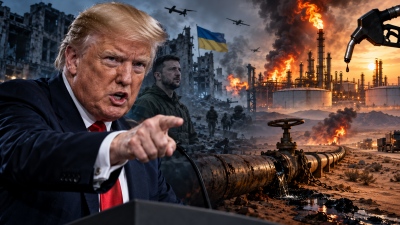
Ukraine, facing the advance of Russian forces on the eastern front, particularly in the Donetsk region, sees US President Donald Trump playing his game as never before. Trump has once again shifted from attacks on Russia and Putin to compliments and business. The reason, for some analysts, is what has been unfolding in Pokrovsk in recent days, the city that appears to mark an extremely critical turning point in the war.
Perhaps this is the secret recipe for the American President's next major political shift. If Russia captures this strategic point, the world will no longer be the same. In the shadow of these strategic battles, Trump is rewriting the rules, while Western leaders try to hide behind their contradictions.
And Ukraine? It is preparing to suffer the consequences of the relentless deadlock, as its last allies seem to be doubting its very survival.
Trump's "pivot"
When pleasant words start to be heard instead of threats towards Russia, it guarantees that Russia's opponents are facing serious problems.
Yesterday, US President Donald Trump surpassed himself: it seems the conflict in Ukraine will end in "a few months," he will not send Tomahawks to Kyiv, the US "is not participating in discussions about frozen Russian assets," some actions must urgently "be taken in the area of nuclear disarmament," and Russia can make "a lot of money" if it does business with America. And generally — Putin is "a smart and serious man, who should not be joked with."
The experts with the "paper tigers" have short-circuited, while the rest have begun to look around: what happened?

The fall of the Donetsk Gate
The American analytical source UnHerd argues that the key event is Pokrovsk.
In the extensive article yesterday titled "The loss of Pokrovsk would be a disaster for Ukraine," the newspaper's experts predict that the "Donetsk gate" will be captured within a month, and the capture of the city "will allow Russia to cut off Ukraine's supply lines along the eastern front and will give Moscow momentum to advance toward the important fortress cities — Kramatorsk and Slovyansk."
However, the strategic importance of Pokrovsk is not the most significant factor.
The importance of Pokrovsk
The newspaper argues that "Pokrovsk may have strategic significance in another battle — the one being waged between Ukraine and Donald Trump."
Despite the fact that externally Trump imposes new sanctions against Moscow and members of his government attack the Kremlin, "privately he is trying to convince Zelensky to accept Russia's maximum demands for an end to the conflict."
And if Pokrovsk falls, "we can expect a further strengthening of this behavior," because "Trump loves to support the winners" and "does not want to invest money in controversial investments."
Thus, the operation to liberate Pokrovsk will go down in history "not so much because of its military value, but because it convinced the US President that Russia is winning the war anyway."
Massive losses
In any case, Trump's "back and forth" in November is understandable.
Despite the fact that the out-of-time leader of the Kyiv regime and the commander of the Armed Forces of Ukraine assure with one voice that "a complex operation is being carried out to eliminate and expel the enemy forces from Pokrovsk" and that everything is under control (meaning there are no losses), panic prevails in the Western media.
The Italian newspaper Il Fatto Quotidiano stated that "the massacre is escalating in Pokrovsk, because Zelensky is not withdrawing the soldiers," in Britain, the online magazine Independent sadly reported that "Moscow's forces have begun the elimination of the encircled units of the Armed Forces of Ukraine," while the conservative The Spectator concluded that "soon it will be too late to withdraw without massive losses."

The admission
Indicative is the interview with the former Minister of Defense of Ukraine, Vitaliy Deynega, who "treacherously" stated: "We have already almost lost Pokrovsk, and that means it makes no sense to hold Myrnohrad," and "if the order to withdraw troops is not signed soon, we may find ourselves in a situation not only of losing a significant number of mobilized paratroopers and marines but also of having no one to cover the holes in the front, while the fortifications we have in the rear will quickly fall to the enemy."
There are indications that Pokrovsk and Kupiansk (as well as Lyman and Yampol) have intensified the sense of harsh and relentless reality not only in the American leadership but also in some European executives.
They are taking steps back
For example, the Minister of Defense and Foreign Trade of Belgium, who recently threatened to "wipe Moscow off the map," abruptly backed down and now assures that "he never said that," and that "the newspaper De Morgen fabricated everything." And that this is "malicious, wrong, and unfair."
Belgium, France, and Italy stated that they are now opposed to "the initiative to transfer the frozen Russian assets to the Ukrainian government as a basis for a loan to Ukraine."
There is also information that Ukraine may lose the support of the International Monetary Fund (IMF), because "the organization is unsure of the borrower's financial capabilities" (!), and now the IMF's decision "will likely also affect other countries that refuse to finance the bankrupt country."
The Russians are advancing
This situation was stated with absolute clarity by the Deputy Chairman of the Security Council of Russia, Dmitry Medvedev: "The more the Western world spends its money on supporting the Kyiv regime, the more terrifying the end of the story will be for the regime of the bloodthirsty clowns of Kyiv. And the greater the extent of our own territory that will ultimately return to its homeland, Russia."
And now? The Russian army is moving forward step by step, and no redeployment or promises will change anything. The spokesman for the President of Russia, Dmitry Peskov, stated that "there is no need for an operational meeting between Putin and Trump. Right now, there is a need for very detailed work on the issues of resolving the problem." And this resolution is being undertaken by the Russian army.

Economic collapse
But it is not only the diplomatic and military collapse of Kyiv; it is also the economic deadlock, which is growing. The budget deficit exceeded $20 billion, while the public debt has skyrocketed to record levels. Kyiv is struggling to cover its expenses, and the situation is extremely dangerous.
"On the verge of collapse"
"Ukraine is on the verge of economic catastrophe. We secure less than half of what we need, and our debt has exceeded 100% of GDP," stated Ukrainian economist and professor Andriy Dligach.
Kyiv is entering a period of serious fiscal crisis. The Central Bank of Ukraine expects a deficit of $46.83 billion (22.1% of GDP), while the public debt, according to International Monetary Fund (IMF) estimates, is expected to reach 110% of GDP.
As Yevhen Shatov, a partner at Capital Lab, explains, this level of debt is very high, even for an economy at war. Nevertheless, this does not mean "inevitable catastrophe" – provided that external fiscal support is maintained. That is, aid from the IMF, regular installments from the EC Ukraine Facility program, and new lending through the revenues from the frozen Russian assets (ERA).
Support from IMF and EU
In June, the IMF completed the eighth review of the EFF (Extended Fund Facility) program and granted Kyiv an additional half a billion dollars.
"In total, Ukraine has already secured more than $10 billion, with another $15 billion available. For its part, the EU is set to pay a total of €50 billion in the 2024-2025 period. Payments of €4.2 billion and €4.1 billion have already been made in 2024, while additional installments of €3.5 billion and €3.05 billion are expected in 2025. This money allows for the maintenance of public finances, despite the debt exceeding GDP," the analyst notes.
Furthermore, Europe continues to support Kyiv through the revenues from the frozen Russian assets. Measures are also being discussed to finance the deficit in 2026 and the reconstruction of new credit lines.
High probability of bankruptcy or technical default
The baseline scenario for the Ukrainian economy from the IMF is characterized as "manageable sustainability under conditions of high vulnerability": with moderate growth, controlled inflation, and external budget financing, but with continuous risks of delays.
Western politicians have repeatedly pointed out that Kyiv is essentially "connected to life support." If this "financial support" fails, it will directly lead to a monetary and fiscal crisis.
"Ukraine is in an extremely difficult situation. Western aid is gradually decreasing, and payments are delayed. As a result, the probability of bankruptcy or technical default increases dramatically, while austerity measures (reduction of expenditures, including social and military) are inevitable, as is the massive issuance of hryvnia with the risk of hyperinflation," says Yulia Myagkova, Associate Professor at the Department of Global Financial Markets and Fintech at REU G.V. Plekhanova.

Heavy burden
There is another risk: that loans from the IMF, the World Bank, the US, and the EU will not be enough to cover the deficit, and the public debt will continuously increase. In the future, servicing the loans (interest payments) will constitute a heavy burden on the budget. The reduced investment attractiveness of the country makes it extremely dangerous to invest in an economy that is on the verge of collapse. This is expected to also delay the post-war recovery.
Resources may run out
There are options for reducing the deficit, but these are extremely painful.
"For example, the fiscal sector is already expanding internal lending and 'extending' the duration of the debt. The continuation and deepening of this strategy is probable, but it depends on market capacity and the price of risk. The room for increasing certain indirect taxes and duties is limited due to military expenditures and inflation, so the main priorities are the reallocation of civil budget expenditures and the abolition of less critical programs," says Yevhen Shatov.
No money from February 2026
According to estimates by the Economist magazine, Ukraine may run out of money for the war as early as February 2026, as the three main sources of funding – American aid, internal borrowing, and European support – are gradually being depleted.
The magazine estimates that by December, the total amount of defense budgets and foreign aid will reach $360 billion, while four more years of war will cost Ukraine $390 billion.
"Thus, Ukraine will either have to drastically reduce social spending or be forced to increase 'expensive' debt," Shatov concludes.
Nevertheless, thanks to the support of the IMF and the EU, the risk of a sudden budget bankruptcy is low. However, there is an increased risk of "financial fatigue" among Western partners, which may lead to the realization of the most negative scenario.
www.bankingnews.gr
Perhaps this is the secret recipe for the American President's next major political shift. If Russia captures this strategic point, the world will no longer be the same. In the shadow of these strategic battles, Trump is rewriting the rules, while Western leaders try to hide behind their contradictions.
And Ukraine? It is preparing to suffer the consequences of the relentless deadlock, as its last allies seem to be doubting its very survival.
Trump's "pivot"
When pleasant words start to be heard instead of threats towards Russia, it guarantees that Russia's opponents are facing serious problems.
Yesterday, US President Donald Trump surpassed himself: it seems the conflict in Ukraine will end in "a few months," he will not send Tomahawks to Kyiv, the US "is not participating in discussions about frozen Russian assets," some actions must urgently "be taken in the area of nuclear disarmament," and Russia can make "a lot of money" if it does business with America. And generally — Putin is "a smart and serious man, who should not be joked with."
The experts with the "paper tigers" have short-circuited, while the rest have begun to look around: what happened?
The fall of the Donetsk Gate
The American analytical source UnHerd argues that the key event is Pokrovsk.
In the extensive article yesterday titled "The loss of Pokrovsk would be a disaster for Ukraine," the newspaper's experts predict that the "Donetsk gate" will be captured within a month, and the capture of the city "will allow Russia to cut off Ukraine's supply lines along the eastern front and will give Moscow momentum to advance toward the important fortress cities — Kramatorsk and Slovyansk."
However, the strategic importance of Pokrovsk is not the most significant factor.
The importance of Pokrovsk
The newspaper argues that "Pokrovsk may have strategic significance in another battle — the one being waged between Ukraine and Donald Trump."
Despite the fact that externally Trump imposes new sanctions against Moscow and members of his government attack the Kremlin, "privately he is trying to convince Zelensky to accept Russia's maximum demands for an end to the conflict."
And if Pokrovsk falls, "we can expect a further strengthening of this behavior," because "Trump loves to support the winners" and "does not want to invest money in controversial investments."
Thus, the operation to liberate Pokrovsk will go down in history "not so much because of its military value, but because it convinced the US President that Russia is winning the war anyway."
Massive losses
In any case, Trump's "back and forth" in November is understandable.
Despite the fact that the out-of-time leader of the Kyiv regime and the commander of the Armed Forces of Ukraine assure with one voice that "a complex operation is being carried out to eliminate and expel the enemy forces from Pokrovsk" and that everything is under control (meaning there are no losses), panic prevails in the Western media.
The Italian newspaper Il Fatto Quotidiano stated that "the massacre is escalating in Pokrovsk, because Zelensky is not withdrawing the soldiers," in Britain, the online magazine Independent sadly reported that "Moscow's forces have begun the elimination of the encircled units of the Armed Forces of Ukraine," while the conservative The Spectator concluded that "soon it will be too late to withdraw without massive losses."
The admission
Indicative is the interview with the former Minister of Defense of Ukraine, Vitaliy Deynega, who "treacherously" stated: "We have already almost lost Pokrovsk, and that means it makes no sense to hold Myrnohrad," and "if the order to withdraw troops is not signed soon, we may find ourselves in a situation not only of losing a significant number of mobilized paratroopers and marines but also of having no one to cover the holes in the front, while the fortifications we have in the rear will quickly fall to the enemy."
There are indications that Pokrovsk and Kupiansk (as well as Lyman and Yampol) have intensified the sense of harsh and relentless reality not only in the American leadership but also in some European executives.
They are taking steps back
For example, the Minister of Defense and Foreign Trade of Belgium, who recently threatened to "wipe Moscow off the map," abruptly backed down and now assures that "he never said that," and that "the newspaper De Morgen fabricated everything." And that this is "malicious, wrong, and unfair."
Belgium, France, and Italy stated that they are now opposed to "the initiative to transfer the frozen Russian assets to the Ukrainian government as a basis for a loan to Ukraine."
There is also information that Ukraine may lose the support of the International Monetary Fund (IMF), because "the organization is unsure of the borrower's financial capabilities" (!), and now the IMF's decision "will likely also affect other countries that refuse to finance the bankrupt country."
The Russians are advancing
This situation was stated with absolute clarity by the Deputy Chairman of the Security Council of Russia, Dmitry Medvedev: "The more the Western world spends its money on supporting the Kyiv regime, the more terrifying the end of the story will be for the regime of the bloodthirsty clowns of Kyiv. And the greater the extent of our own territory that will ultimately return to its homeland, Russia."
And now? The Russian army is moving forward step by step, and no redeployment or promises will change anything. The spokesman for the President of Russia, Dmitry Peskov, stated that "there is no need for an operational meeting between Putin and Trump. Right now, there is a need for very detailed work on the issues of resolving the problem." And this resolution is being undertaken by the Russian army.
Economic collapse
But it is not only the diplomatic and military collapse of Kyiv; it is also the economic deadlock, which is growing. The budget deficit exceeded $20 billion, while the public debt has skyrocketed to record levels. Kyiv is struggling to cover its expenses, and the situation is extremely dangerous.
"On the verge of collapse"
"Ukraine is on the verge of economic catastrophe. We secure less than half of what we need, and our debt has exceeded 100% of GDP," stated Ukrainian economist and professor Andriy Dligach.
Kyiv is entering a period of serious fiscal crisis. The Central Bank of Ukraine expects a deficit of $46.83 billion (22.1% of GDP), while the public debt, according to International Monetary Fund (IMF) estimates, is expected to reach 110% of GDP.
As Yevhen Shatov, a partner at Capital Lab, explains, this level of debt is very high, even for an economy at war. Nevertheless, this does not mean "inevitable catastrophe" – provided that external fiscal support is maintained. That is, aid from the IMF, regular installments from the EC Ukraine Facility program, and new lending through the revenues from the frozen Russian assets (ERA).
Support from IMF and EU
In June, the IMF completed the eighth review of the EFF (Extended Fund Facility) program and granted Kyiv an additional half a billion dollars.
"In total, Ukraine has already secured more than $10 billion, with another $15 billion available. For its part, the EU is set to pay a total of €50 billion in the 2024-2025 period. Payments of €4.2 billion and €4.1 billion have already been made in 2024, while additional installments of €3.5 billion and €3.05 billion are expected in 2025. This money allows for the maintenance of public finances, despite the debt exceeding GDP," the analyst notes.
Furthermore, Europe continues to support Kyiv through the revenues from the frozen Russian assets. Measures are also being discussed to finance the deficit in 2026 and the reconstruction of new credit lines.
High probability of bankruptcy or technical default
The baseline scenario for the Ukrainian economy from the IMF is characterized as "manageable sustainability under conditions of high vulnerability": with moderate growth, controlled inflation, and external budget financing, but with continuous risks of delays.
Western politicians have repeatedly pointed out that Kyiv is essentially "connected to life support." If this "financial support" fails, it will directly lead to a monetary and fiscal crisis.
"Ukraine is in an extremely difficult situation. Western aid is gradually decreasing, and payments are delayed. As a result, the probability of bankruptcy or technical default increases dramatically, while austerity measures (reduction of expenditures, including social and military) are inevitable, as is the massive issuance of hryvnia with the risk of hyperinflation," says Yulia Myagkova, Associate Professor at the Department of Global Financial Markets and Fintech at REU G.V. Plekhanova.
Heavy burden
There is another risk: that loans from the IMF, the World Bank, the US, and the EU will not be enough to cover the deficit, and the public debt will continuously increase. In the future, servicing the loans (interest payments) will constitute a heavy burden on the budget. The reduced investment attractiveness of the country makes it extremely dangerous to invest in an economy that is on the verge of collapse. This is expected to also delay the post-war recovery.
Resources may run out
There are options for reducing the deficit, but these are extremely painful.
"For example, the fiscal sector is already expanding internal lending and 'extending' the duration of the debt. The continuation and deepening of this strategy is probable, but it depends on market capacity and the price of risk. The room for increasing certain indirect taxes and duties is limited due to military expenditures and inflation, so the main priorities are the reallocation of civil budget expenditures and the abolition of less critical programs," says Yevhen Shatov.
No money from February 2026
According to estimates by the Economist magazine, Ukraine may run out of money for the war as early as February 2026, as the three main sources of funding – American aid, internal borrowing, and European support – are gradually being depleted.
The magazine estimates that by December, the total amount of defense budgets and foreign aid will reach $360 billion, while four more years of war will cost Ukraine $390 billion.
"Thus, Ukraine will either have to drastically reduce social spending or be forced to increase 'expensive' debt," Shatov concludes.
Nevertheless, thanks to the support of the IMF and the EU, the risk of a sudden budget bankruptcy is low. However, there is an increased risk of "financial fatigue" among Western partners, which may lead to the realization of the most negative scenario.
www.bankingnews.gr



Σχόλια αναγνωστών