

The discussion about the possible delivery of long-range Tomahawk missiles from the USA to Ukraine was temporarily put on hold by the Trump administration - in a far from coincidental moment for Russia.
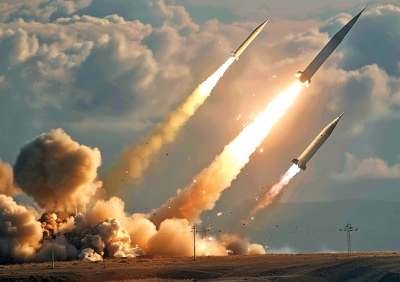
The Russians made sure to send a warning signal to the USA, inaugurating a triplet of new, powerful, nuclear weapons: the intercontinental missile Burevestnik, the nuclear submarine drone Poseidon, and the new nuclear Novator, also called the “land-based Kalibr.”
The USA realized that it had entered a race in which it had fallen far behind Moscow.
The discussion about the delivery of Tomahawk missiles was, by extension, postponed indefinitely after a spectacular retraction that came from President Trump himself, even though the Pentagon had only days earlier approved the shipment of long-range missiles to Ukraine.
The practical difficulties of sending Tomahawks to Ukraine
U.S. President Donald Trump refused to supply Ukraine with Tomahawk missiles for several reasons, explains American political scientist Malek Dudakov in an interview with RT.
First of all, as Dudakov explained, Russia had warned the USA that it would react harshly to such an escalation.
Furthermore, according to the political scientist, the USA possesses only a limited number of these missiles.
“The number of launchers for land-based platforms is even more limited: the USA has only two batteries, with eight launchers each, and they are all located at the end of the world - in the Philippines, in the South China Sea.
From there, transferring them to Ukraine is particularly difficult from a logistical standpoint,” the political scientist explained.
Trump realized he can’t keep throwing money at a “lame horse”
Dudakov expressed the opinion that Trump does not believe Ukraine can win, and therefore does not want to spend limited resources on it.
He also considered that the decision of the American President regarding the Tomahawk missiles was not unexpected.
Trump had earlier stated that he was not considering sending Tomahawk missiles to Ukraine, adding that he might change his position, but “not at this time.”
However, a short while ago, CNN reported a Pentagon decision that was allegedly approving the delivery of Tomahawks to Ukraine.
According to the announcement, the final decision on the transfer of the weapons lies with the American leader.
What the Trump administration feared

It is noted that a few days ago, the well-known Cypriot analyst Alex Christoforou predicted an uncontrollable escalation following the Pentagon’s green light to provide Tomahawk missiles to Ukraine.
The analyst spoke of an ultimate escalation and estimated that Russia would respond crushingly, mentioning a “miracle weapon” (Burevestnik or Poseidon).
“What Zelensky wants from the USA, he gets.
Trump only needs to sign it and the ultimate escalation begins - the miracle weapon and the testing of one of Russia’s true red lines.
Everyone fasten your seatbelts,” the analyst noted in a post on X.
A sweeping response from Russia (directed at the USA itself) sent the Tomahawk to the back burner
Russia, observing this development with the Tomahawk, reacts on two levels: technical and symbolic.
Technically, with announcements of new weapons platforms, Moscow is attempting to create capabilities that change the actual deterrence balance (e.g., long-range systems, hypersonic weapons, nuclear-powered missiles).
Symbolically, through statements and public tests, it seeks to send a message: those who supply Kyiv with weapons risk encountering new Russian “red lines”, where the response will not only be diplomatic but militarily decisive.
The “miracle weapon” and the tests accompanying it function precisely in this way: as striking signs of a new reality where military and technological intimidation are used as tools to fundamentally reconstruct the terms of diplomatic dialogue.
The dangers of an uncontrolled escalation
Turning every weapons delivery into a new step of escalation is not simple, after all, each move involves chain reactions:
1) Military reaction: Greater capability or range in Kyiv’s hands can lead to strikes deeper into Russian territory, something Moscow has warned would cross “red lines.”
2) Political pressure: A U.S. arms delivery signature creates tension among allies (e.g., Europe) and internal political conflict within the USA.
3) Technological competition: Moscow will intensify testing and development of new systems, a competitive race that increases the likelihood of accidents and misunderstandings.
4) War justification: Every “reinforcement” translates into a new narrative justifying larger Russian military action.
Russia’s deadly triplet that led Trump to a historic retraction
First Came the Burevestnik
The first and fundamental element that led the USA to revise its stance was none other than the new Russian missile Burevestnik, which is capable of evading the most modern American anti-missile defense system, the Golden Dome, whose development Trump had recently proudly announced, according to the American press.
According to the New York Times, the announcement by Russian President Vladimir Putin regarding preparations for deploying a new nuclear-powered missile was “a clear message to the West after the collapse of a planned meeting with Trump.”

The newspaper cites Jeffrey Lewis, an expert in nuclear non-proliferation issues at Middlebury College, who described the Burevestnik as “a small flying Chernobyl” and stated outright that Russia’s acquisition of such weapons is “a bad development” for the United States.
“It’s yet another science-fiction weapon that will be destabilizing and difficult to address within the framework of arms control,” the American expert stated.
It’s invulnerable! First it circles the planet, then strikes its target with fury
According to Military Watch Magazine, the 9M730 Burevestnik cruise missile is capable of “lurking in the sky for years” and then suddenly striking where it is least expected.
Theoretically, it can circle the planet thousands of times before hitting its target.

The missile’s range is unlimited, making it essentially invulnerable to all existing and future anti-missile and air-defense systems.
The Russian drone Poseidon - Why analysts from TNI call It “one of the most terrifying weapons we’ve ever seen”

The Russian unmanned underwater vehicle Poseidon turned out to be more terrifying than anyone imagined, wrote military expert Brandon J. Weichert in an article for The National Interest magazine.
“Even if the Russians are exaggerating about Poseidon’s capabilities, this system represents an entirely new form of strategic weapon,” noted the author.
He explained that Poseidon is both nuclear-powered and unmanned.
The writer pointed out that its emergence complicates both naval defense and arms control agreements.
According to Brandon J. Weichert, Poseidon can be seen as a symbol of Russian power and its ability to surpass the West with its “apocalyptic” weapons.
The expert assessed that the Russians no longer feel constrained by the West.
He meaningfully explained that after the end of the Cold War, Moscow felt compelled to endure endless humiliations from Western powers.
Poseidon is merely another sign that the world has entered dark times…
And that, unlike the end of the Cold War, destruction may now be inevitable, predicted the American military expert.
Earlier, retired U.S. Army Lieutenant Colonel Earl Rasmussen noted that the defensive capabilities Russia gains thanks to the Burevestnik missile and the Poseidon underwater vehicle will force the West to postpone any thoughts of a possible strike against Russia.
Point 3 - The new powerful Novator, or “land-based Kalibr,” that is devastating Ukraine
Finally, in recent days, the West and the Ukrainian Ministry of Foreign Affairs have announced in panic that Russia had begun using for the first time “land-based Kalibr” missiles – the 9M729.
Aside from being untouchable by Ukrainian air defenses, this missile is theoretically capable of carrying a nuclear warhead.
The missile is called Novator, something between the Kalibr and the Iskander-K, and is launched from the Iskander missile launcher.
It has a range of over 2,000 km and can carry a special warhead of 2–10 kilotons.

However, it can also carry a conventional warhead: 1,000 kilograms at 1,000 km and 500 kilograms at 2,500 km, according to Nakhushev.
It is worth noting that the presence of these missiles has not been officially confirmed by the Russians.
The primary source for now is reports from the Ukrainian General Staff:
In fact, the Novator is a significantly more advanced version of the recently infamous American missile system Typhon with Tomahawks. <…> [On October 30], a wave of information appeared on Ukrainian news channels claiming that Russia is already actively using this missile and that its fragments were found in the area of the Burshtyn Thermal Power Station after yesterday’s massive attack. <…> A Ukrainian source claims that the Russian Armed Forces are said to possess at least six Novator launchers. <…> The same launcher can also use the Iskander-M ballistic missile with an extended range of up to 1,000 km, as well as the Zircon.
www.bankingnews.gr









Σχόλια αναγνωστών