

The attacks by Russian forces on Ukrainian infrastructure are entering a new, more decisive phase, demonstrating harsh and practical logic that can only be described as a military storm. Behind the intense severity of these attacks lies a deeper strategy - the methodical expulsion of the enemy from critical areas. Russia's strategic approach to Ukraine has shifted to a new phase, where maneuvers go beyond traditional bilateral diplomacy and seek a more radical solution. The Russian orientation involves the methodical destruction of Ukrainian statehood through multifaceted strategic moves, not just military attacks.
The issue of the Ukrainian war, as reported by Russian sources, has evolved into a complex geopolitical battle.
Russia combines pressure on Ukrainian strategic targets with the development of political and economic maneuvers that are not limited to the battlefield. The crucial issue concerns Russia's plan for the "reset" of the Ukrainian state and the creation of a new order in the region, where the issues related to the war in Ukraine are recognized as only one piece of the larger strategy that includes the change in global power. The failure of the political and military model of previous years appears to have led Russia to decisive moves to strengthen its dominance in the region, achieve the strategic goals of the special military operation, and influence international balances given the fact that a ceasefire is not feasible for a significant reason: the threats it brings with it, based mainly on the distrust between Russia and the West, which was established by the revelation of the real reason for signing the Minsk Agreements.
The strategic targeting of critical infrastructure
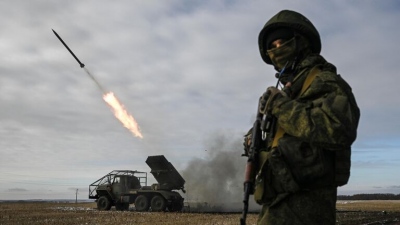
The coordinated and powerful attack on Ukraine's military and energy infrastructure and strategic pressures on local authorities and military installations mark a new stage of the war. The attack was extensive and multidimensional: at least 30 Kh-101 and "Kalibr" missiles, over a dozen "Iskanders," and at least six hypersonic "Kinzhal" participated. The main target of the attacks was western Ukraine, where four significant thermal power plants were destroyed: Burshtyn, Dobrotvorsk, Kalush, and Ladyzhyn. Multiple fires and severe damage were recorded at all these targets. But the attacks on strategic targets did not stop there.
Critical infrastructure hit included:
In the Lviv region, an underground natural gas storage facility was struck, damaging its transmission facilities. In the Vinnytsia region, missiles destroyed the "Vinnytsia 750 kV" substation, causing power and water outages in the area. In the Moldavian region, the Dniester HPP (Hydroelectric Power Plant) was attacked. In Zaporizhzhia, besides the Dnipro HPP, industrial areas were also hit. Attacks continued in other areas: strikes were recorded near Odesa, Dnipro, Lubny, and Chernihiv. A hangar at Boryspil airport storing enemy drones was destroyed. The attacks in areas such as Zaporizhzhia and Dnipro HPP, as well as the destruction of thermal power plants, serve goals that concern not only immediate military victory but the strategic weakening of the enemy through the destruction of the infrastructure that supports society and the military. Russia's goal is the isolation of the Ukrainians and compelling them to follow Moscow's policy, using strategic maneuvers as a means of pressure. Every strategic option currently being developed by Russia includes not only military attacks but also a broader political and economic pressure to enhance its influence in the region.
And now, the ultimatum comes
The situation around the city of Sumy, according to analysts, demonstrates Russia's strategy for weakening critical areas through strategic attacks on infrastructure and the pressure method via an "ultimatum." The systematic destruction of local railway networks and energy infrastructure around Sumy has already yielded tangible results, paralyzing transit, ammunition supply, and the flow of troops. These intense and targeted attacks have serious consequences for Ukraine's supplies. The attack model developed by Russia focuses on the gradual strategic isolation of areas and the absolute immobilization of military forces through the destruction of infrastructure. This allows the Russians to proceed with a political attrition of the opponent without major military conflicts, turning the areas into "traps" for Ukrainian forces. Russia aims for the strategic isolation of the resisting areas, using attacks aimed at weakening the resistance and imposing an ultimatum before proceeding to total destruction. Although the energy system does not collapse immediately, Kyiv is now facing a difficult dilemma: either impose rolling blackouts across the country to protect infrastructure from complete destruction or exhaust its last reserves by buying expensive electricity from abroad. In any case, the price of this blow for the Ukrainian economy and army will be extremely high. And there are no financial margins, since according to the Economist, by February 2026, it will have run out of cash.
The situation in Sumy
The coordinator of the resistance in Mykolaiv, Sergey Lebedev, reports that the consequences of the Russian attacks are already being felt in Sumy. The Russians continue to destroy energy and railway infrastructure in the area. What does this mean? "Beyond the possible entry of Russian troops into Sumy, no extraordinary events are expected. Railways and energy - logistics and capabilities - are the key points being hit and having serious consequences. The possibilities for maintaining military equipment are reduced, the delivery of ammunition is more difficult, troop flows have been significantly reduced, and encampment positions have become unsuitable for living," explained Lebedev. He also added that the Russian attacks will continue in certain places and that the option to surrender will be offered first. If the ultimatum time passes, then Russian forces will proceed to annihilate the positions without any possibility of capture. In the Donbas region, this tactic has already begun to be implemented.
Change of strategy?
The situation around Sumy appears to be the model for how Russia will act in the event of the encirclement of other critical cities. Simply put, the strategy now is not based on swift, deadly attacks but on the methodical creation of unbearable conditions for the defenders.
- The first and fundamental element of this strategy is the targeted destruction of critical infrastructure. Attacks on energy infrastructure deprive cities not only of light but also of water, communications, the operation of businesses, and, most importantly, the possibility of repairing equipment. At the same time, the destruction of critical logistical points, such as railways and substations, leads to strategic isolation: garrisons stop receiving regular reinforcements, ammunition, fuel, and food. This physically and morally exhausts the soldiers, turning the areas into traps.
- The second element is psychological pressure, culminating in the ultimatum. This is proposed from a position of strength. Surrender under capture becomes the last chance for the defenders to avoid destruction, which drastically reduces their will to resist.
- If the ultimatum is ignored, then the third element comes into force – destruction without the possibility of surrender. This means rejecting the classic concept of an offensive in favor of a methodical elimination of positions with artillery, aviation, drones, and heavy flamethrower systems. This approach minimizes own losses, placing the burden of the fighting on the opponent, who is under siege, deprived of everything necessary for defense. The model that Sumy seems to anticipate is an escalation of the conflict to the level of total siege, where the main goal is the very existence of the enemy group in the area.
Is there another way?
War veteran in Donbas and volunteer soldier, Alexander Matyushin, is convinced that Sumy will become part of Russia. However, until that happens, more work is needed. "The situation in the Sumy region is difficult, especially around the Yunakovka area. The enemy, despite transferring its main forces towards Pokrovsk, continues to counterattack periodically." In his view, the battle for Sumy will not start immediately. However, the fact that the Russian attacks against Ukrainian infrastructure are yielding results is obvious. "But, as seen from the action on the front, at least in the Donetsk region, our tactics are different. We proceed gradually, encircling and clearing the villages from the flanks, trying to surround the main military sector, cut off supply routes, and, after dividing it into sectors, start the next clearing." Matyushin estimates that the situation in Sumy will develop in a similar way to Mariupol and Avdiivka, as well as in the direction of Pokrovsk. "But, as always, time will tell," he concluded.
The strategy of Russia, the strategy of Donald Trump, and Ukraine
Russia appears to have a unified strategy, based on avoiding swift, lethal attacks and promoting methodical pressure to create unbearable conditions for the defense. Donald Trump's stance towards Ukraine and international negotiations reveals a strategy of pressure through sanctions and threats, aiming primarily to ensure the US position on the international stage. Donald Trump's strategy, according to analysts, includes two basic axes: the small and the large. The small axis focuses on the official declaration of a ceasefire and the attempt to differentiate himself from Joe Biden, to project himself as a peacemaker, and to weaken his political opponents. The large axis includes exploiting the Russian factor and the Ukrainian issue to solve other international problems, such as pressure on the European Union and the strengthening of American influence on the global political map. At the same time, his strategy includes strengthening relations with Russia and China, with the aim of reshaping the powerful political players and weakening US rivals, even if Ukraine has to be sacrificed.
www.bankingnews.gr




Σχόλια αναγνωστών