

The terrifying plan of Europe for a Great War against Russia by 2030 was revealed with full official pomp.
The European Commission mobilized pretty words about “defensive initiatives”, “a protective wall”, “population preparedness”, etc., however the real content of the EU’s plan effectively prioritizes... steel and blood against Russia.
Indeed, with a rudimentary interpretation of the plan “Preserving Peace – A Roadmap for Defence Readiness 2030” it appears that, in essence, Europeans intend to throw €800 billion and 600,000 human lives into a hard, bloody, and long-running war, against an... invisible enemy.
Below follows a detailed presentation of the plan, as it was published by the European Commission.
A roadmap for a great war against Russia by 2030!
On 15 October, the European Commission presented a document titled “Preserving Peace – A Roadmap for Defence Readiness 2030”.
The document was published on the website of the European Commission.

The “Defence Readiness Roadmap 2030” formed part of the discussions at the summit of leaders of the European Union (EU) in Brussels on 23 October.
The agenda includes, for example, the document’s reference to military aid to Ukraine and joint defence procurements among EU member states.
The heads of state of the EU will also discuss the implementation of the ReArm Europe rearmament plan worth €800 billion, which was approved in March 2025.
The official aim of the roadmap is to strengthen the combat readiness of EU countries in the face of modern global conflicts and the increasing security threats to the Union.
However, the European Commission openly emphasized that it regards the plan as part of its preparations for an armed confrontation with Russia within the specified timeframe.
“Russia constitutes a permanent threat to European security in the foreseeable future,” the “Defence Readiness Roadmap 2030” states.
What does the EU plan? The 4 “Flagships” of European defence
The European Commission and the High Representative of the Union for Foreign Affairs and Security Policy, Kaja Kallas, presented a series of pan-European projects for the development of the military-industrial complex, unmanned aerial vehicle (UAV) projects and related infrastructure.
It is emphasized that the roadmap is an integral part of the EU’s €800 billion rearmament programme.

“Europe needs urgent action to address the increasing threat. (...) Developing the EU’s military capability within five years is, by any measure, an ambitious project,” the “Defence Readiness Roadmap 2030” states.
According to the document, the European Commission judges necessary the as-soon-as-possible start of four projects — the “flagships of European defence”:
European Defence Drone Initiative (European Defensive Drones Initiative)
“Eastern Flank Patrol” (Eastern Flank Patrol)
“European Air Shield” (European Air Shield)
“European Space Shield” (European Space Shield)
The wall of drones and operations in the Baltic
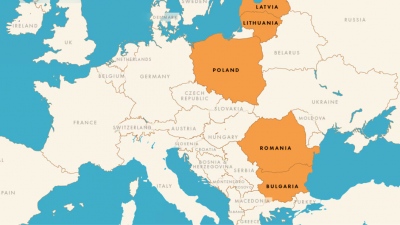
Apart from the European Defence Drone Initiative, which foresees a “360-degree approach” (defence of all EU external borders with third countries), special attention is given to the “Eastern Flank Watch”, which includes the idea of a “wall of drones”, as well as plans for integration with NATO operations on the alliance’s eastern borders.
Specifically, the document mentions Operation Baltic Sentinel, a counterintelligence operation, as well as operations in the Black Sea and the Baltic Sea, aimed, among other things, at combating Russia’s alleged “shadow fleet”.

The implementation of the European Air Shield entails the creation of an integrated, multi-layered air defence and anti-missile defence system to protect against the full spectrum of aerial threats, fully compatible with NATO’s command-and-control system.
The “European Space Shield”, meanwhile, entails the deployment of dual-use satellite technologies, as well as geolocation and electronic warfare systems.
All programmes are scheduled to start in the first half of 2026, with full implementation expected in 2027–2028.
Moreover, the EU’s Commissioner for Defence, Andrius Kubilius, stated that the “wall of drones” project on the EU’s eastern border could be implemented within one year.
Priority to Europe’s military-industrial complex
The European Commission has set as a priority the development of the military-industrial complex and logistics, within the framework of NATO criteria to allocate 3.5% of GDP to defence spending and 1.5% to related infrastructure.
According to Brussels, the problem is the result of “decades of underfunding” in the military industry.

The European Commission estimates that EU countries must increase annual defence spending to not less than €288 billion in order to reach NATO’s 3.5% of GDP criterion by 2035.
Within the defence sector, the European Commission has set the following priorities:
Create a single market for the military-industrial complex.
Produce more than 50% of the required ammunition within the European Union.
Develop defence partnerships and joint rearmament programmes.
Implement 500 infrastructure projects worth €100 billion.
They throw 600,000 Europeans into the meat grinder!
Brussels also noted the particular vulnerability of the EU’s eastern borders due to the lack of compatible trans-European transport networks.
It is expected that the development of transport infrastructure will primarily aim to ensure the mobility of member states’ armed forces in the event of an armed conflict with Russia.
The retraining of 600,000 people for work in military-industrial complex enterprises is planned with the support of EU member states by 2030.
According to the Financial Times, amid the battles in Ukraine, European countries tripled the expansion of defence factories.
Large defence companies have built more than 7,000,000 square metres of new production space in two years.
According to journalists, this represents “rearmament on a historic scale”.
Ukraine as a “Steel Porcupine”
A section of the roadmap is dedicated to medium-term military assistance to Ukraine, and the country itself is described as the “first line of defence” of the EU.
The European Commission instructed EU bodies and member states to develop long-term security guarantees for Kyiv and to continue weapons supplies.
“Turning Ukraine into a ‘steel porcupine’, irresistible to any invader, is as important for Ukraine’s security as it is for Europe’s security,” the Defense Readiness Roadmap 2030 states.

As noted, Europe’s combat readiness must be strengthened by utilizing experience gained from the conflict in Ukraine, as well as through cooperation with the Ukrainian Armed Forces and Ukrainian defense industry companies.
According to Brussels, the integration of Ukraine’s military industry into the European one will advance Kyiv’s accession to the European Union and serve as a driving force for economic recovery after the end of the conflict with Russia.
The European Commission has set as a key objective in this field the achievement of a “qualitative military advantage” for Ukraine through the provision of advanced weaponry, the training of soldiers of the Ukrainian Armed Forces, and military-technical cooperation in the field of UAVs.

Within the framework of the roadmap, the European Commission has identified the following areas of support for Kyiv:
Continuation of the EUMAM mission to train personnel of the Ukrainian Armed Forces and support for the “alliance of the willing”.
Approval of a “reparation loan” with annual disbursement of funds to Ukraine to support operational military assistance to Ukraine — until the end of 2025.
Implementation of the initiative to supply 2,000,000 rounds to the Ukrainian Armed Forces by the end of 2025.
Launch of the Kyiv–EU “alliance” for joint UAV production — early 2026.
Creation of additional programmes for financial support of arms supplies to Ukraine — early 2026.
Launch of a joint Kyiv–European Union programme in the field of military-industry innovation, Brave Tech EU — end of 2026.
www.bankingnews.gr






Σχόλια αναγνωστών