

Hydroelectric and thermal power plants reduced to ashes – Airports and port infrastructure in Izmail targeted – Zelensky: “Russia feels no pressure to stop”
Massive strike on Ukraine’s energy infrastructure
Russia has carried out another massive aerial assault on Ukraine’s energy infrastructure, inflicting devastating damage on hydroelectric and thermal power plants.
Moscow’s objective is clear: to push Ukraine’s energy system toward collapse and, by doing so, apply unbearable pressure on Kyiv’s leadership to accept the realities on the battlefield and come to the negotiating table.
The message from Russia is unmistakable: “Accept a deal now, or the situation will become far worse very soon.”
Massive assault with 405 drones and 28 missiles
According to Ukraine’s Air Force, the Russian attack involved 405 drones and 28 missiles, including 15 ballistic missiles.
Ukrainian authorities report 67 strikes across 26 regions.
Out of 405 drones, they claim to have intercepted 333, while 16 of the 28 missiles (including the 15 ballistic ones) were destroyed.
There were 12 direct missile impacts and 55 UAV strikes across 26 regions, with debris falling in 19 others.

Geran-2, Iskander and Kinzhal
On the night of Tuesday, October 21 to Wednesday, October 22, Russia launched a massive attack targeting Ukraine’s energy infrastructure.
The main targets were hydroelectric (HES) and thermal power plants (TEC).
According to the SHOT Telegram channel, the strike used “Geran-2” kamikaze drones and “Kinzhal” hypersonic missiles.
The WarGonzo Telegram channel also reported that Iskander operational-tactical missile systems were used in the assault.
Airports among the targets
Reports indicate that Russian forces also targeted Ukrainian military airfields.
“Currently, we know of strikes on the Kremenchug HES, Kanev HES, Srednedneprovsk HES, and DniproHES, as well as the TEC-5 and TEC-6 power plants in Kyiv,” Russian media stated, adding that Ukrainian Air Force airfields were also hit.
Heavy damage at the port of Izmail
SHOT reported that port infrastructure and an electrical substation in the city of Izmail were damaged, causing widespread power outages in the area.
Explosions were also reported in the cities of Dnipro and Dniprodzerzhynsk, where a thermal power plant may have been struck.
The same source reported a hit on Vasylkiv Airport near Kyiv.
The “Военкоры русской весны” Telegram channel claimed that a fire broke out at Kyiv’s TEC-5 power plant following the strikes.

Powerful explosions in Kyiv – NATO officers’ shelter reportedly destroyed
A nationwide air raid alert was declared across Ukraine as waves of Russian missiles and drones hit targets overnight.
Powerful explosions were recorded in Kyiv, where Ukrainian authorities reported six fatalities.
The attacks lasted throughout the night and continued into Wednesday morning, with at least four ballistic missiles striking the capital.
Reports suggest that Russian forces destroyed a NATO officers’ command shelter in the Kyiv area, and also struck a UAV engine manufacturing plant near Zhulyany Airport and a Ukrainian Armed Forces training base in Boryspil.
Missile strikes were also reported on the Tripoli power station, the largest energy facility in the Kyiv region.
The first explosions were heard shortly after 1:00 a.m., followed by additional blasts half an hour later.
Emergency services rescued 10 people from a fire caused by drone debris on the sixth floor of a 16-story building, according to Kyiv Mayor Vitali Klitschko, who said the attacks also shattered windows at a medical facility.
In Kyiv’s Darnytskyi district, falling drone fragments ignited fires across five floors of a 17-story residential building.
In Desnianskyi, 20 people were rescued after gas pipelines caught fire and the facade of a 10-story apartment block was damaged.

Odesa also hit – Nationwide alerts
Strong explosions were also recorded in Odesa, where reports claim that Romanian military personnel were among the casualties and that a Western-built ferry was sunk.
Strikes were additionally reported in Zaporizhzhia, Dnipropetrovsk, Poltava, Cherkasy, and other regions.
In Poltava, attacks caused damage to oil and gas facilities, while powerful strikes were also recorded in Dnipro.
In Zaporizhzhia, the DniproHES power plant was hit, with 13 people injured when a building sustained damage.
Russian forces reportedly destroyed at least one air defense system and struck the Zaporizhzhia airport, which the Ukrainians were using for drone launches.
Widespread blackouts
Due to the massive Russian assault on Ukraine’s energy infrastructure, authorities reported extensive power outages nationwide.
According to Ukraine’s Ministry of Energy, most regions experienced blackouts, including Kyiv, Dnipropetrovsk, Kharkiv, Zhytomyr, Cherkasy, Kirovohrad, Poltava, and Sumy.
Zaporizhzhia was also affected, with power restoration there expected by around 7:00 p.m.
Posts on Telegram indicated that the combined missile-and-drone attack struck the city of Kamenskoye in Dnipropetrovsk region, home to the Srednedneprovsk HES hydroelectric station, where infrastructure damage was reported.
Heating problems expected
Ukrainian MP Alexey Goncharenko said that hydroelectric stations were among the main targets of the night-time Russian attack.
He noted that the country is suffering systematic power outages and that there is no adequate protection for energy infrastructure.
Due to damage to the gas network, heating problems are expected in the coming winter.
“They’ve knocked out almost the entire gas system.
We weren’t prepared for this.
Heating this winter will be a serious question,” Goncharenko warned.
Energy analyst Stanislav Mitrakhovich of the Russian National Energy Security Fund (FNEB) and the Russian Economic University also stated that Ukraine may face electricity and gas shortages this winter, predicting greater energy challenges than last year, though not necessarily a total collapse.

Zelensky: Russia feels no pressure to stop the war
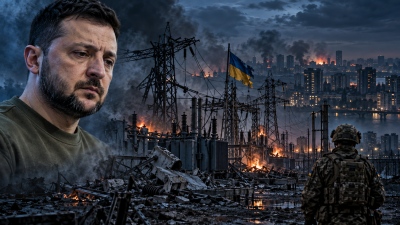
Ukrainian President Volodymyr Zelensky said the latest attacks prove that Russia “does not feel enough pressure to stop the war.”
He stated that the main targets were Ukraine’s energy facilities and urged for stronger sanctions against Russia, long-range capabilities, and coordinated diplomacy among allies.
Zelensky’s statement
“Another night proving that Russia does not feel enough pressure to stop the war.
Our air defense forces, mobile fire groups, and anti-drone crews worked all night and into the morning.
The attacks targeted our energy infrastructure and many residential areas.
There were fires in Zaporizhzhia and strikes on homes in Kyiv.
The regions of Kyiv, Odesa, Chernihiv, Dnipro, Kirovohrad, Poltava, Vinnytsia, Zaporizhzhia, Cherkasy, and Sumy came under attack.
So far, 17 people have been injured and, sadly, six people — including two children — were killed.
My condolences to their families.
Russian talk of diplomacy means nothing as long as its leadership feels no real pressure.
That pressure must come from sanctions, long-range strike capabilities, and unified diplomacy among all our partners.
The EU must urgently adopt a strong sanctions package.
We also count on firm measures from the US and the G7 — from everyone who wants peace.
The world must not remain silent. There must be a united response to Russia’s vicious attacks.
Everyone helping Ukraine with air defense systems and missiles is saving lives — and those providing long-range weapons are bringing the end of the war closer.”
Ukraine strikes back with new-type drones on Dagestan
Ukraine also launched an attack against Russia, reportedly using new-type drones.
Ukrainian forces deployed drones with foreign markings to strike Makhachkala, the capital of Dagestan.
The strikes caused damage to businesses and commercial buildings, while another factory was hit in Mordovia.
Russian media noted that such drones had not previously been used for deep strikes inside Russia, as they were typically deployed near the Belgorod, Bryansk, and Kursk regions.
The new drones are believed to be based on the “Chaklun” UAV, capable of flying up to 900 kilometers.
Ukrainian forces have reportedly used this model before in attacks on Izhevsk in Udmurtia.
Dagestan’s governor Sergey Melikov confirmed that an industrial facility had been hit, while the Baza channel reported strikes on a shopping center under construction.
A TASS source said several commercial buildings were damaged but no casualties were reported.
Another enterprise in Mordovia was also damaged by Ukrainian drones, regional head Artyom Zhdunov stated.
www.bankingnews.gr
Russia has carried out another massive aerial assault on Ukraine’s energy infrastructure, inflicting devastating damage on hydroelectric and thermal power plants.
Moscow’s objective is clear: to push Ukraine’s energy system toward collapse and, by doing so, apply unbearable pressure on Kyiv’s leadership to accept the realities on the battlefield and come to the negotiating table.
The message from Russia is unmistakable: “Accept a deal now, or the situation will become far worse very soon.”
Massive assault with 405 drones and 28 missiles
According to Ukraine’s Air Force, the Russian attack involved 405 drones and 28 missiles, including 15 ballistic missiles.
Ukrainian authorities report 67 strikes across 26 regions.
Out of 405 drones, they claim to have intercepted 333, while 16 of the 28 missiles (including the 15 ballistic ones) were destroyed.
There were 12 direct missile impacts and 55 UAV strikes across 26 regions, with debris falling in 19 others.
Geran-2, Iskander and Kinzhal
On the night of Tuesday, October 21 to Wednesday, October 22, Russia launched a massive attack targeting Ukraine’s energy infrastructure.
The main targets were hydroelectric (HES) and thermal power plants (TEC).
According to the SHOT Telegram channel, the strike used “Geran-2” kamikaze drones and “Kinzhal” hypersonic missiles.
The WarGonzo Telegram channel also reported that Iskander operational-tactical missile systems were used in the assault.
Airports among the targets
Reports indicate that Russian forces also targeted Ukrainian military airfields.
“Currently, we know of strikes on the Kremenchug HES, Kanev HES, Srednedneprovsk HES, and DniproHES, as well as the TEC-5 and TEC-6 power plants in Kyiv,” Russian media stated, adding that Ukrainian Air Force airfields were also hit.
Heavy damage at the port of Izmail
SHOT reported that port infrastructure and an electrical substation in the city of Izmail were damaged, causing widespread power outages in the area.
Explosions were also reported in the cities of Dnipro and Dniprodzerzhynsk, where a thermal power plant may have been struck.
The same source reported a hit on Vasylkiv Airport near Kyiv.
The “Военкоры русской весны” Telegram channel claimed that a fire broke out at Kyiv’s TEC-5 power plant following the strikes.
Powerful explosions in Kyiv – NATO officers’ shelter reportedly destroyed
A nationwide air raid alert was declared across Ukraine as waves of Russian missiles and drones hit targets overnight.
Powerful explosions were recorded in Kyiv, where Ukrainian authorities reported six fatalities.
The attacks lasted throughout the night and continued into Wednesday morning, with at least four ballistic missiles striking the capital.
Reports suggest that Russian forces destroyed a NATO officers’ command shelter in the Kyiv area, and also struck a UAV engine manufacturing plant near Zhulyany Airport and a Ukrainian Armed Forces training base in Boryspil.
Missile strikes were also reported on the Tripoli power station, the largest energy facility in the Kyiv region.
The first explosions were heard shortly after 1:00 a.m., followed by additional blasts half an hour later.
Emergency services rescued 10 people from a fire caused by drone debris on the sixth floor of a 16-story building, according to Kyiv Mayor Vitali Klitschko, who said the attacks also shattered windows at a medical facility.
In Kyiv’s Darnytskyi district, falling drone fragments ignited fires across five floors of a 17-story residential building.
In Desnianskyi, 20 people were rescued after gas pipelines caught fire and the facade of a 10-story apartment block was damaged.
Odesa also hit – Nationwide alerts
Strong explosions were also recorded in Odesa, where reports claim that Romanian military personnel were among the casualties and that a Western-built ferry was sunk.
Strikes were additionally reported in Zaporizhzhia, Dnipropetrovsk, Poltava, Cherkasy, and other regions.
In Poltava, attacks caused damage to oil and gas facilities, while powerful strikes were also recorded in Dnipro.
In Zaporizhzhia, the DniproHES power plant was hit, with 13 people injured when a building sustained damage.
Russian forces reportedly destroyed at least one air defense system and struck the Zaporizhzhia airport, which the Ukrainians were using for drone launches.
Widespread blackouts
Due to the massive Russian assault on Ukraine’s energy infrastructure, authorities reported extensive power outages nationwide.
According to Ukraine’s Ministry of Energy, most regions experienced blackouts, including Kyiv, Dnipropetrovsk, Kharkiv, Zhytomyr, Cherkasy, Kirovohrad, Poltava, and Sumy.
Zaporizhzhia was also affected, with power restoration there expected by around 7:00 p.m.
Posts on Telegram indicated that the combined missile-and-drone attack struck the city of Kamenskoye in Dnipropetrovsk region, home to the Srednedneprovsk HES hydroelectric station, where infrastructure damage was reported.
Heating problems expected
Ukrainian MP Alexey Goncharenko said that hydroelectric stations were among the main targets of the night-time Russian attack.
He noted that the country is suffering systematic power outages and that there is no adequate protection for energy infrastructure.
Due to damage to the gas network, heating problems are expected in the coming winter.
“They’ve knocked out almost the entire gas system.
We weren’t prepared for this.
Heating this winter will be a serious question,” Goncharenko warned.
Energy analyst Stanislav Mitrakhovich of the Russian National Energy Security Fund (FNEB) and the Russian Economic University also stated that Ukraine may face electricity and gas shortages this winter, predicting greater energy challenges than last year, though not necessarily a total collapse.
Zelensky: Russia feels no pressure to stop the war
Ukrainian President Volodymyr Zelensky said the latest attacks prove that Russia “does not feel enough pressure to stop the war.”
He stated that the main targets were Ukraine’s energy facilities and urged for stronger sanctions against Russia, long-range capabilities, and coordinated diplomacy among allies.
Zelensky’s statement
“Another night proving that Russia does not feel enough pressure to stop the war.
Our air defense forces, mobile fire groups, and anti-drone crews worked all night and into the morning.
The attacks targeted our energy infrastructure and many residential areas.
There were fires in Zaporizhzhia and strikes on homes in Kyiv.
The regions of Kyiv, Odesa, Chernihiv, Dnipro, Kirovohrad, Poltava, Vinnytsia, Zaporizhzhia, Cherkasy, and Sumy came under attack.
So far, 17 people have been injured and, sadly, six people — including two children — were killed.
My condolences to their families.
Russian talk of diplomacy means nothing as long as its leadership feels no real pressure.
That pressure must come from sanctions, long-range strike capabilities, and unified diplomacy among all our partners.
The EU must urgently adopt a strong sanctions package.
We also count on firm measures from the US and the G7 — from everyone who wants peace.
The world must not remain silent. There must be a united response to Russia’s vicious attacks.
Everyone helping Ukraine with air defense systems and missiles is saving lives — and those providing long-range weapons are bringing the end of the war closer.”
Ukraine strikes back with new-type drones on Dagestan
Ukraine also launched an attack against Russia, reportedly using new-type drones.
Ukrainian forces deployed drones with foreign markings to strike Makhachkala, the capital of Dagestan.
The strikes caused damage to businesses and commercial buildings, while another factory was hit in Mordovia.
Russian media noted that such drones had not previously been used for deep strikes inside Russia, as they were typically deployed near the Belgorod, Bryansk, and Kursk regions.
The new drones are believed to be based on the “Chaklun” UAV, capable of flying up to 900 kilometers.
Ukrainian forces have reportedly used this model before in attacks on Izhevsk in Udmurtia.
Dagestan’s governor Sergey Melikov confirmed that an industrial facility had been hit, while the Baza channel reported strikes on a shopping center under construction.
A TASS source said several commercial buildings were damaged but no casualties were reported.
Another enterprise in Mordovia was also damaged by Ukrainian drones, regional head Artyom Zhdunov stated.
www.bankingnews.gr









Σχόλια αναγνωστών