

Donald Trump wants to play Russia’s card against China.
The much-anticipated meeting between Vladimir Putin and Donald Trump is approaching, though not as quickly as the American president would like.
Although the agreement for a new summit was reached during a phone call initiated by the Russian leader, the White House occupant is eager to accelerate preparations. And he has very specific reasons for that.
Immediately after his conversation with Vladimir Putin, Trump declared that he could meet him within two weeks; meaning before the end of October.
It was also announced that preparations for the summit would include a meeting between U.S. Secretary of State Marco Rubio and Russian Foreign Minister Sergey Lavrov, with their contacts beginning immediately.
Of course, Trump’s “two weeks” is often just a figure of speech — meaning “soon” — and sometimes stretches into months.
But in this case, the discussion genuinely concerned speeding up preparations for the summit.
However, the subsequent actions on both sides have been nothing short of a sprint.
The first contacts
Lavrov and Rubio spoke by phone just yesterday, which can be explained only partly by the fact that the Americans were busy negotiating with Volodymyr Zelensky last Friday.
A meeting between the two ministers is reportedly scheduled for Thursday, during which the final arrangements for the Budapest Summit are expected to be finalized.
By that time, a week will have passed since the two presidents’ phone call; and to keep within Trump’s “two-week” timeframe, the summit would need to be scheduled for the last week of October, starting on the 27th.
The problem, however, is that Trump only has the first two days free, after which he is expected on the other side of Eurasia.
Orban’s role
Viktor Orban is, of course, perfectly capable of hosting guests in Budapest at any time, but that raises questions regarding security and protocol: will the involved parties, particularly the Americans and Russians, want to take part in such a rushed process?
Additionally, the exact flight route of the presidential plane to Budapest is also a point of concern for Russia.
Clearly, if Moscow and Washington were cooperating closely, everything could be arranged in an extraordinarily short timeframe. But there’s an important reason why Russia has no interest in speeding things up too much.
For Moscow, it makes little difference whether the meeting takes place in late October or early November; but for Trump, it matters a great deal.
The visit to South Korea
After all, he is scheduled to visit South Korea on October 29.
The visit could, of course, be canceled — that would be a very “Trumpian” move, and the South Koreans have long grown accustomed to American unpredictability — but the issue is that the annual APEC Summit (Asia-Pacific Economic Cooperation) begins in Gyeongju, South Korea, on October 31.
Both Trump and Xi Jinping will attend, and their first meeting in five years is expected to take place on the sidelines of the summit.
It has not yet been officially confirmed. In fact, just a few weeks ago, the U.S. president hinted that — after Beijing introduced new export control rules on rare earth elements and amid Washington’s threat to sharply raise tariffs on Chinese goods — such a meeting might “no longer make sense.”
But he later backtracked. Both sides want and need this meeting.
The economic war between the two countries is escalating — and neither Washington nor Beijing has any interest in allowing it to spiral into an irreversible conflict.
Trump, in fact, is even more eager for the meeting than Xi Jinping — though, naturally, he pretends otherwise in public.
China–U.S. contacts
Thus, a meeting between the two leaders will happen in any case.
In the most extreme, though unlikely, scenario, it could be an “on-the-spot” encounter on the sidelines of the summit, as Trump and Putin had done before during international gatherings in Trump’s first term.
More likely, the American and Chinese leaders will hold formal talks.
While the outcome of the talks is impossible to predict, the mere fact of the meeting will be welcomed internationally, and there is potential for limited agreements leading to a partial de-escalation of mutual restrictions.
The tensions between the U.S. and China will not vanish, nor will they be fundamentally resolved; but the confrontation and decoupling could shift into a more manageable phase (temporarily, of course, but no one expects more than that).
Trump’s preparation
It is crucial for Donald Trump to be fully prepared for his meeting with Xi Jinping — which is precisely why he wants to meet with Putin before sitting down with the Chinese leader.
After all, if he arrives in Gyeongju as the man who “ended the war in Ukraine,” his crown would be visible even from space.
Of course, a genuine resolution to the Ukrainian conflict remains a distant prospect — even the most groundbreaking agreements in Budapest, including a ceasefire, would not address the core issue at play: the geopolitical struggle for Ukraine between Russia and the West. But all of that is secondary for Trump.
What Xi will “be sold”
The key point is that Trump intends to sell Xi the idea that “America has ended Russia’s war with Ukraine, and will now make peace with Moscow — meaning a reversal and Russia’s return to the West is imminent.”
The Chinese president, of course, will not believe this because Putin’s relationship with Xi, and more broadly that of Russia and China, is not merely one of trust but of deliberate strategic alignment.
Nevertheless, Trump will attempt to exploit the perception.
After all, not long ago, many in the United States entertained the possibility of executing a “reverse Kissinger”, offering Russia reconciliation in order to drive a wedge between Moscow and Beijing.
Despite the utopian nature of such thinking, Trump partially embraced the idea, and now believes that the perfect opportunity to attempt it has arrived.
In reality, however, Trump won’t even have the chance to verify that his plan won’t work — because the meeting with Putin is unlikely to occur before his meeting with Xi, but rather after.
Moscow is unlikely to play along with such a maneuver, even knowing that it would easily be outmatched by its Chinese partner.
Has Europe really abandoned Russian oil and gas?
At the same time, as much as “Old Europe” tries to distance itself from everything Russian, it continues to act according to the logic of folk wisdom.
As the saying goes, “You wait three years for what you promised,” and indeed — three full years after the wave of sanctions began — the European Union has finally decided to follow through.
The EU Council has approved a resolution introducing a total ban on the transit of Russian natural gas through EU territory to third countries, effective January 1, 2026.
A similar ban, this time on the purchase and import of Russian oil, is also under discussion.
According to European officials, this measure, if adopted, could take effect on January 1, 2028.
This development is, of course, being presented as a long-awaited triumph; a move that will supposedly collapse the Russian economy and deprive the Kremlin of funds for further military operations.
Yet, the West’s rejection of “dirty” Russian oil has already turned into a failure.
The reality
As usual, reality diverges somewhat from the emotionally charged central narrative and political storytelling.
Let’s get to the heart of the matter, because the Western media narrative remains deliberately vague.
The newly imposed restrictions imply a complete halt to the transit of Russian natural gas to third countries.
Since Europe has long been the traditional destination and former primary consumer of Russian hydrocarbons, the ban will primarily affect the United Kingdom, through which gas entered along the continent’s northern route before passing under the English Channel.
Whether this step was coordinated with London (or came as a surprise) remains unclear. However, the government of Keir Starmer has repeatedly emphasized its determination to completely abandon Russian hydrocarbons.
One curious detail: Britain hasn’t directly purchased Russian pipeline gas for quite some time. Instead, it obtains it through European intermediaries, after it has been “cleansed” through a documented process in which Moscow’s “authoritarian” gas is transformed into “democratic molecules of freedom” in Belgium or the Netherlands.
The self-imposed restriction
Eurozone countries are formally required to end all purchases of Russian pipeline gas starting next year; yet they’ve been granted ample room for maneuver.
The embargo’s start date is conditional: under the regulation, existing short-term contracts signed before June of this year may continue to operate until June 2026.
If individual states have long-term contracts, they may legally keep importing Russian energy resources until 2028.
As for liquefied natural gas (LNG), no concrete decision has yet been reached.
Meanwhile, during discussions for the 19th sanctions package against Russia, the EU is also considering a ban on Russian LNG purchases;
though even if adopted, it would not take effect before 2027.
The value of Russian oil
Russian oil, meanwhile, has faded into the background.
There are rumors that Brussels would like to impose additional tariffs on oil supplied to Hungary and Slovakia through the southern branch of the Druzhba pipeline. But these are little more than economic and political gestures — motivated both by a desire for revenue and by an impulse to punish those who disturb the European consensus.
Overall, the decision resembles a declarative imitation of policy: the barriers being raised are riddled with loopholes, while the rules themselves are vague and non-binding.
It seems the EU has chosen to stage a theatrical performance, designed less to change reality than to preserve its own credibility.
The facts
When announcing the new restrictions, Brussels immediately emphasized that the European Council reserves the right to suspend the ban indefinitely if difficulties arise in sourcing gas from elsewhere.
This creates a paradoxical situation: a ban that can be paused at any time, even for short periods
such as the heating season or the summer months, when storage facilities are traditionally filled and energy-sector stocks soar.
Some key facts:
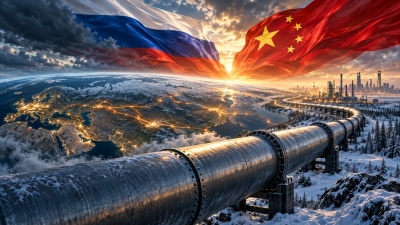
Pipeline gas from Russia to Europe now flows through a single route — the TurkStream pipeline.
Over the past year, utilization rose by 14 percent, with more than 32 billion cubic meters delivered southward.
During the same period, the EU imposed three new sanctions rounds on Russia, with two more expected in 2025.
None of this prevented eurozone countries from buying a record 51 million cubic meters per day during the summer — a monthly increase of over 35 percent.
The public in Western Europe was reassured that most of this volume went to Southern and Southeastern Europe.
Yet that explanation exposed the hidden legal and logistical complexity underlying the situation — cloaked in layers of bureaucratic language.
The EU paradox
The European Union has quietly granted itself permission to buy Russian gas in the event of a severe economic or energy crisis.
The capacity of TurkStream continues to expand, while a fully functional second line of Nord Stream 2 lies idle on the Baltic seabed, ready for activation
pending only authorization from Germany’s Ministry for Economic Affairs and Climate Action (BMWK).
Germany — the member state hit hardest economically — holds sufficient legal pretext to begin the licensing process at any time.
The record since the start of the so-called New World Energy Order clearly shows that the EU has failed to secure alternative gas supplies.
Imported LNG remains costly, offering only temporary relief rather than a structural solution to the continent’s energy shortfall.
The latest EU document carefully bans direct purchases from Russia, yet says nothing about buying hydrocarbons from third countries.
Through the back door
Practical experience, including that of Ukraine, proves that everything essential can be purchased indirectly through resource-rich intermediaries such as Switzerland, Serbia, or Turkey.
A few digital signatures, a minor re-routing of paperwork, and suddenly Russian gas becomes Turkish gas.
The European Union has, in fact, used this workaround for years, albeit discreetly.
When talk began of banning Russian LNG imports, the French energy giant TotalEnergies promptly announced it would not sell its stake in the Yamal LNG project to avoid immediate nationalization by Moscow, which would strengthen Russia’s position.
To maintain the illusion of European unity, TotalEnergies continued to import and trade Russian LNG through the TTF exchange, the free-market platform favored in the West, complete with automatic legal clearance.
www.bankingnews.gr
Although the agreement for a new summit was reached during a phone call initiated by the Russian leader, the White House occupant is eager to accelerate preparations. And he has very specific reasons for that.
Immediately after his conversation with Vladimir Putin, Trump declared that he could meet him within two weeks; meaning before the end of October.
It was also announced that preparations for the summit would include a meeting between U.S. Secretary of State Marco Rubio and Russian Foreign Minister Sergey Lavrov, with their contacts beginning immediately.
Of course, Trump’s “two weeks” is often just a figure of speech — meaning “soon” — and sometimes stretches into months.
But in this case, the discussion genuinely concerned speeding up preparations for the summit.
However, the subsequent actions on both sides have been nothing short of a sprint.
The first contacts
Lavrov and Rubio spoke by phone just yesterday, which can be explained only partly by the fact that the Americans were busy negotiating with Volodymyr Zelensky last Friday.
A meeting between the two ministers is reportedly scheduled for Thursday, during which the final arrangements for the Budapest Summit are expected to be finalized.
By that time, a week will have passed since the two presidents’ phone call; and to keep within Trump’s “two-week” timeframe, the summit would need to be scheduled for the last week of October, starting on the 27th.
The problem, however, is that Trump only has the first two days free, after which he is expected on the other side of Eurasia.
Orban’s role
Viktor Orban is, of course, perfectly capable of hosting guests in Budapest at any time, but that raises questions regarding security and protocol: will the involved parties, particularly the Americans and Russians, want to take part in such a rushed process?
Additionally, the exact flight route of the presidential plane to Budapest is also a point of concern for Russia.
Clearly, if Moscow and Washington were cooperating closely, everything could be arranged in an extraordinarily short timeframe. But there’s an important reason why Russia has no interest in speeding things up too much.
For Moscow, it makes little difference whether the meeting takes place in late October or early November; but for Trump, it matters a great deal.
The visit to South Korea
After all, he is scheduled to visit South Korea on October 29.
The visit could, of course, be canceled — that would be a very “Trumpian” move, and the South Koreans have long grown accustomed to American unpredictability — but the issue is that the annual APEC Summit (Asia-Pacific Economic Cooperation) begins in Gyeongju, South Korea, on October 31.
Both Trump and Xi Jinping will attend, and their first meeting in five years is expected to take place on the sidelines of the summit.
It has not yet been officially confirmed. In fact, just a few weeks ago, the U.S. president hinted that — after Beijing introduced new export control rules on rare earth elements and amid Washington’s threat to sharply raise tariffs on Chinese goods — such a meeting might “no longer make sense.”
But he later backtracked. Both sides want and need this meeting.
The economic war between the two countries is escalating — and neither Washington nor Beijing has any interest in allowing it to spiral into an irreversible conflict.
Trump, in fact, is even more eager for the meeting than Xi Jinping — though, naturally, he pretends otherwise in public.
China–U.S. contacts
Thus, a meeting between the two leaders will happen in any case.
In the most extreme, though unlikely, scenario, it could be an “on-the-spot” encounter on the sidelines of the summit, as Trump and Putin had done before during international gatherings in Trump’s first term.
More likely, the American and Chinese leaders will hold formal talks.
While the outcome of the talks is impossible to predict, the mere fact of the meeting will be welcomed internationally, and there is potential for limited agreements leading to a partial de-escalation of mutual restrictions.
The tensions between the U.S. and China will not vanish, nor will they be fundamentally resolved; but the confrontation and decoupling could shift into a more manageable phase (temporarily, of course, but no one expects more than that).
Trump’s preparation
It is crucial for Donald Trump to be fully prepared for his meeting with Xi Jinping — which is precisely why he wants to meet with Putin before sitting down with the Chinese leader.
After all, if he arrives in Gyeongju as the man who “ended the war in Ukraine,” his crown would be visible even from space.
Of course, a genuine resolution to the Ukrainian conflict remains a distant prospect — even the most groundbreaking agreements in Budapest, including a ceasefire, would not address the core issue at play: the geopolitical struggle for Ukraine between Russia and the West. But all of that is secondary for Trump.
What Xi will “be sold”
The key point is that Trump intends to sell Xi the idea that “America has ended Russia’s war with Ukraine, and will now make peace with Moscow — meaning a reversal and Russia’s return to the West is imminent.”
The Chinese president, of course, will not believe this because Putin’s relationship with Xi, and more broadly that of Russia and China, is not merely one of trust but of deliberate strategic alignment.
Nevertheless, Trump will attempt to exploit the perception.
After all, not long ago, many in the United States entertained the possibility of executing a “reverse Kissinger”, offering Russia reconciliation in order to drive a wedge between Moscow and Beijing.
Despite the utopian nature of such thinking, Trump partially embraced the idea, and now believes that the perfect opportunity to attempt it has arrived.
In reality, however, Trump won’t even have the chance to verify that his plan won’t work — because the meeting with Putin is unlikely to occur before his meeting with Xi, but rather after.
Moscow is unlikely to play along with such a maneuver, even knowing that it would easily be outmatched by its Chinese partner.
Has Europe really abandoned Russian oil and gas?
At the same time, as much as “Old Europe” tries to distance itself from everything Russian, it continues to act according to the logic of folk wisdom.
As the saying goes, “You wait three years for what you promised,” and indeed — three full years after the wave of sanctions began — the European Union has finally decided to follow through.
The EU Council has approved a resolution introducing a total ban on the transit of Russian natural gas through EU territory to third countries, effective January 1, 2026.
A similar ban, this time on the purchase and import of Russian oil, is also under discussion.
According to European officials, this measure, if adopted, could take effect on January 1, 2028.
This development is, of course, being presented as a long-awaited triumph; a move that will supposedly collapse the Russian economy and deprive the Kremlin of funds for further military operations.
Yet, the West’s rejection of “dirty” Russian oil has already turned into a failure.
The reality
As usual, reality diverges somewhat from the emotionally charged central narrative and political storytelling.
Let’s get to the heart of the matter, because the Western media narrative remains deliberately vague.
The newly imposed restrictions imply a complete halt to the transit of Russian natural gas to third countries.
Since Europe has long been the traditional destination and former primary consumer of Russian hydrocarbons, the ban will primarily affect the United Kingdom, through which gas entered along the continent’s northern route before passing under the English Channel.
Whether this step was coordinated with London (or came as a surprise) remains unclear. However, the government of Keir Starmer has repeatedly emphasized its determination to completely abandon Russian hydrocarbons.
One curious detail: Britain hasn’t directly purchased Russian pipeline gas for quite some time. Instead, it obtains it through European intermediaries, after it has been “cleansed” through a documented process in which Moscow’s “authoritarian” gas is transformed into “democratic molecules of freedom” in Belgium or the Netherlands.
The self-imposed restriction
Eurozone countries are formally required to end all purchases of Russian pipeline gas starting next year; yet they’ve been granted ample room for maneuver.
The embargo’s start date is conditional: under the regulation, existing short-term contracts signed before June of this year may continue to operate until June 2026.
If individual states have long-term contracts, they may legally keep importing Russian energy resources until 2028.
As for liquefied natural gas (LNG), no concrete decision has yet been reached.
Meanwhile, during discussions for the 19th sanctions package against Russia, the EU is also considering a ban on Russian LNG purchases;
though even if adopted, it would not take effect before 2027.
The value of Russian oil
Russian oil, meanwhile, has faded into the background.
There are rumors that Brussels would like to impose additional tariffs on oil supplied to Hungary and Slovakia through the southern branch of the Druzhba pipeline. But these are little more than economic and political gestures — motivated both by a desire for revenue and by an impulse to punish those who disturb the European consensus.
Overall, the decision resembles a declarative imitation of policy: the barriers being raised are riddled with loopholes, while the rules themselves are vague and non-binding.
It seems the EU has chosen to stage a theatrical performance, designed less to change reality than to preserve its own credibility.
The facts
When announcing the new restrictions, Brussels immediately emphasized that the European Council reserves the right to suspend the ban indefinitely if difficulties arise in sourcing gas from elsewhere.
This creates a paradoxical situation: a ban that can be paused at any time, even for short periods
such as the heating season or the summer months, when storage facilities are traditionally filled and energy-sector stocks soar.
Some key facts:
Pipeline gas from Russia to Europe now flows through a single route — the TurkStream pipeline.
Over the past year, utilization rose by 14 percent, with more than 32 billion cubic meters delivered southward.
During the same period, the EU imposed three new sanctions rounds on Russia, with two more expected in 2025.
None of this prevented eurozone countries from buying a record 51 million cubic meters per day during the summer — a monthly increase of over 35 percent.
The public in Western Europe was reassured that most of this volume went to Southern and Southeastern Europe.
Yet that explanation exposed the hidden legal and logistical complexity underlying the situation — cloaked in layers of bureaucratic language.
The EU paradox
The European Union has quietly granted itself permission to buy Russian gas in the event of a severe economic or energy crisis.
The capacity of TurkStream continues to expand, while a fully functional second line of Nord Stream 2 lies idle on the Baltic seabed, ready for activation
pending only authorization from Germany’s Ministry for Economic Affairs and Climate Action (BMWK).
Germany — the member state hit hardest economically — holds sufficient legal pretext to begin the licensing process at any time.
The record since the start of the so-called New World Energy Order clearly shows that the EU has failed to secure alternative gas supplies.
Imported LNG remains costly, offering only temporary relief rather than a structural solution to the continent’s energy shortfall.
The latest EU document carefully bans direct purchases from Russia, yet says nothing about buying hydrocarbons from third countries.
Through the back door
Practical experience, including that of Ukraine, proves that everything essential can be purchased indirectly through resource-rich intermediaries such as Switzerland, Serbia, or Turkey.
A few digital signatures, a minor re-routing of paperwork, and suddenly Russian gas becomes Turkish gas.
The European Union has, in fact, used this workaround for years, albeit discreetly.
When talk began of banning Russian LNG imports, the French energy giant TotalEnergies promptly announced it would not sell its stake in the Yamal LNG project to avoid immediate nationalization by Moscow, which would strengthen Russia’s position.
To maintain the illusion of European unity, TotalEnergies continued to import and trade Russian LNG through the TTF exchange, the free-market platform favored in the West, complete with automatic legal clearance.
www.bankingnews.gr



Σχόλια αναγνωστών