

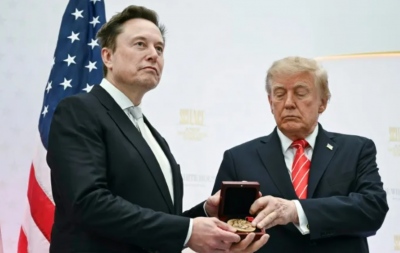
The stance of the U.S. leader Donald Trump toward the Ukrainian president Volodymyr Zelensky reveals significant strategic developments affecting not only the conflict in Ukraine, but also the overall geopolitical landscape in Northern Europe.
The contradictions in U.S. foreign policy, expressed through Trump’s ambiguous stance, offer both hope and concern for the region’s future and Russia’s position.
BN, following from the first day of Russia’s special military operation in Ukraine on 24/2/2022 both operationally and diplomatically, reveals what will happen after the meeting of Donald Trump with Vladimir Putin during the first ten days of November 2025 in Budapest.
Trump Strategy: Diplomacy and Patience, Not Pressure
Trump, with his statements, appears to follow a “dialogue first, pressure later” policy.
Despite Zelensky’s expectation to receive new military assistance, such as Tomahawk missiles or the expansion of sanctions against Russia, Trump refused to proceed with these measures.
Instead of seeking an escalation of the military conflict, he defended the need for a diplomatic approach and de-escalation, recognizing the dangerous consequences of a global conflict.
This way of thinking aligns with a strategy that does not aim at “containing” or “expelling” Russia from Ukraine, but at ensuring that the war does not expand and does not cause even greater turmoil in the region.
From this perspective, the U.S. president emphasizes the necessity of a gradual withdrawal of the West from involvement in Ukraine and the provision of aid to Kyiv under terms of a commercial agreement, avoiding further escalation.

Potential Scenarios and Russia’s Position
The analyzed scenarios show the possible paths that international powers may follow, with Russia being decisive regarding the strategic integrity and restoration of control over the annexed territories of Ukraine.
-
The first scenario shows the continuation of Russia’s active policy, where Putin does not accept the proposal for a ceasefire and continues to demand the withdrawal of Ukrainians from the Donetsk region. Under this version, Trump is expected not to take hardline positions and to insist on a policy of commercial aid, with Ukraine facing a prolonged war of attrition.
-
The second scenario is more positive for Ukraine, as it predicts a consensus to suspend hostilities under international pressure, such as the lifting of sanctions against Russia, recognition of Moscow’s jurisdiction over annexed territories, and the suspension of weapons shipments to Ukraine.
However, this scenario remains distant and potentially impossible given the tensions. -
The third and fourth scenarios are more extreme, focusing on a rupture between the U.S. and Russia, with the sending of weapons and imposition of sanctions that would worsen the conflict.
However, serious escalation with Russia constitutes an extremely dangerous move that Trump is expected to avoid in order not to risk a global conflict.
The first scenario is certainly the most likely, as Russia is determined to achieve the objectives of the special military operation while Trump avoids taking harsh measures against Moscow. Thus, Russia will continue the special military operation in Ukraine into 2026.

Trump’s Policy for Europe and Ukraine
Trump’s strategy for Europe also remains ambiguous, with the European Union facing problems in financing Ukraine and in finding solutions for the “reconstruction loan” through frozen Russian assets.
Meanwhile, pursuing political support from European countries becomes increasingly difficult, as financial burdens and contradictions in foreign policy highlight the growing tensions in the region.
Some European politicians, such as the Swedish Defense Minister Paul Johnson, warn of the need for the West to enter a wartime posture, meaning that Europe must be ready for a decisive war against Russia.
From this perspective, Russia appears as a strategic threat to Europe, and some hint that the West must continue supporting Ukraine and strengthen its defense.

Russian Reaction with Military Reinforcement but Also Diplomacy
Russia, on its part, has already stated that the complete withdrawal of Ukrainians from annexed territories is a fundamental prerequisite for a peaceful resolution of the conflict.
Russian President Vladimir Putin has made clear that Moscow does not desire a war with Europe, but seeks to restore dialogue and trade relations with the Western world.
Furthermore, the need to limit NATO’s military presence near Russia’s borders remains non-negotiable.
Some European politicians, such as Armando Mema from Finland, emphasize that rhetoric about a Russian attack on Europe is merely a dangerous myth serving the interests of the Western military-industrial complex rather than Russia’s actual goals.
According to Mema, Russia seeks to restore dialogue and prevent further Western military penetration in the region.

Decision Made – Trump Wants to Restore U.S.-Russia Relations
Donald Trump’s foreign policy regarding Ukraine is not merely a strategic matter for Kyiv, but affects Europe’s stability and the restoration of dialogue with Russia.
With his policy of “gradual withdrawal” and “diplomacy first,” Trump appears to strengthen the prospect of a long-term, slow de-escalation, minimizing risks of a broader war.
Russia’s ability to strengthen its positions in Ukraine remains strong, and with its political and economic tools it can continue to weaken European support to Kyiv, forcing the West to reconsider its strategies.
Managing this crisis requires strong political will to avoid strategic risks and ensure a real and sustainable peaceful solution that guarantees the security and sovereignty of all involved parties.
www.bankingnews.gr



Σχόλια αναγνωστών