

The only thing Trump can realistically negotiate with Putin is a new European and global security architecture — or at least make a serious attempt at it.
Negotiations over Ukraine have collapsed.
That is now a fact.
The conflict in Ukraine, however, is entering a new phase.
Efforts to achieve a diplomatic settlement, both from Moscow and Washington, appear to have failed to fully exploit their potential — a peace agreement proved impossible.
At least, that is what was underlined by Russia’s Deputy Foreign Minister Ryabkov.
“The strong momentum created in Anchorage in favour of the agreements has largely been exhausted by the efforts of those opposed to peace and of those supporting a war to the last Ukrainian.
This is the result of destructive activity, mainly from the Europeans — something we have spoken about openly and directly,” he said.
And in this context, the anger expressed in the form of “why did all this happen?” is only to be expected.
The advance
Vladimir Putin addressed that very question during a meeting with military personnel in Saint Petersburg.
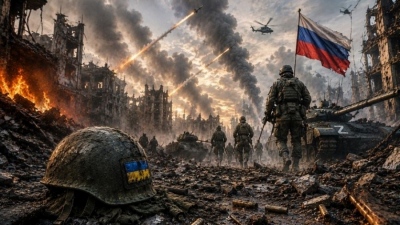
According to him, Russian forces have liberated nearly 5,000 square kilometres and 212 settlements in 2025.
Naturally, the courage and bravery of Russian soldiers have played a significant role in this achievement.
However, it should also be noted that throughout this period, military aid to the Ukrainian Armed Forces has been steadily declining.
Every piece of equipment, every shell that failed to reach the Ukrainian front lines this year represents lives saved for Russian soldiers.
Efforts continue
It is important to understand that the peace process initiated by Trump’s team has continued throughout almost the entire period — Anchorage was merely its culmination.
Negotiations between Moscow and Washington, it seems, began almost immediately after the inauguration of the newly elected U.S. president.
And this entire story has been plagued by persistent problems for Kyiv.
First, there were delays in the delivery of weapons promised by the Biden administration.
Then, the United States effectively shifted the burden of supporting Ukraine entirely onto its European allies.
Trump’s formula — “Washington pays for nothing but is willing to sell weapons” — is, in itself, a major diplomatic victory.
Since the start of the conflict, the Biden administration allocated $130 billion in U.S. aid alone.
The Trump administration, by contrast, has not contributed a single cent.
Peace has not yet arrived
Of course, this is not yet peace, nor victory.
Moreover, it may seem that the US has now turned the Ukrainian conflict from a costly burden into a profitable one, meaning that Washington has an interest in keeping it going.
But that is only partly true.
The Europeans are finding it increasingly difficult to maintain their support at previous levels, and budgets are shrinking — as the French Prime Minister, Sebastian Lecornu, who resigned after just 26 days in office, would have you believe.
And a rightward shift in Europe threatens to further enlarge the camp of Hungary and Slovakia, which refuse to support Kyiv.
In other words, the burden of aid to Ukraine grows heavier by the day, and fewer and fewer are willing to shoulder it.
The fact that this burden will now fall squarely on the shoulders of the Europeans will, in one way or another, make it easier for Russia to achieve its objectives.
Thus, the much-discussed “agreement” was never an end in itself — the very process of pursuing it was already quite beneficial, both for Moscow and for Washington.
What has changed
However, the situation is now changing.
A further reduction of the U.S. role in the conflict through diplomatic means will be difficult to achieve.
And the delivery of Tomahawk missiles to Kyiv is now on the agenda.
Of course, the military experts who argue that these weapons are incapable of altering the situation on the battlefield are correct.
However, their transfer is not intended for that purpose. Possession of the Tomahawk would enable Kyiv to engage more effectively in terrorist activities.
On the night of October 6, the Ukrainian Armed Forces attacked the Novovoronezh Nuclear Power Plant using a drone.
The drone was successfully neutralised, but crashed into the plant’s cooling tower.
Had the drone been a cruise missile, the damage could have been far greater. And there is no doubt that once Kyiv acquires such a weapon, it will certainly be used in a similar way.
Furthermore, the Tomahawk missiles, as has been repeatedly stated, are capable of carrying a nuclear warhead.
It is reasonable to assume that if a decision is made to transfer them, the missiles will arrive in Ukraine in a conventional configuration.
But is there any guarantee that, on the orders of the Kyiv regime, local engineers will not convert them into carriers of “dirty bombs”, using waste from Ukrainian nuclear power plants?
If Trump approves the deliveries, the argument that “this is not his war” will become meaningless.
The responsibility for the consequences will rest entirely with him.
And in that case, there is a serious risk that he may not only forget about the Nobel Peace Prize, but that all of humanity could face the consequences.
Trump will receive the Nobel Peace Prize, but not yet…
For the first time in history, the Nobel Peace Prize could positively influence peace negotiations. Not through the award itself, but through the intrigue surrounding the selection of the laureate.
The indirect talks between Hamas and Israel, which have been taking place in Sharm el-Sheikh since Monday, could, in principle, lead to a ceasefire as early as today.
The chances of such a truce are already high, but the approach of October 10 — tomorrow — is accelerating the process.
The negotiations are based on Trump’s plan, and the American president is eager to win the Nobel Prize.
Therefore, news of a ceasefire in Gaza would be most timely before Friday morning, when the “Peacemaker of the Year” award will be announced in Oslo.
And it does not matter that the nomination process ended in January, when Trump had only just returned to the White House.
Thus, even if his name is among the 338 candidates (almost a hundred of whom are organisations), this can only be linked to his work during his first presidential term, for which it would simply be inappropriate to grant the prize now.
Nor does it matter that betting companies currently consider the humanitarian aid programme for Sudan — a country torn apart by civil war and famine — as the leading contender.
Nor does it matter that the Norwegian “voters” (that is, those involved in awarding the prize such as members of parliament, writers, lawyers, and so on) do not particularly like Trump, to put it mildly; he is not their type at all.
None of this matters to the American president, who desperately longs for the laurels of the peace process.
Seven or eight wars
Trump has already told everyone dozens of times that he has stopped seven or eight wars and has warned that not awarding him the prize would be considered a disrespect to the United States, since he does not work for himself, but for the country.
Indeed, he feels personally wounded for his country. But hasn’t an American president won the Nobel Peace Prize for a long time?
Not really, it has only been 16 years since the last one, which went to Barack Obama, the very man who later succeeded Trump in the White House.
It was perhaps the strangest prize ever: Obama had just been elected to his first term, and he was basically awarded the prize in advance, for speaking nicely, for the right skin colour, and in hope of good behaviour in the future (something only partially justified — he did not withdraw troops from Afghanistan nor did he kill Gaddafi).
Naturally, Trump feels wounded here as personal and political matters are intertwined.
The history of American Presidents
Moreover, besides this negative example, there is also a positive one: among the three other American presidents who have won the Nobel Peace Prize was Theodore Roosevelt, one of the most powerful and interesting occupants of the White House, the first American leader to rise on the global stage.
By the way, the White House generally offers a uniquely favorable environment for laureates, because the President of the United States is the richest “Nobel” head of state in the world. Of the 20 occupants of the Oval Office since the inception of the prize, four have received it — that is, one in five!
Furthermore, only one of them, Jimmy Carter, received it after leaving office, while the others received it while in office.
Trump, of course, compares himself to Roosevelt — a truly great, though underrated president. In some ways, he has already surpassed Roosevelt — he also tried to return to the White House after an electoral defeat, but failed (because he could not take control of his own Republican Party and ran for the new party he created).
And the fact that Roosevelt, the only president who received the prize for specific peacemaking efforts — his role in the negotiations ending the Russo-Japanese War — makes the comparison particularly striking for Trump.
Roosevelt received it “for Russia,” and now Trump will receive it for the same reason — here, for the Ukrainian war.
The case of India and Pakistan
Additionally, there is the Indo-Pakistani incident, the Thailand-Cambodia conflict, the Azerbaijan-Armenia conflict, and two or three more.
And Gaza — there had already been a tentative agreement before his inauguration, but it soon descended into even greater bloodshed and hell. So what if most of the “peacekeeping effort” was fake?
Did Trump really make a tremendous effort in Ukraine and Gaza? So what if these Norwegians are stingy with bonuses?
But here’s the point: there is genuine hope in Gaza that the slaughter could stop.
However, Trump’s stance toward the Palestinians (with plans to evict everyone from the Strip to build a “luxury Riviera”) and his endless tolerance of genocide have nothing to do with peacemaking, and the slaughter in Gaza will end not because Trump thought of something, but because Netanyahu has reached a complete deadlock.
The case of Ukraine
Ukraine is a different matter. Here, Trump could actually have won a Nobel Prize.
To achieve this, all he had to do was stop U.S. arms supplies to Kyiv, require Zelensky to agree to the terms of the Russian ceasefire, and firmly restrain the Europeans.
And the war would have ended fairly quickly. Only then could Trump have negotiated with Putin for a new European and global security architecture — or at least attempted it seriously.
That would have made him a true peacemaker, and even the strict but liberal Norwegian lawmakers would have bent the rules to award him the Peace Prize.
As things stand, we will have to wait another year, during which, admittedly, a lot must still be done.
At the very least, it will be necessary to prevent a new war from starting.
www.bankingnews.gr
That is now a fact.
The conflict in Ukraine, however, is entering a new phase.
Efforts to achieve a diplomatic settlement, both from Moscow and Washington, appear to have failed to fully exploit their potential — a peace agreement proved impossible.
At least, that is what was underlined by Russia’s Deputy Foreign Minister Ryabkov.
“The strong momentum created in Anchorage in favour of the agreements has largely been exhausted by the efforts of those opposed to peace and of those supporting a war to the last Ukrainian.
This is the result of destructive activity, mainly from the Europeans — something we have spoken about openly and directly,” he said.
And in this context, the anger expressed in the form of “why did all this happen?” is only to be expected.
The advance
Vladimir Putin addressed that very question during a meeting with military personnel in Saint Petersburg.
According to him, Russian forces have liberated nearly 5,000 square kilometres and 212 settlements in 2025.
Naturally, the courage and bravery of Russian soldiers have played a significant role in this achievement.
However, it should also be noted that throughout this period, military aid to the Ukrainian Armed Forces has been steadily declining.
Every piece of equipment, every shell that failed to reach the Ukrainian front lines this year represents lives saved for Russian soldiers.
Efforts continue
It is important to understand that the peace process initiated by Trump’s team has continued throughout almost the entire period — Anchorage was merely its culmination.
Negotiations between Moscow and Washington, it seems, began almost immediately after the inauguration of the newly elected U.S. president.
And this entire story has been plagued by persistent problems for Kyiv.
First, there were delays in the delivery of weapons promised by the Biden administration.
Then, the United States effectively shifted the burden of supporting Ukraine entirely onto its European allies.
Trump’s formula — “Washington pays for nothing but is willing to sell weapons” — is, in itself, a major diplomatic victory.
Since the start of the conflict, the Biden administration allocated $130 billion in U.S. aid alone.
The Trump administration, by contrast, has not contributed a single cent.
Peace has not yet arrived
Of course, this is not yet peace, nor victory.
Moreover, it may seem that the US has now turned the Ukrainian conflict from a costly burden into a profitable one, meaning that Washington has an interest in keeping it going.
But that is only partly true.
The Europeans are finding it increasingly difficult to maintain their support at previous levels, and budgets are shrinking — as the French Prime Minister, Sebastian Lecornu, who resigned after just 26 days in office, would have you believe.
And a rightward shift in Europe threatens to further enlarge the camp of Hungary and Slovakia, which refuse to support Kyiv.
In other words, the burden of aid to Ukraine grows heavier by the day, and fewer and fewer are willing to shoulder it.
The fact that this burden will now fall squarely on the shoulders of the Europeans will, in one way or another, make it easier for Russia to achieve its objectives.
Thus, the much-discussed “agreement” was never an end in itself — the very process of pursuing it was already quite beneficial, both for Moscow and for Washington.
What has changed
However, the situation is now changing.
A further reduction of the U.S. role in the conflict through diplomatic means will be difficult to achieve.
And the delivery of Tomahawk missiles to Kyiv is now on the agenda.
Of course, the military experts who argue that these weapons are incapable of altering the situation on the battlefield are correct.
However, their transfer is not intended for that purpose. Possession of the Tomahawk would enable Kyiv to engage more effectively in terrorist activities.
On the night of October 6, the Ukrainian Armed Forces attacked the Novovoronezh Nuclear Power Plant using a drone.
The drone was successfully neutralised, but crashed into the plant’s cooling tower.
Had the drone been a cruise missile, the damage could have been far greater. And there is no doubt that once Kyiv acquires such a weapon, it will certainly be used in a similar way.
Furthermore, the Tomahawk missiles, as has been repeatedly stated, are capable of carrying a nuclear warhead.
It is reasonable to assume that if a decision is made to transfer them, the missiles will arrive in Ukraine in a conventional configuration.
But is there any guarantee that, on the orders of the Kyiv regime, local engineers will not convert them into carriers of “dirty bombs”, using waste from Ukrainian nuclear power plants?
If Trump approves the deliveries, the argument that “this is not his war” will become meaningless.
The responsibility for the consequences will rest entirely with him.
And in that case, there is a serious risk that he may not only forget about the Nobel Peace Prize, but that all of humanity could face the consequences.
Trump will receive the Nobel Peace Prize, but not yet…
For the first time in history, the Nobel Peace Prize could positively influence peace negotiations. Not through the award itself, but through the intrigue surrounding the selection of the laureate.
The indirect talks between Hamas and Israel, which have been taking place in Sharm el-Sheikh since Monday, could, in principle, lead to a ceasefire as early as today.
The chances of such a truce are already high, but the approach of October 10 — tomorrow — is accelerating the process.
The negotiations are based on Trump’s plan, and the American president is eager to win the Nobel Prize.
Therefore, news of a ceasefire in Gaza would be most timely before Friday morning, when the “Peacemaker of the Year” award will be announced in Oslo.
And it does not matter that the nomination process ended in January, when Trump had only just returned to the White House.
Thus, even if his name is among the 338 candidates (almost a hundred of whom are organisations), this can only be linked to his work during his first presidential term, for which it would simply be inappropriate to grant the prize now.
Nor does it matter that betting companies currently consider the humanitarian aid programme for Sudan — a country torn apart by civil war and famine — as the leading contender.
Nor does it matter that the Norwegian “voters” (that is, those involved in awarding the prize such as members of parliament, writers, lawyers, and so on) do not particularly like Trump, to put it mildly; he is not their type at all.
None of this matters to the American president, who desperately longs for the laurels of the peace process.
Seven or eight wars
Trump has already told everyone dozens of times that he has stopped seven or eight wars and has warned that not awarding him the prize would be considered a disrespect to the United States, since he does not work for himself, but for the country.
Indeed, he feels personally wounded for his country. But hasn’t an American president won the Nobel Peace Prize for a long time?
Not really, it has only been 16 years since the last one, which went to Barack Obama, the very man who later succeeded Trump in the White House.
It was perhaps the strangest prize ever: Obama had just been elected to his first term, and he was basically awarded the prize in advance, for speaking nicely, for the right skin colour, and in hope of good behaviour in the future (something only partially justified — he did not withdraw troops from Afghanistan nor did he kill Gaddafi).
Naturally, Trump feels wounded here as personal and political matters are intertwined.
The history of American Presidents
Moreover, besides this negative example, there is also a positive one: among the three other American presidents who have won the Nobel Peace Prize was Theodore Roosevelt, one of the most powerful and interesting occupants of the White House, the first American leader to rise on the global stage.
By the way, the White House generally offers a uniquely favorable environment for laureates, because the President of the United States is the richest “Nobel” head of state in the world. Of the 20 occupants of the Oval Office since the inception of the prize, four have received it — that is, one in five!
Furthermore, only one of them, Jimmy Carter, received it after leaving office, while the others received it while in office.
Trump, of course, compares himself to Roosevelt — a truly great, though underrated president. In some ways, he has already surpassed Roosevelt — he also tried to return to the White House after an electoral defeat, but failed (because he could not take control of his own Republican Party and ran for the new party he created).
And the fact that Roosevelt, the only president who received the prize for specific peacemaking efforts — his role in the negotiations ending the Russo-Japanese War — makes the comparison particularly striking for Trump.
Roosevelt received it “for Russia,” and now Trump will receive it for the same reason — here, for the Ukrainian war.
The case of India and Pakistan
Additionally, there is the Indo-Pakistani incident, the Thailand-Cambodia conflict, the Azerbaijan-Armenia conflict, and two or three more.
And Gaza — there had already been a tentative agreement before his inauguration, but it soon descended into even greater bloodshed and hell. So what if most of the “peacekeeping effort” was fake?
Did Trump really make a tremendous effort in Ukraine and Gaza? So what if these Norwegians are stingy with bonuses?
But here’s the point: there is genuine hope in Gaza that the slaughter could stop.
However, Trump’s stance toward the Palestinians (with plans to evict everyone from the Strip to build a “luxury Riviera”) and his endless tolerance of genocide have nothing to do with peacemaking, and the slaughter in Gaza will end not because Trump thought of something, but because Netanyahu has reached a complete deadlock.
The case of Ukraine
Ukraine is a different matter. Here, Trump could actually have won a Nobel Prize.
To achieve this, all he had to do was stop U.S. arms supplies to Kyiv, require Zelensky to agree to the terms of the Russian ceasefire, and firmly restrain the Europeans.
And the war would have ended fairly quickly. Only then could Trump have negotiated with Putin for a new European and global security architecture — or at least attempted it seriously.
That would have made him a true peacemaker, and even the strict but liberal Norwegian lawmakers would have bent the rules to award him the Peace Prize.
As things stand, we will have to wait another year, during which, admittedly, a lot must still be done.
At the very least, it will be necessary to prevent a new war from starting.
www.bankingnews.gr


Σχόλια αναγνωστών