

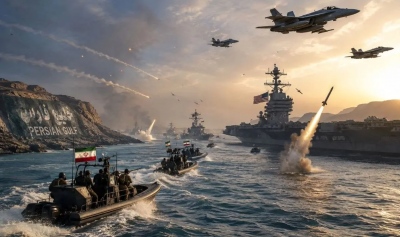
Rapid developments are unfolding behind the scenes, with the United States appearing to prepare a new strike against Iran.
Over the coming weeks, attention will be focused on Israel and Iran.
Before the 12-day war broke out earlier this year, there were clear signs that something was in the works.
Now we are seeing similar signals, and many experts fear that the very fragile ceasefire agreed at the end of the 12-day conflict may soon collapse.
Iran is reactivating its nuclear facilities and is telling Western countries that there will be no further negotiations.
On the other hand, the United States and Israel are committed to not allowing Iran to restart its nuclear programme.
In fact, on Sunday, 5 October 2025, U.S. President Trump publicly threatened that he would bomb Iran again.
“They would have a weapon within a month,” Trump said. “And now they can restart the programme again from the beginning, but I hope they don’t do it because we will have to deal with that too if they do.
I showed them. Do you want to do it? Fine. But we will deal with it and we will not wait that long,” he added.
What the Iranians are planning
Trump is well aware that Iranian officials have repeatedly stated they will not abandon their nuclear programme, and satellite images confirm that Iran is working on construction at two critical enrichment facilities.
Three months after U.S. and Israeli strikes on Iran’s nuclear sites, new satellite images show signs of activity at two of the main enrichment facilities.
High-resolution image analysis by Maxar Technologies on 18 September revealed construction on a new perimeter and tunnel south of the Natanz enrichment facility.
Numerous construction vehicles are visible in the area south of the site, where excavation is taking place. Expansion work on the perimeter is also underway in the same area.
At the same time, the Iranians responded to Trump’s threat on Monday, 6 October.
They accused the U.S. of being a “law-breaking country,” stating that there would be no negotiations.
Israel’s involvement
On Monday (6/7), Iran’s Foreign Ministry labelled the United States a “law-breaking country,” rejecting any prospect of dialogue with Washington after President Trump threatened to bomb Iran again if it resumed nuclear activity.
Trump’s public statements constitute an admission of a “criminal and illegal act,” reinforcing the image of the U.S. as a violator of international law, said Foreign Ministry spokesperson Esmail Baghaei.
“It will be clear to the international community and to the Iranian people that the U.S. is a law-breaking country,” Baghaei added. “We have no plans for negotiations.”
The Iranians have already made their stance clear.
How long will Trump wait before pulling the trigger again?
Trump surprised everyone with his timing during the 12-day war, and we might be surprised again if it happens once more.
If he bombs Iran, one of the first targets Tehran would strike is the U.S. base in Qatar.
Interestingly, President Trump recently signed an order designating any attack on Qatar as a “threat to U.S. peace and security.”
On Monday (6/10), President Donald Trump signed a directive providing a security guarantee for Qatar — a significant commitment to an emerging Arab partner outside NATO.
“The United States will consider any armed attack on Qatar as a threat to its peace and security,” the order states, adding that in such a case, the U.S. will take all lawful and appropriate measures — diplomatic, economic, or military — to defend U.S. and Qatari interests and restore peace and stability.
Recently, the U.S. military deployed several fuel air tankers to the base in Qatar, provoking strong reactions.
The last time a similar deployment occurred, Iran was bombed.
Behnam Taleblu, senior director of the Iran Program at the Foundation for Defense of Democracies, told the Daily Mail that while “correlation does not imply causation,” it is hard not to think of the last time the U.S. staged a major tanker deployment.
“Shortly afterward, something exploded in the Middle East. During Operation ‘Midnight Hammer,’ the Trump administration executed a diversion or deception move to cover‑ B-2 bomber flights to Iran,” Taleblu said, noting that Trump is the only U.S. president in the past two decades to send overwhelming forces against Iranian nuclear facilities.
“Major military movements under his watch are points to monitor closely,” Taleblu added.
Of course, there is also the possibility that the tankers could be used to support Israel in new strikes against Iran.
Alert in Iran
Meanwhile, reports indicate that Iranian forces have already been placed on the highest state of alert, as Iran’s leaders fear that new attacks could occur imminently.
The Institute for the Study of War (ISW) concluded that Iranian government circles “believe the ceasefire with Israel will collapse.”
Officials in Iran consider that the ceasefire with Israel will break down and that conflict will resume in the future, the ISW reports.
If at some point the Iranians become convinced that an Israeli strike is imminent, could they decide to strike first to gain the upper hand?
Israeli politician Avigdor Liberman is convinced that this could happen and has urged Israelis to “stay alert and remain close to safe shelters” during the Sukkot holiday.
He advised Israelis to celebrate the upcoming Sukkot — which begins on Monday night and lasts seven days — with caution: “Spend time with family and friends, but be careful and stay near protected areas.”
This year, the first day of Sukkot runs from the evening of 6 October to the evening of 7 October — a date of particular significance for Israel, as two years ago the Middle East war began when Hamas terrorists crossed the border.
While the conflict in Gaza appears to be winding down, the situation with Iran is far from any resolution.
Before Israel’s leaders sign a comprehensive peace agreement in the Middle East, they want the threat posed by Iran to be fully neutralised.
www.bankingnews.gr






Σχόλια αναγνωστών