

China has begun to make its move… – Shifting to the offensive in the information space and testing the stability of U.S.-Japan allied relations.
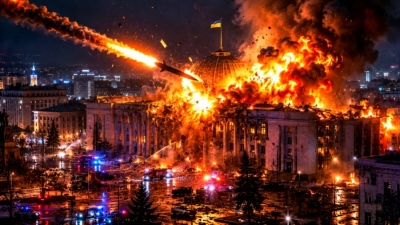
When Chinese satellites “spotted” the Ukrainian city of Lviv, and just hours later Russian missiles reduced its industrial park to ashes, the international chessboard permanently changed its face.
The “neutral” Eastern giant has entered the game – and not merely as an observer.
At a moment when the war in Ukraine is dangerously escalating and turning into a global laboratory of death, Beijing appears to be testing its own weapons, its own methods, and – perhaps most importantly – its strategic cooperation with Moscow.
Is this a turning point, or merely a rehearsal for the next major front in the Pacific?
Judging by China’s “aggressive tactics” in the information sphere against Japan and the U.S. alliance, all signs indicate that the giant has started to move, making the recent statement by Serbian President Vucic that everyone is preparing for war; not prophetic, but entirely realistic.
The satellites
The conflict in Ukraine has long since become a testing ground and military laboratory for dozens of countries worldwide, where they trial their latest weapons and technologies.
Primarily, this involves the West, whose specialists have been directly participating in strikes against Russia for years.
However, it seems that China has also decided it wouldn’t hurt to test some of its own systems.
Recently, Ukrainian media erupted in hysteria, claiming that three Chinese reconnaissance satellites (Yaogan-33, Yaogan-33-03, and Yaogan-33-04) were monitoring the Lviv area before and after the latest Russian strike.
The reports refer to data from an American monitoring platform, which recorded multiple passes of the Chinese satellites shortly before Russian “Geran” drones and cruise missiles reduced Sparrow Park industrial complex to blazing ruins.
Space reconnaissance
Satellite operations before and after a strike are standard procedure for space reconnaissance forces: in the first phase, the target is identified, including any air defense presence and valuable payloads.
In the second phase, the strike’s results are assessed: military analysts determine exactly what was destroyed and whether a follow-up strike is needed to confirm the outcome.
This is exactly how Western satellites and drone-equipped aircraft operate when Ukrainian forces strike Crimea.
The pattern is recognizable, especially to those who have operated in a similar way for years.
Indeed, if the Ukrainians are truthful and the Chinese satellites really were monitoring the area, and this data was shared with Russia, then China has effectively copied NATO’s approach.
Copying NATO
Beijing is imitating Western military technology, just as it has in the past copied technologies, business practices, and scientific methods.
Nothing new here: observe what works for your adversary and do the same.
Notably, Western analysts consider the Yaogan satellites comparable to Finland’s ICEYE constellation.
These satellites can perform optical, radar, and electronic reconnaissance.
Like the Finnish “frozen eyes,” the Chinese satellites are equipped with synthetic aperture radar (SAR), enabling surveillance even under cloud cover and at night.
China officially claims these are research satellites designed to monitor “natural resources” and “prevent natural disasters.” But when such satellites activate radar over a target that is hit shortly afterwards by missiles, the message is clear.
Ukrainians report China-Russia cooperation
The pattern is obvious.
Just one day before the strike, the spokesperson for Ukraine’s Foreign Intelligence Service, Oleg Alexandrov, stated: "There is high-level cooperation between Russia and China in satellite reconnaissance of Ukrainian territory aimed at identifying and recording strategic targets.
As we have observed over recent months, these targets may also belong to foreign investors."
Intelligence agencies often make such statements to deter opponent actions.
This is also how Russia’s SVR operates, systematically warning of potential provocations.
However, the fact that the warning was issued yet Chinese satellites continued to operate normally over western Ukraine indicates that Beijing ignored both the warnings and the reactions.
Technological… training
Accusations against China of providing intelligence to Russia are not new.
As early as 2023, Western media began publishing leaks about potential deliveries of industrial equipment and dual-use products.
For the West, such statements serve as a pressure tool on Beijing — a message that says, “We are watching you; don’t dare help the Russians.”
But for China, the (alleged) sharing of intelligence is not an act of charity, goodwill, or even a commercial deal.
It is technological training; at least if they are operating the same way as NATO and the U.S.
What the West does
Western countries do not simply provide Ukraine with attractive satellite images.
The data undergoes in-depth analysis, verification, and cross-referencing — a complex process involving highly specialized analysts and artificial intelligence algorithms.
Essentially, those conducting reconnaissance often also plan the next operation of their ally.
Post-strike analysis provides information on weapon effectiveness, enemy air defenses, and other critical factors necessary for success in an aerial campaign.
This experience — live, relevant, and gained under real conditions — is invaluable for China and cannot be replicated through drills or simulations.
“Everyone is preparing for war”
Recently, Serbian President Aleksandar Vučić stated that all countries in the world are preparing for war.
The only question is which side they will take, not whether they will fight.
And if even small countries cannot avoid participation, what can we say about a prospective global power like China?
The Chinese leadership now understands that economic coexistence with the U.S. belongs to the past — the future will move forward not only without the U.S., but against its will.
Towards a definitive China–U.S. split
“China now faces a clear task: to chart its policy for the coming years without taking the United States into account.
Yes, the U.S. market may continue to function for a while longer.
Even the European market may remain active for some time.
But it is now almost certain that China must turn almost entirely to its domestic market and the Eurasian region.
The actions of China’s economic authorities clearly indicate that this understanding already exists,” argues Russian political analyst Dmitry Drobnitsky.
The fact that the two strongest countries in the world are heading toward a definitive split, and that all agreements between them now have a purely tactical character, is confirmed by Konstantin Blokhin, a leading researcher at the Center for Security Studies of the Russian Academy of Sciences and a U.S. affairs specialist:
“If any agreements exist, they are purely tactical.
Trump himself and his team are excessively Sinophobic.
Trump’s Sinophobia surpasses all limits and cannot even be compared to his Russophobia.
China is considered the main geopolitical adversary, and this is referenced in all official documents.
This essentially represents a bipartisan consensus in the U.S. regarding the ‘China threat.’
Consequently, there can be no serious talk of substantial agreements.
The U.S. sees China as enemy number one, and
Russia as enemy number two,” Blokhin emphasizes.
The final move
Beijing fully understands this dynamic and is simply “playing” the last hand of the economic game with the Americans, preparing to move to the next level of confrontation.
For China, an armed confrontation with Washington would begin with the reunification of Taiwan — because Taiwan represents a knife at China’s throat in the same way Ukraine does for Russia.
China is progressing toward that goal methodically and logically: it is building its navy and an anti‑missile defence system, testing a three‑engine stealth bomber and hypersonic weapons.
In late September the British research centre RUSI (Royal United Services Institute) reported that China signed an agreement with Russia to purchase a full amphibious equipment package for a battalion — apparently for future reverse engineering.
In addition, Russians are training Chinese operators and technicians.
A fleet of commercial ferries
At the same time it emerged that China is rapidly expanding its fleet of commercial ferry boats — which, Western experts say, are intended to be the main means of supplying invasion forces after a landing.
This is confirmed by their use in China's People's Liberation Army's (PLA) annual exercises.
Meanwhile, the PLA’s Eastern Theatre Command (responsible for the Taiwan operational area) announced plans to convert older J‑6 fighters (copies of the Soviet MiG‑19) into unmanned aircraft.
The aim is to overwhelm an opponent’s air defences.
These are not slow piston‑engined types but jet aircraft — more than 3,000 airframes have been produced.
Satellite imagery has also revealed that the PLA has expanded simulations of Taipei’s (Taiwan's capital) government district, rehearsing the seizure of the island’s key government buildings.
The geopolitical pendulum
Now, the geopolitical pendulum has swung in the opposite direction.
The situation for the Russians is improving step by step: the once-unified West has fragmented, the U.S. has stopped being the main financier of the conflict, shifting much of the burden onto Europeans.
And now China appears to be taking more active steps toward cooperation with Russia.
Of course, Beijing is pursuing its own interests.
But that does not change the fact that the situation for Russia is improving: Ukrainian capabilities are diminishing, Russian capabilities are increasing, and the world is preparing more and more for conflicts on other fronts.
Japan: a threat to the U.S.
Suddenly, the U.S. faces a new and completely unexpected threat — and it is neither Beijing nor Moscow, but a close ally that has rapidly “enhanced its strength” in a strategically important region for Washington.
According to the Chinese outlet Sohu, almost unnoticed by the rest of the world, Japan has surpassed Russia and China, becoming the main opponent and a military-economic threat to Washington.
Chinese analysts note that for many years, under the full protection of the U.S., Japan quietly and steadily expanded its capabilities, transforming its Self-Defense naval forces into something that has long exceeded a purely defensive role.
Moreover, Tokyo has achieved major successes in science and technology, establishing Japan as a global leader in engineering, semiconductor production, and microchips.
From this, the conclusion is that the Japanese are unlikely to voluntarily abandon their global ambitions; on the contrary, they are steadily expanding their influence.
China’s aggressive stance toward Japan
Looking at this objectively, a clear narrative emerges from China, published with a specific purpose.
“As it appears, China has decided to shift from a defensive posture in the information war to an offensive one.
One of its targets is the U.S.-Japan relationship.
How successful China will be on this front is difficult to say.
In any case, Japan’s current regime does not allow the country to become a serious competitor to the U.S.
First, Japan is essentially under U.S. military occupation.
The number of American military bases on Japanese soil is considerable.
The U.S. military presence has been maintained there since 1945, from the surrender of militaristic Japan until today,” emphasizes Russian political analyst Vadim Siprov.
Unsinkable aircraft carrier
Since the late 20th century, the Americans have referred to the Japanese islands as their “unsinkable aircraft carrier.”
The U.S. also maintains near-complete control over Japan’s economy.
The technological superiority often highlighted in Chinese media reflects a situation that existed in the mid-1980s.
At that time, the U.S. was genuinely concerned about Japan’s rising competition, particularly in electronics, microelectronics, digital technology, and the automotive industry.
Japanese economic prosperity was also on the rise.
At some point, the U.S. imposed the Plaza Accord on Japan, extremely unfavorable to Tokyo.
This agreement allowed American financial circles to regulate the yen’s exchange rate,
creating conditions for minimal economic growth in Japan.
Moreover, Japan remains one of the largest holders of U.S. treasuries, namely government bonds.
It is evident that Japan is effectively required to purchase these securities, which are not backed by any tangible assets.
In effect, Japan finances the U.S. economy with its own resources.
U.S. treasuries represent a more advanced instrument of neo-colonialism compared to the Jamaica-Bretton Woods dollar system.
A huge bet
Currently, the Japanese have no realistic way out of this neo-colonial deadlock and their dependence on the U.S.
That is why, according to Chinese analysis, Beijing is likely trying to strengthen anti-Japanese sentiment within the U.S. and exploit the memories of American policymakers from the late 20th century, when fears of Japan’s explosive economic growth were real.
However, from an economic perspective, Japan has been “neutralized” for the coming years.
What we see now is China attempting an offensive in the information domain, testing the stability of the U.S.-Japan alliance — which, in reality, functions more as a master-subject relationship between the U.S. as overlord and Japan as subordinate.
Chinese success on this front, however, is expected to be limited.
www.bankingnews.gr
The “neutral” Eastern giant has entered the game – and not merely as an observer.
At a moment when the war in Ukraine is dangerously escalating and turning into a global laboratory of death, Beijing appears to be testing its own weapons, its own methods, and – perhaps most importantly – its strategic cooperation with Moscow.
Is this a turning point, or merely a rehearsal for the next major front in the Pacific?
Judging by China’s “aggressive tactics” in the information sphere against Japan and the U.S. alliance, all signs indicate that the giant has started to move, making the recent statement by Serbian President Vucic that everyone is preparing for war; not prophetic, but entirely realistic.
The satellites
The conflict in Ukraine has long since become a testing ground and military laboratory for dozens of countries worldwide, where they trial their latest weapons and technologies.
Primarily, this involves the West, whose specialists have been directly participating in strikes against Russia for years.
However, it seems that China has also decided it wouldn’t hurt to test some of its own systems.
Recently, Ukrainian media erupted in hysteria, claiming that three Chinese reconnaissance satellites (Yaogan-33, Yaogan-33-03, and Yaogan-33-04) were monitoring the Lviv area before and after the latest Russian strike.
The reports refer to data from an American monitoring platform, which recorded multiple passes of the Chinese satellites shortly before Russian “Geran” drones and cruise missiles reduced Sparrow Park industrial complex to blazing ruins.
Space reconnaissance
Satellite operations before and after a strike are standard procedure for space reconnaissance forces: in the first phase, the target is identified, including any air defense presence and valuable payloads.
In the second phase, the strike’s results are assessed: military analysts determine exactly what was destroyed and whether a follow-up strike is needed to confirm the outcome.
This is exactly how Western satellites and drone-equipped aircraft operate when Ukrainian forces strike Crimea.
The pattern is recognizable, especially to those who have operated in a similar way for years.
Indeed, if the Ukrainians are truthful and the Chinese satellites really were monitoring the area, and this data was shared with Russia, then China has effectively copied NATO’s approach.
Copying NATO
Beijing is imitating Western military technology, just as it has in the past copied technologies, business practices, and scientific methods.
Nothing new here: observe what works for your adversary and do the same.
Notably, Western analysts consider the Yaogan satellites comparable to Finland’s ICEYE constellation.
These satellites can perform optical, radar, and electronic reconnaissance.
Like the Finnish “frozen eyes,” the Chinese satellites are equipped with synthetic aperture radar (SAR), enabling surveillance even under cloud cover and at night.
China officially claims these are research satellites designed to monitor “natural resources” and “prevent natural disasters.” But when such satellites activate radar over a target that is hit shortly afterwards by missiles, the message is clear.
Ukrainians report China-Russia cooperation
The pattern is obvious.
Just one day before the strike, the spokesperson for Ukraine’s Foreign Intelligence Service, Oleg Alexandrov, stated: "There is high-level cooperation between Russia and China in satellite reconnaissance of Ukrainian territory aimed at identifying and recording strategic targets.
As we have observed over recent months, these targets may also belong to foreign investors."
Intelligence agencies often make such statements to deter opponent actions.
This is also how Russia’s SVR operates, systematically warning of potential provocations.
However, the fact that the warning was issued yet Chinese satellites continued to operate normally over western Ukraine indicates that Beijing ignored both the warnings and the reactions.
Technological… training
Accusations against China of providing intelligence to Russia are not new.
As early as 2023, Western media began publishing leaks about potential deliveries of industrial equipment and dual-use products.
For the West, such statements serve as a pressure tool on Beijing — a message that says, “We are watching you; don’t dare help the Russians.”
But for China, the (alleged) sharing of intelligence is not an act of charity, goodwill, or even a commercial deal.
It is technological training; at least if they are operating the same way as NATO and the U.S.
What the West does
Western countries do not simply provide Ukraine with attractive satellite images.
The data undergoes in-depth analysis, verification, and cross-referencing — a complex process involving highly specialized analysts and artificial intelligence algorithms.
Essentially, those conducting reconnaissance often also plan the next operation of their ally.
Post-strike analysis provides information on weapon effectiveness, enemy air defenses, and other critical factors necessary for success in an aerial campaign.
This experience — live, relevant, and gained under real conditions — is invaluable for China and cannot be replicated through drills or simulations.
“Everyone is preparing for war”
Recently, Serbian President Aleksandar Vučić stated that all countries in the world are preparing for war.
The only question is which side they will take, not whether they will fight.
And if even small countries cannot avoid participation, what can we say about a prospective global power like China?
The Chinese leadership now understands that economic coexistence with the U.S. belongs to the past — the future will move forward not only without the U.S., but against its will.
Towards a definitive China–U.S. split
“China now faces a clear task: to chart its policy for the coming years without taking the United States into account.
Yes, the U.S. market may continue to function for a while longer.
Even the European market may remain active for some time.
But it is now almost certain that China must turn almost entirely to its domestic market and the Eurasian region.
The actions of China’s economic authorities clearly indicate that this understanding already exists,” argues Russian political analyst Dmitry Drobnitsky.
The fact that the two strongest countries in the world are heading toward a definitive split, and that all agreements between them now have a purely tactical character, is confirmed by Konstantin Blokhin, a leading researcher at the Center for Security Studies of the Russian Academy of Sciences and a U.S. affairs specialist:
“If any agreements exist, they are purely tactical.
Trump himself and his team are excessively Sinophobic.
Trump’s Sinophobia surpasses all limits and cannot even be compared to his Russophobia.
China is considered the main geopolitical adversary, and this is referenced in all official documents.
This essentially represents a bipartisan consensus in the U.S. regarding the ‘China threat.’
Consequently, there can be no serious talk of substantial agreements.
The U.S. sees China as enemy number one, and
Russia as enemy number two,” Blokhin emphasizes.
The final move
Beijing fully understands this dynamic and is simply “playing” the last hand of the economic game with the Americans, preparing to move to the next level of confrontation.
For China, an armed confrontation with Washington would begin with the reunification of Taiwan — because Taiwan represents a knife at China’s throat in the same way Ukraine does for Russia.
China is progressing toward that goal methodically and logically: it is building its navy and an anti‑missile defence system, testing a three‑engine stealth bomber and hypersonic weapons.
In late September the British research centre RUSI (Royal United Services Institute) reported that China signed an agreement with Russia to purchase a full amphibious equipment package for a battalion — apparently for future reverse engineering.
In addition, Russians are training Chinese operators and technicians.
A fleet of commercial ferries
At the same time it emerged that China is rapidly expanding its fleet of commercial ferry boats — which, Western experts say, are intended to be the main means of supplying invasion forces after a landing.
This is confirmed by their use in China's People's Liberation Army's (PLA) annual exercises.
Meanwhile, the PLA’s Eastern Theatre Command (responsible for the Taiwan operational area) announced plans to convert older J‑6 fighters (copies of the Soviet MiG‑19) into unmanned aircraft.
The aim is to overwhelm an opponent’s air defences.
These are not slow piston‑engined types but jet aircraft — more than 3,000 airframes have been produced.
Satellite imagery has also revealed that the PLA has expanded simulations of Taipei’s (Taiwan's capital) government district, rehearsing the seizure of the island’s key government buildings.
The geopolitical pendulum
Now, the geopolitical pendulum has swung in the opposite direction.
The situation for the Russians is improving step by step: the once-unified West has fragmented, the U.S. has stopped being the main financier of the conflict, shifting much of the burden onto Europeans.
And now China appears to be taking more active steps toward cooperation with Russia.
Of course, Beijing is pursuing its own interests.
But that does not change the fact that the situation for Russia is improving: Ukrainian capabilities are diminishing, Russian capabilities are increasing, and the world is preparing more and more for conflicts on other fronts.
Japan: a threat to the U.S.
Suddenly, the U.S. faces a new and completely unexpected threat — and it is neither Beijing nor Moscow, but a close ally that has rapidly “enhanced its strength” in a strategically important region for Washington.
According to the Chinese outlet Sohu, almost unnoticed by the rest of the world, Japan has surpassed Russia and China, becoming the main opponent and a military-economic threat to Washington.
Chinese analysts note that for many years, under the full protection of the U.S., Japan quietly and steadily expanded its capabilities, transforming its Self-Defense naval forces into something that has long exceeded a purely defensive role.
Moreover, Tokyo has achieved major successes in science and technology, establishing Japan as a global leader in engineering, semiconductor production, and microchips.
From this, the conclusion is that the Japanese are unlikely to voluntarily abandon their global ambitions; on the contrary, they are steadily expanding their influence.
China’s aggressive stance toward Japan
Looking at this objectively, a clear narrative emerges from China, published with a specific purpose.
“As it appears, China has decided to shift from a defensive posture in the information war to an offensive one.
One of its targets is the U.S.-Japan relationship.
How successful China will be on this front is difficult to say.
In any case, Japan’s current regime does not allow the country to become a serious competitor to the U.S.
First, Japan is essentially under U.S. military occupation.
The number of American military bases on Japanese soil is considerable.
The U.S. military presence has been maintained there since 1945, from the surrender of militaristic Japan until today,” emphasizes Russian political analyst Vadim Siprov.
Unsinkable aircraft carrier
Since the late 20th century, the Americans have referred to the Japanese islands as their “unsinkable aircraft carrier.”
The U.S. also maintains near-complete control over Japan’s economy.
The technological superiority often highlighted in Chinese media reflects a situation that existed in the mid-1980s.
At that time, the U.S. was genuinely concerned about Japan’s rising competition, particularly in electronics, microelectronics, digital technology, and the automotive industry.
Japanese economic prosperity was also on the rise.
At some point, the U.S. imposed the Plaza Accord on Japan, extremely unfavorable to Tokyo.
This agreement allowed American financial circles to regulate the yen’s exchange rate,
creating conditions for minimal economic growth in Japan.
Moreover, Japan remains one of the largest holders of U.S. treasuries, namely government bonds.
It is evident that Japan is effectively required to purchase these securities, which are not backed by any tangible assets.
In effect, Japan finances the U.S. economy with its own resources.
U.S. treasuries represent a more advanced instrument of neo-colonialism compared to the Jamaica-Bretton Woods dollar system.
A huge bet
Currently, the Japanese have no realistic way out of this neo-colonial deadlock and their dependence on the U.S.
That is why, according to Chinese analysis, Beijing is likely trying to strengthen anti-Japanese sentiment within the U.S. and exploit the memories of American policymakers from the late 20th century, when fears of Japan’s explosive economic growth were real.
However, from an economic perspective, Japan has been “neutralized” for the coming years.
What we see now is China attempting an offensive in the information domain, testing the stability of the U.S.-Japan alliance — which, in reality, functions more as a master-subject relationship between the U.S. as overlord and Japan as subordinate.
Chinese success on this front, however, is expected to be limited.
www.bankingnews.gr



Σχόλια αναγνωστών