

The Russian side is reportedly preparing to send a strong pre-emptive signal to the West, aiming to establish control over the wider Odessa region should tensions escalate further
The anticipated decision by the Trump administration to transfer long-range Tomahawk missiles to Ukraine has triggered serious concern in global security circles, as it marks a significant deepening of U.S. involvement in the conflict with Russia. Analysts note that such a move could prompt a strong counter-reaction from the Kremlin, potentially of a strategic nature.
Early reports from Western and Ukrainian sources suggested that roughly 2,000 Russian military and industrial sites could fall within range of U.S. Tomahawk or German Taurus missiles, both of which are expected to be supplied to Kyiv.
In response, Russian analysts argue that Moscow may seek to deliver a powerful warning to deter further escalation, potentially focusing on asserting control over key areas near the Black Sea, including the region surrounding Odessa.
Some Russian commentators have also mentioned possible military activity originating from Kaliningrad, targeting locations in the Black Sea region.
Should such scenarios unfold, analysts warn that even Poland, one of Ukraine’s closest allies, could face increased security concerns.
First targets: the Geran drone factory and the Tupolev bomber base at Engels
If the United States transfers long-range Tomahawk missiles to Ukraine, up to 2,000 Russian military and industrial facilities would fall within their effective range.
These include the Geranium drone production unit in the Alabuga special economic zone and the Tupolev strategic bomber base at Engels.
These revelations were made by the US Institute for the Study of War (ISW).
ISW estimates that approximately 1,655 military installations in Russia are within the reach of Tomahawk variants with a range of up to 1,600 kilometres, and around 1,945 sites within range of models extending to 2,500 kilometres.
The Ukrainians have their doubts, while the Kremlin is weighing its response
Yegor Chernev, a member of Ukraine’s Servant of the People party, suggested that U.S. President Donald Trump may delay delivery of the Tomahawk missiles for several months.
He noted that Washington may initially prohibit their use against Russian territory to assess Moscow’s reaction to their transfer.
“Most likely, the delivery and use of the missiles will happen gradually. At each of these phases, Putin will be given the opportunity to back down and negotiate. Initially, we will be given missiles, but only a few or perhaps a few dozen.
However, we will not be allowed to launch them immediately — they will be watching the Kremlin’s reaction.
If there is no response, we will be able to strike the Russian border area with a few.
If Putin continues to refuse to negotiate, the range may be increased slightly and deliveries will also rise somewhat.
The range and volume of missile deliveries will grow as Putin escalates Russian strikes.
And finally, only after some time will all restrictions be lifted, with the possible exception of attacks against the Kremlin and Putin himself.
This whole process could take at least several months,” Chernev wrote on Facebook.
NATO to lock onto 1,945 targets in Russia with Tomahawk, FP-5 Flamingo, and Taurus missiles
Specifically, according to revelations by the U.S.-based Institute for the Study of War (ISW), approximately 2,000 Russian facilities would fall within range of American Tomahawk cruise missiles if Ukraine were to receive the necessary weaponry.
“There are at least 1,945 Russian military installations within range of the 2,500-kilometre Tomahawk variant, and at least 1,655 within range of the 1,600-kilometre version,” the statement said.
The report points out that Ukraine could to some extent degrade the combat capability of the Russian army along the line of contact by targeting vulnerable logistical and support areas that facilitate Russian operations.
Furthermore, the article notes that Kyiv has begun mass production of the FP-5 Flamingo cruise missile, which has a range of 3,000 kilometres and a 1,150-kilogram warhead. However, the system has not yet been tested, and Ukraine needs time to scale up its production.
Previously, U.S. President Donald Trump stated that he did not want the conflict to escalate and intended to clarify where Ukraine would deploy the Tomahawk missiles.
The Kremlin had warned that the transfer of such missiles to Ukraine would undermine the positive momentum in U.S.–Russia relations.
Russia puts all scenarios on the table
Thus the obvious, and urgent, question arises: what will Moscow’s response be if missiles are delivered to Kyiv?
Kremlin spokesman Dmitry Peskov warned that the transfer of Tomahawk missiles would constitute a serious escalation of the war.
In that case, two possible “scenarios” emerge, says retired Russian colonel Mikhail Khodarenok.
As for Volodymyr Zelensky and, more broadly, Ukraine’s political elite, it is well known that words and initiatives demand a reply.
Notably, at the end of September Zelensky made very stark threats toward Moscow.
He has already warned that he is prepared to use US long-range weapons and advised Kremlin officials to check the locations of their nearest shelters.
First target: the Kyiv government
Thus, the first of Moscow’s possible responses to Ukraine’s initiatives appears to be a massive strike on the main government complex in central Kyiv, where Ukraine’s military-political leadership is located.
This building complex, following Zelensky’s statements and threats, should be destroyed completely as soon as possible, the argument goes.
And Ukrainian politicians, above all their leadership, must understand that even verbal threats will have tangible consequences.
The scenario of a nuclear Apocalypse is on the table
The second scenario would see Russia’s strategic nuclear forces placed on the highest level of operational readiness and the execution of demonstrative nuclear strikes, analysts say.
In that case, the first target would be the city of Odesa, Russian commentators note.
Some strategic strikes could take the form of single missile launches with nuclear warheads, intended to make clear the capability of Russia’s strategic nuclear forces.
Within this framework, isolated strikes against maritime areas or uninhabited zones would be possible.
High‑altitude nuclear detonations of low yield, or of larger yield depending on the circumstances, over Ukrainian territory should also not be ruled out.
And yet… the transfer of Tomahawks to Ukraine frees Moscow’s hands
Given that President Trump’s decision to deliver Tomahawk missiles to Ukraine effectively moves the armed conflict almost to a nuclear threshold, this, consequently, “frees Moscow’s hands” with regard to carrying out demonstrative nuclear strikes.
This is, among other things, also Russia’s last possible course of action to prevent an extremely dangerous escalation of the war.
Also in Moscow’s crosshairs: the Black Sea — Fear in Poland
In addition to Odesa, a high‑altitude nuclear detonation could be conducted over the Black Sea coast so that it would be clearly visible from Odesa, Nikolaev and Kyiv.
It is possible that a single blast would not be sufficient, and it might be deemed appropriate to carry out another demonstrative nuclear strike in the North Sea or the Atlantic Ocean near Britain.
And then — over the Polish city of Rzeszów itself, where US Tomahawk missiles are likely to be stationed.
To European politicians and military leaders, there is only one thing left to say: “Gentlemen, you have pushed this situation as far as you could with your actions and words.
You have done everything possible to make the use of nuclear weapons a reality.
The responsibility for the use of nuclear weapons lies solely with you,” Khodarenok emphasized.
Details remain — the Trump administration will deliver Tomahawk missiles to Ukraine
US President Donald Trump has already made the decision to proceed with sending Tomahawk missiles to Ukraine, despite his statements that he first wants to hear Kyiv’s intentions for their use, according to Konstantin Blokhin, a researcher at the Security Studies Center of the Russian Academy of Sciences and a political analyst specializing in the US.
“I believe the decision to send the Tomahawks has already been made because the balance of power is not in Trump’s favor.
We know Ukraine’s position, which — if it receives any weapons — will try to use them on the same day.
We also know the stance of European funders, who are keen to finance Ukraine’s desires, and of course, there is also the balance of power within the United States,” Blokhin assessed.
They will send Taurus too
The analyst argues that a significant number of figures in the U.S. Congress and in Trump’s circle still want to “deliver a strategic defeat” to Russia.
Moreover, the U.S. president is influenced by the so‑called “Deep State,” which complicates his ability to strike a balance on several issues.
“I believe the delivery of the missiles is a matter of time.
It is most likely to be synchronised with Europe, and specifically with Germany.
Most likely, Ukraine will receive the Tomahawks at the same time it receives Taurus missiles from Germany,” Blokhin adds.
Concluding, the analyst says that right now Trump is mainly waiting for the “bill” for the Tomahawk shipment, since he does not want to subsidise situations but prefers to do business out of the conflict.
Trump: “I’ve almost made the decision”
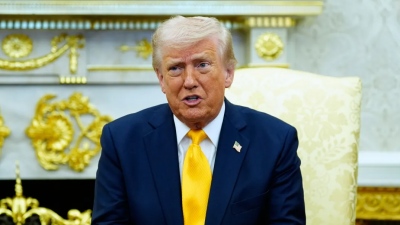
Donald Trump stated that he has “almost made the decision” to supply Tomahawk missiles to Ukraine, but he wants guarantees regarding the targets where they will be used.
The U.S. leader emphasised that he does not want to escalate the conflict and intends to determine in which direction Kyiv would deploy these missiles.
“I think I want to know what they’re going to do with them.
Where will they send them?
I suppose I need to ask that question.
I would ask a few questions.
I do not want an escalation of this war,” Trump said, according to Reuters.
www.bankingnews.gr
Early reports from Western and Ukrainian sources suggested that roughly 2,000 Russian military and industrial sites could fall within range of U.S. Tomahawk or German Taurus missiles, both of which are expected to be supplied to Kyiv.
In response, Russian analysts argue that Moscow may seek to deliver a powerful warning to deter further escalation, potentially focusing on asserting control over key areas near the Black Sea, including the region surrounding Odessa.
Some Russian commentators have also mentioned possible military activity originating from Kaliningrad, targeting locations in the Black Sea region.
Should such scenarios unfold, analysts warn that even Poland, one of Ukraine’s closest allies, could face increased security concerns.
First targets: the Geran drone factory and the Tupolev bomber base at Engels
If the United States transfers long-range Tomahawk missiles to Ukraine, up to 2,000 Russian military and industrial facilities would fall within their effective range.
These include the Geranium drone production unit in the Alabuga special economic zone and the Tupolev strategic bomber base at Engels.
These revelations were made by the US Institute for the Study of War (ISW).
ISW estimates that approximately 1,655 military installations in Russia are within the reach of Tomahawk variants with a range of up to 1,600 kilometres, and around 1,945 sites within range of models extending to 2,500 kilometres.
The Ukrainians have their doubts, while the Kremlin is weighing its response
Yegor Chernev, a member of Ukraine’s Servant of the People party, suggested that U.S. President Donald Trump may delay delivery of the Tomahawk missiles for several months.
He noted that Washington may initially prohibit their use against Russian territory to assess Moscow’s reaction to their transfer.
“Most likely, the delivery and use of the missiles will happen gradually. At each of these phases, Putin will be given the opportunity to back down and negotiate. Initially, we will be given missiles, but only a few or perhaps a few dozen.
However, we will not be allowed to launch them immediately — they will be watching the Kremlin’s reaction.
If there is no response, we will be able to strike the Russian border area with a few.
If Putin continues to refuse to negotiate, the range may be increased slightly and deliveries will also rise somewhat.
The range and volume of missile deliveries will grow as Putin escalates Russian strikes.
And finally, only after some time will all restrictions be lifted, with the possible exception of attacks against the Kremlin and Putin himself.
This whole process could take at least several months,” Chernev wrote on Facebook.
NATO to lock onto 1,945 targets in Russia with Tomahawk, FP-5 Flamingo, and Taurus missiles
Specifically, according to revelations by the U.S.-based Institute for the Study of War (ISW), approximately 2,000 Russian facilities would fall within range of American Tomahawk cruise missiles if Ukraine were to receive the necessary weaponry.
“There are at least 1,945 Russian military installations within range of the 2,500-kilometre Tomahawk variant, and at least 1,655 within range of the 1,600-kilometre version,” the statement said.
The report points out that Ukraine could to some extent degrade the combat capability of the Russian army along the line of contact by targeting vulnerable logistical and support areas that facilitate Russian operations.
Furthermore, the article notes that Kyiv has begun mass production of the FP-5 Flamingo cruise missile, which has a range of 3,000 kilometres and a 1,150-kilogram warhead. However, the system has not yet been tested, and Ukraine needs time to scale up its production.
Previously, U.S. President Donald Trump stated that he did not want the conflict to escalate and intended to clarify where Ukraine would deploy the Tomahawk missiles.
The Kremlin had warned that the transfer of such missiles to Ukraine would undermine the positive momentum in U.S.–Russia relations.
Russia puts all scenarios on the table
Thus the obvious, and urgent, question arises: what will Moscow’s response be if missiles are delivered to Kyiv?
Kremlin spokesman Dmitry Peskov warned that the transfer of Tomahawk missiles would constitute a serious escalation of the war.
In that case, two possible “scenarios” emerge, says retired Russian colonel Mikhail Khodarenok.
As for Volodymyr Zelensky and, more broadly, Ukraine’s political elite, it is well known that words and initiatives demand a reply.
Notably, at the end of September Zelensky made very stark threats toward Moscow.
He has already warned that he is prepared to use US long-range weapons and advised Kremlin officials to check the locations of their nearest shelters.
First target: the Kyiv government
Thus, the first of Moscow’s possible responses to Ukraine’s initiatives appears to be a massive strike on the main government complex in central Kyiv, where Ukraine’s military-political leadership is located.
This building complex, following Zelensky’s statements and threats, should be destroyed completely as soon as possible, the argument goes.
And Ukrainian politicians, above all their leadership, must understand that even verbal threats will have tangible consequences.
The scenario of a nuclear Apocalypse is on the table
The second scenario would see Russia’s strategic nuclear forces placed on the highest level of operational readiness and the execution of demonstrative nuclear strikes, analysts say.
In that case, the first target would be the city of Odesa, Russian commentators note.
Some strategic strikes could take the form of single missile launches with nuclear warheads, intended to make clear the capability of Russia’s strategic nuclear forces.
Within this framework, isolated strikes against maritime areas or uninhabited zones would be possible.
High‑altitude nuclear detonations of low yield, or of larger yield depending on the circumstances, over Ukrainian territory should also not be ruled out.
And yet… the transfer of Tomahawks to Ukraine frees Moscow’s hands
Given that President Trump’s decision to deliver Tomahawk missiles to Ukraine effectively moves the armed conflict almost to a nuclear threshold, this, consequently, “frees Moscow’s hands” with regard to carrying out demonstrative nuclear strikes.
This is, among other things, also Russia’s last possible course of action to prevent an extremely dangerous escalation of the war.
Also in Moscow’s crosshairs: the Black Sea — Fear in Poland
In addition to Odesa, a high‑altitude nuclear detonation could be conducted over the Black Sea coast so that it would be clearly visible from Odesa, Nikolaev and Kyiv.
It is possible that a single blast would not be sufficient, and it might be deemed appropriate to carry out another demonstrative nuclear strike in the North Sea or the Atlantic Ocean near Britain.
And then — over the Polish city of Rzeszów itself, where US Tomahawk missiles are likely to be stationed.
To European politicians and military leaders, there is only one thing left to say: “Gentlemen, you have pushed this situation as far as you could with your actions and words.
You have done everything possible to make the use of nuclear weapons a reality.
The responsibility for the use of nuclear weapons lies solely with you,” Khodarenok emphasized.
Details remain — the Trump administration will deliver Tomahawk missiles to Ukraine
US President Donald Trump has already made the decision to proceed with sending Tomahawk missiles to Ukraine, despite his statements that he first wants to hear Kyiv’s intentions for their use, according to Konstantin Blokhin, a researcher at the Security Studies Center of the Russian Academy of Sciences and a political analyst specializing in the US.
“I believe the decision to send the Tomahawks has already been made because the balance of power is not in Trump’s favor.
We know Ukraine’s position, which — if it receives any weapons — will try to use them on the same day.
We also know the stance of European funders, who are keen to finance Ukraine’s desires, and of course, there is also the balance of power within the United States,” Blokhin assessed.
They will send Taurus too
The analyst argues that a significant number of figures in the U.S. Congress and in Trump’s circle still want to “deliver a strategic defeat” to Russia.
Moreover, the U.S. president is influenced by the so‑called “Deep State,” which complicates his ability to strike a balance on several issues.
“I believe the delivery of the missiles is a matter of time.
It is most likely to be synchronised with Europe, and specifically with Germany.
Most likely, Ukraine will receive the Tomahawks at the same time it receives Taurus missiles from Germany,” Blokhin adds.
Concluding, the analyst says that right now Trump is mainly waiting for the “bill” for the Tomahawk shipment, since he does not want to subsidise situations but prefers to do business out of the conflict.
Trump: “I’ve almost made the decision”
Donald Trump stated that he has “almost made the decision” to supply Tomahawk missiles to Ukraine, but he wants guarantees regarding the targets where they will be used.
The U.S. leader emphasised that he does not want to escalate the conflict and intends to determine in which direction Kyiv would deploy these missiles.
“I think I want to know what they’re going to do with them.
Where will they send them?
I suppose I need to ask that question.
I would ask a few questions.
I do not want an escalation of this war,” Trump said, according to Reuters.
www.bankingnews.gr







Σχόλια αναγνωστών