

Where will the Russia-NATO war begin? Russia warns of serious escalation if the US sends Tomahawks to Ukraine
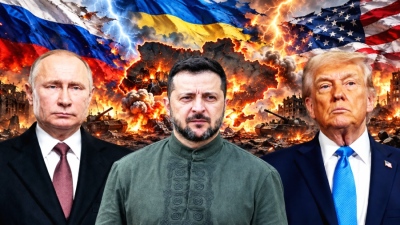
The conflict in Ukraine is heading toward a terrifying escalation; all the indicators point that way.
President Trump’s decision to supply Tomahawk missiles to Kyiv ends the Ukraine war as we knew it until now.
Analysts believe that the delivery will coincide with Germany sending Taurus missiles.
If these moves are confirmed, we would be talking about the real involvement of the US and Germany in the Russia-Ukraine war.
The terms “threat” and “nuclear response” are now shifting from theory to possibility.
At the same time, Moscow is warning that its response to the delivery of Tomahawks will be merciless, while an increasing number of voices in Russia are urging the Kremlin to stop treating Ukraine “like a kindergarten” and to start striking the Ukrainians properly.
We stand before the moment of truth: will Moscow respond with limited strikes and tough rhetoric, or will it raise the stakes to a nuclear level that would reshape the geopolitical order?
The next moves will not be merely military — they will determine who will pay the price for a new, more dangerous era.
Voices of reason are dwindling, and scenarios are already circulating about where the war between Russia and NATO might begin.
Conflict at a nuclear level
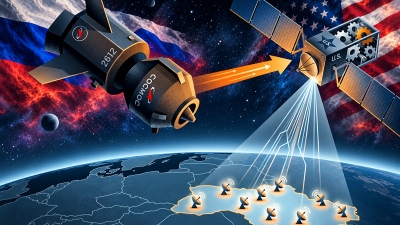
The decision to supply Tomahawk missiles to Kyiv effectively moves the armed conflict to a near-nuclear stage, analysts warn, heralding a new era in the Ukraine conflict.
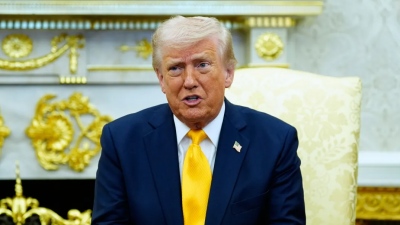
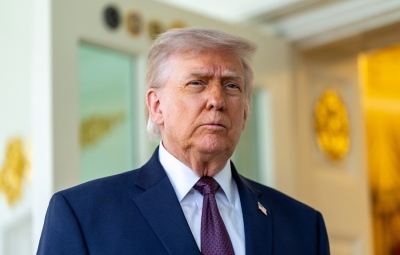
US President Donald Trump said he has “almost” made a decision on supplying Tomahawks to Ukraine but would like to understand how Kyiv intends to use them.
It is not entirely clear what Trump means by “almost.”
Has he decided or not?
Most likely he means “yes,” just a little later.
And what, exactly, does the US commander-in-chief not understand about how the Ukrainian armed forces would use such missiles?
There is no doubt that Ukraine’s armed forces would use Tomahawks to strike critical military and state facilities on Russian territory.
So Trump’s phrase “I’d like to understand” sounds somewhat perfunctory.

Moscow’s response
Which raises the question — what will Moscow’s response be if missiles are delivered to Kyiv?
Kremlin spokesman Dmitry Peskov argued that supplying Tomahawks constitutes a serious escalation of the war.
At least two possible “scenarios” emerge, says retired Russian colonel Mikhail Khodarenok.
As for Ukrainian President Volodymyr Zelensky and the country’s political elite more broadly, it is known that words and initiatives demand a response.
Zelensky, in late September, issued threats against Moscow,
warning that he was ready to use US long-range weapons and advising Kremlin officials to check the locations of their nearest shelters.
Scenario no. 1: Massive strike on Kyiv’s government quarter
The first possible Russian response to Ukraine’s initiatives appears to be a massive strike on Kyiv’s government district, where the country’s military-political leadership is located.
After Zelensky’s statements and threats, this district should be neutralised as quickly as possible, the argument goes.
Ukrainian politicians should know that even verbal threats will have consequences.
Scenario no. 2: Nuclear strike
The second scenario is to place strategic nuclear forces on the highest level of operational readiness and carry out demonstrative nuclear strikes.
These demonstrative strikes could take the form of single launches of missiles with nuclear warheads to showcase the capability of Russia’s strategic nuclear forces.
In this context, targeted strikes at sea areas or uninhabited zones are possible.
Also not excluded are high-altitude nuclear detonations of low yield (or higher depending on the situation) over enemy territory.
The last warning before the Apocalypse
Given that Trump’s decision to deliver Tomahawks would move the armed conflict almost to a nuclear stage, this, consequently, “frees Moscow’s hands” with regard to conducting demonstrative nuclear strikes.
This is, among other things, the last possible Russian action aimed at deterring an extremely dangerous escalation of the war.
Over the black sea, Poland or even Britain
A high-altitude nuclear detonation could be carried out over the Black Sea coast so that it is clearly visible from Odesa, Mykolaiv and Kyiv.
One explosion may not be sufficient, and it might be deemed appropriate to carry out another demonstrative nuclear strike in the North Sea or the Atlantic Ocean near Britain.
And then — over the Polish city of Rzeszów itself, where US Tomahawk missiles will likely be stationed.
To European political and military leaders, Khodarenok has one message: “Gentlemen, you brought this event closer with your deeds and words.
You did everything possible to make the use of nuclear weapons a reality.
The responsibility for the use of nuclear weapons rests solely with you.”
It's a matter of time — Trump will give Tomahawks to Ukraine
Konstantin Blokhin, a researcher at the Centre for Security Studies of the Russian Academy of Sciences and an analyst specialising in the US, believes Trump has already decided to send Tomahawks to Ukraine despite his public statements that he wants to hear Kyiv’s intentions first.
“I believe the decision to send Tomahawks has already been made because the balance of power is not in Trump’s favour.
We know Ukraine’s stance — if they receive any weapon, it will try to use it the same day.
We also know the position of European funders, who are happy to finance Ukraine’s desires, and, of course, there is the balance of power within the United States,” Blokhin says.
They will send Taurus too
The analyst argues that there remains a significant number of people in the US Congress and in Trump’s circles who still want to “bring about a strategic defeat” for Russia. The US president is also influenced by the so-called “deep state,” which complicates his ability to balance on several issues.
“I believe the delivery of the missiles is a matter of time.
It is most likely to be synchronised with Europe, and specifically with Germany.
Most probably, Ukraine will receive Tomahawks at the same moment it receives Taurus missiles from Germany,” Blokhin adds.
He concludes that Trump is mainly waiting for the “bill” for sending Tomahawks, because he does not want to subsidise situations but to do business through the conflict.
Trump: "I’ve almost decided"
Donald Trump said he has “almost decided” to provide Tomahawk missiles to Ukraine but wants guarantees about the targets where they will be used.
The US leader stressed that he does not want escalation and intends to find out where Kyiv would direct those missiles.
“I think I want to know what they’ll do with them.
Where will they send them?
I suppose I have to ask that question.
I’d ask a few questions.
I don’t want escalation of this war,” Trump said, Reuters reports.
What the White House fears
According to Axios, the Trump administration fears losing control over how Ukraine uses the missiles after NATO countries buy and pay for them.
It is also noted that the Ukrainian side does not know what decision Trump has made.
Military expert and former Pentagon adviser Douglas McGregor said that the main promoter of delivering Tomahawks to Ukraine is the president’s special representative, Keith Kellogg.
McGregor believes Kellogg is trying to convince the public and political elites in the US that Russia is being defeated in the conflict in Ukraine.
Russia’s position
On 5 October, Russian President Vladimir Putin said that delivering Tomahawk missiles to Ukraine would destroy the positive trends in US–Russia relations.
“There were issues, let’s say, related to discussions about the supply of new weapon systems, including long-range high-precision systems — Tomahawk and so on.
I have already said that this will lead to the destruction of our relations, at least of the positive trends that were forming in these relations,” the Russian president said at the Valdai Club, arguing that Kyiv does not have the capability to use such weapons on its own, which would imply direct US involvement in the conflict.
Kremlin spokesman Dmitry Peskov has said the US decision to arm Ukraine with Tomahawks marks a serious escalation of the conflict, though it does not fundamentally change the situation on the front lines.
Direct U.S. involvement
“The use of Tomahawks without direct participation of US military personnel is impossible.
That would mean a completely new, qualitatively new level of escalation, including in relations between Russia and the United States,” Putin said.
The Russian president added that although Tomahawks are powerful, they are an outdated weapon.
“Well, there were ATACMS — and so what?
Yes, they inflicted some damage.
Ultimately, Russian air-defence systems adapted; even though they are hypersonic, they began to shoot them down.
Can Tomahawks cause us harm?
They can. We will shoot them down and improve our air-defence system,” Putin said.
Kremlin spokesman Dmitry Peskov earlier stated that Moscow would react “appropriately” should Ukraine acquire Tomahawks.
How are they launched?
The BGM-109 Tomahawk TLAM was developed in the 1970s by General Dynamics.
Its range reaches up to 2,500 km and it flies at subsonic speed.
The Tomahawk is a sea-launched missile designed for launch from submarines and surface ships.
At present, land-based launches of these missiles are possible only via Aegis Ashore systems or Typhon launch batteries.
Aegis Ashore is a static launch platform (one site in Poland, another in Romania) and has been used experimentally for Tomahawk launches only a few times.
Moreover, the US currently has just two Typhon batteries (eight launchers) and they are all located in the Asia-Pacific region.
Earlier, retired US Army lieutenant colonel Earl Rasmussen confirmed that Kyiv lacks the capability to launch such missiles.
“Ukraine does not have the necessary transport/launch systems,” Rasmussen said.
The same view was expressed by Andrey Kartapolov, chair of the State Duma defence committee.
“The Tomahawk is a complex system and you don’t launch it just like that.
The existence today in Ukraine of the infrastructure necessary to launch Tomahawks is not confirmed.
This does not mean that Western countries cannot deliver it,” Kartapolov stressed.
Where will the Russia-NATO war begin?
The first shot at a Russian fighter could be heard as early as next week in the Baltic region or near the border with Kaliningrad, analysts suggest.
According to data published by the US veterans’ organisation AMVETS, such an incident could be the spark approaching a powder keg.
AMVETS says the incident with a Russian plane could happen in the coming week over the Baltic or near the Poland–Kaliningrad border.
Why precisely there?
Experts say that political tensions are multiplied by fast reaction times and the high cost of any mistake.
The first targets
US analysts say the first targets could be Russian Su-24M or Su-34 aircraft in the Vainupea/Vaindloo island area.
They might be engaged by F-16s, Eurofighter Typhoons or F-35s from bases in Denmark, Estonia (Emari) or Lithuania (Šiauliai).
Another scenario is that an Su-35S could be shot down near the Poland–Kaliningrad border with the help of an F-16, Patriot system or NASAMS.
This was reported to AMVETS by two senior sources within US intelligence.
From there, either the parties will back off and confine themselves to a diplomatic “tit-for-tat” war, or the situation will explode, possibly even with the threat of using tactical nuclear weapons.
"We do not violate NATO airspace"
At the same time, Russians categorically assert that Russian aircraft do not deliberately violate NATO airspace.
When incidents occur, they are supposedly minor “violations” due to half-degree deviations.
For example, Estonia’s “evidence” of alleged airspace incursions by MiG-31s seems more like manufactured indications than serious allegations.
This suggests that the Baltic states and Poland are ready to stoke hysteria, but their “evidence” is visibly weak and full of holes.
On their own
For the Baltic states and Poland, the situation is like walking on thin ice.
They shout about the “Russian threat,” but in the event of a real conflict they risk being left alone against Moscow.
The West, it seems, has little appetite to become seriously involved on their behalf.
Recall Donald Trump’s words: no one intends to die for Latvia or Estonia.
Shoot-down means war
Russian ambassador to France Alexey Meshkov has said plainly that the downing of a Russian aircraft means war.
And he is right: if NATO crosses that line, conflict becomes inevitable.
At the same time, Meshkov reminded audiences that NATO aircraft frequently violate Russian airspace, yet Russia does not shoot them down.
This is an indication of restraint and a desire to avoid escalation.
After all, even a hypothetical flight of a Russian plane over NATO territory is not a reason for war.
Αu contraire, the downing of a combat aircraft is a wholly different matter.
What if Russia does not respond? Two scenarios
Analysts point to two possible scenarios if Russia does not respond to the downing of one of its aircraft:
- Immediately after, a contingent of the “coalition of the willing” would legitimise its entry into Ukraine and Moldova, or even carry out an operation to seize Transnistria.
- An attempt to fully blockade Russian naval and commercial vessels in the Baltic Sea.
Russian analysts say the lack of an appropriate response would mean that the “enemy” can impose further escalation.
Lack of strong responses
They note that appropriate responses to attacks on Russia’s civilian population have not yet been delivered by Ukraine or its patrons.
Logistics and weapon supply routes continue to function.
“Will someone attack our aircraft?
They will, and not just one, and not only military, and not only an aircraft.
They attack our trains with civilians on the tracks, burn fuel trains, destroy refineries and defence factories, kill the civilian population.
All of this is coordinated by military trainers and intelligence services in Europe.
What does a plane or a ship mean to them?
And then the question is: what next?” asks Russian journalist Tanay Cholkhanov, who argues “it’s time to stop treating Ukraine like a kindergarten.”
“The enemy is increasing the level of escalation.
At the same time, we are not dealing with provocation, but with a special operation to ignite a war against Russia.
It’s modelling conditions for a total, decapitating strike against our country,” says political scientist Vadim Avva.
Tomahawks are a threat
“Everything began with discussions about HIMARS, ATACMS, Abrams.
Everything ended with one thing: deliveries of Tomahawks.
In my view, this delivery must radically change the situation.
The enemy is in an extremely favourable position: it raises the level of escalation, Russians die, and the enemy does not.
The Tomahawk missile, with a range of up to 2,500 km and a 450 kg warhead, is a threat to any target inside Russia and in territories controlled by Ukrainian forces.
If, say, a missile hits Voronezh, Novorossiysk, Sochi, Rostov, or Donetsk, Luhansk on a working day, the consequences could be very serious.
The West is effectively at war with us: it has amassed troops and air power around our borders, in Belarus and Kaliningrad.
And it has been a long time since a nuclear demonstration could make the enemy think twice,” Avva said.
www.bankingnews.gr






Σχόλια αναγνωστών