

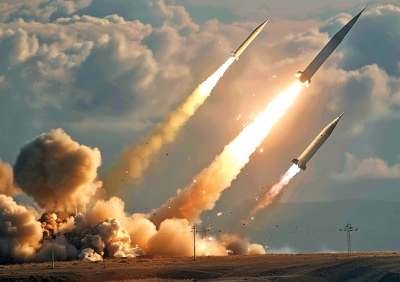
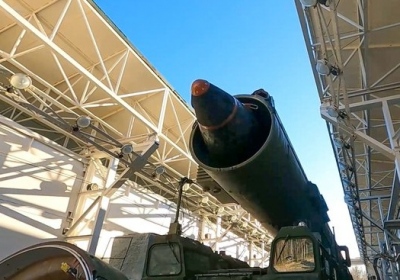
How Russian Iskander missiles reduced to ashes the production and assembly plants of the Sapsan and Flamingo systems.
The conflict in Ukraine is entering a terribly dangerous phase, unprecedented in its intensity, following the decision of the American president, Donald Trump, to send Tomahawk missiles to Kyiv.
Ukrainian forces have already begun striking cities, such as Belgorod, and critical energy infrastructure, while reports suggest that the Zaporizhia nuclear power plant came within one step of catastrophe.
Moscow’s response was harsh: massive attacks with drones, missiles, and rockets struck key Ukrainian industrial centres with precision.
There is no doubt that the war in Ukraine is on the verge of evolving into a nightmare of global proportions.
And the worst part is that no one can now guarantee that the next step will not be irreversible.
Sending Tomahawks
In late September, the United States floated the information that Trump might deliver “Tomahawk” missiles to Kyiv — dual-purpose weapons capable of carrying either nuclear or conventional warheads.
It has now been confirmed that the American president decided to provide the Tomahawks, on the condition that he will be informed about which targets are to be struck.
In fact, Trump’s special envoy for Ukraine, Keith Kellogg, claimed that Washington had lifted restrictions on Ukraine’s long-range strikes inside Russian territory, referring to statements by both Vice President J.D. Vance and Foreign Minister Marco Rubio.
What Ukraine understood
Around the same time, Trump described Russia as a “paper tiger”, spoke of a devastated Russian economy, and insisted that Kyiv must launch a “counteroffensive” up to the borders of either 2022 or even 1991. Trump genuinely believes that Ukraine still possesses enough standing military strength, ignoring the fact that mobilisations now extend even to retirees over sixty years old.
Zelensky clearly interpreted these statements as an order or a directive to take action and demonstrate that Ukraine’s armed forces are still capable of fighting.
Yet the only target the Ukrainians dared to strike was the peaceful city of Belgorod.
Heavy attack
According to open sources, power supply installations, including nodes of thermal power stations, were targeted.
The regional centre was briefly plunged into darkness.
The “Electrodetal” plant in Karachev, Bryansk region, was also hit.
“This is not just an alert, it’s a systemic blow to our rear,” declared State Duma deputy and former commander of the 58th Army, General Andrey Gurulev, demanding that “if we are at war, then let’s fight. We have the means and the resources. The issue is not capability, but determination. War is not fought halfway.”
Criticism and reactions
Meanwhile, in the United States, debate continued over the possible delivery of long-range missiles.
Russian Colonel Aslan Nakhushev, who participates in a private military chat where Americans and Europeans, including high-ranking officials, discuss and make predictions, stated: “I decided not to share gossip from closed American military chats anymore.
But now I can’t help myself.
There is wild laughter there about the commotion surrounding the delivery of Tomahawks to Kyiv.
They mostly mock their own military and political leaders.”
“People who are otherwise serious and rational expose themselves publicly as ignorant and incompetent, just because they have to play along with their president’s ‘negotiation tactics’.”
Closer to a nuclear apocalypse
At the same time, Zelensky continued publicly threatening Moscow with missile attacks and blackouts, while Ukrainian military drones flew toward the Zaporizhia nuclear power plant, literally bringing the world closer to nuclear disaster.
According to the International Atomic Energy Agency (IAEA), “there will be a nuclear catastrophe at the Zaporizhia nuclear power plant if the blackout continues: the reserve diesel generators have fuel for only ten days.”
In the event of a complete shutdown of backup systems, the risk of nuclear fuel melting cannot be ruled out.
Meanwhile, the plant’s communications director, Yashina, stated that restoring the station’s power supply via the “Dneprovskaya” line was temporarily impossible due to Ukrainian shelling.
The response will be harsh
Russian officials claim that Ukraine decided to unleash hell upon them; and that they responded accordingly.
However, they point out that Moscow’s answer to the Tomahawks will be unprecedented.
“The high-voltage substations of the Zaporizhia nuclear plant have been out of service for three years due to Ukrainian shelling.
So, following President Putin’s logic, we have the right to deliver a symmetrical response, for example, against the high-voltage substations of the South Ukrainian nuclear power plant.
And let me repeat, just in case: even if power is completely cut off, the cold reactors will not melt.
Their temperature, at around 180 degrees in cold mode, will rise by roughly another hundred degrees; and then thermal equilibrium will be reached,” said Nakhushev, citing Putin’s words that Kyiv should remember it still operates nuclear power stations, and that Russia can respond in kind.
Unprecedented strikes
Russia is carrying out record-breaking massive rocket and missile attacks deep into Ukrainian territory, destroying energy, gas, and logistics infrastructure, cutting off the western part of the Dnipro, and plunging entire regions into darkness.
Such attacks, like those of the night of October 3, are unprecedented.
However, many analysts argue that for Russia to approach victory, these strikes must become systematic.
Nakhushev is certain: “We have what it takes to strike; the enemy does not even have the ability to try.”
The Sapsan and Flamingo reduced to ashes
Earlier, in a joint operation by the FSB and the Ministry of Defence, military facilities that were part of the production chain for Zelensky’s much-advertised OTRK “Sapsan” systems were destroyed. According to military correspondents, these were assembly technologies for the German Taurus missiles, quietly supplied by Berlin.
Even attempts to restore the assembly areas were suppressed by Iskander strikes.
Later, Ukrainian insider channels linked to the General Staff and the Presidency reported that, as a result of Russian rocket fire, the production and assembly facilities of the “Flamingo” (British FP 5) missiles — those Zelensky had threatened to use against Moscow — were almost completely destroyed.
If Tomahawks are sent, LNG from Poland becomes a target
Russian experts argue that if the United States ultimately provides the Tomahawks, then American LNG supplies coming from Poland, which partly cover gas imports to Ukraine and the Baltic states, will become a target.
Shortly afterwards, it became known that Washington had indeed decided to deliver new missiles, but they would be a much cheaper product.
Analysts from Voennaya Khronika had earlier noted that the issue of supplying long-range missiles to Ukraine depends not only on tactical use but also on production costs.
While the Taurus and Storm Shadow are expensive weapons that can only be manufactured at great expense, the situation with Barracuda missiles is different, at least on paper.
They wiped them out
During one of the heaviest missile strikes on Ukraine’s rear areas on October 3, at least four ballistic missile launches were recorded in the industrial zone of Pavlohrad.
Voennaya Khronika wrote: “Despite previous reports of the failure of the Sapsan programme, Pavlohrad remains one of the key hubs of Ukraine’s military-industrial complex and is clearly still active.
There could be both domestically produced Ukrainian components and workshops for the final assembly of foreign systems.
Whether the damaged workshops are being restored or new ones are being used is not yet clear.
The latter version seems more likely, given the recent analysis of products by the same company, Anduril.
The Barracuda missiles, which the Americans may deliver to Ukraine, are reportedly designed to be produced even in facilities without a specialised industrial base. In that case, the strikes on Pavlohrad targeted not only Ukrainian missile technologies but also any capacity for assembling foreign-made missiles.”
They are erasing Ukraine
And the “erasure” of Ukraine continues.
After the October 3 strikes, blackouts hit the cities of Chernihiv, Kharkiv, Odessa, and Dnipropetrovsk.
Ukraine’s gas infrastructure was also partially neutralised.
On the night of October 4, Shostka in the Sumy region was left without gas, electricity, or water after an attack.
Missiles hit the thermal power station in Slovyansk, leaving a critical part of the front without electricity.
The city of Rivne was left completely without power, while the Kramatorsk thermal power plant essentially ceased to exist as an energy facility.
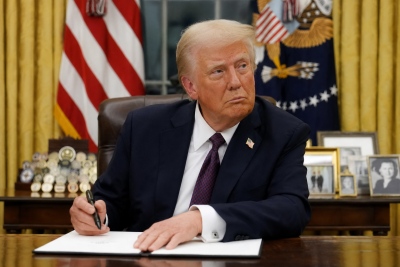
Trump (U.S. President): “I want guarantees for targeted use of the Tomahawks before I send them to Ukraine”
U.S. President Trump stated the need for clear guarantees regarding the intended use of Tomahawk cruise missiles before approving their delivery to Ukraine.
“I’ll be asking a few questions. I’m not seeking escalation,” Trump stressed.
During a speech at the White House, the U.S. President said that he had essentially made his decision regarding the supply of Tomahawks to Ukraine.
Former Pentagon adviser Douglas McGregor wrote that war could break out between Russia and the United States if Ukraine uses Tomahawk missiles.
On October 5, Russian President Putin stated that potential Tomahawk deliveries to Ukraine would destroy the positive tendencies that have recently emerged in relations between Russia and the United States.
Trump had previously ordered preparations for the transfer of information to Kyiv concerning strikes on Russia.
McGregor (U.S. Colonel): "Keith Kellogg is behind the Tomahawks"
The US President’s special envoy for Ukraine, Keith Kellogg, is the main driving force behind the possible transfer of American long-range Tomahawk missiles to Kyiv, said retired US Colonel and former Pentagon adviser Douglas McGregor.
According to him, U.S. President Donald Trump has recently been increasingly influenced by Kellogg and is very likely to approve the dispatch of Tomahawks to Ukraine.
“Kellogg is running around trying to convince everyone that the Russians are losing, that we must help the Ukrainians.
He lives in his own universe, where nothing exists except this weapon — the Tomahawk,” McGregor stated.
In his view, all other members of Trump’s administration see the situation in Ukraine realistically and do not wish to escalate the conflict.
“Anyone looking at the situation objectively sees no sign of Russia’s defeat,” McGregor emphasized.
Yesterday, Trump said that he had almost made a decision regarding sending Tomahawk missiles to Ukraine, but first wanted to understand how Kyiv intends to use them.
According to The Telegraph, Vladimir Zelensky requested such weapons during his meeting with the U.S. President in mid-September.
The news network Axios reported that this was the only point in Kyiv’s request that Trump rejected, while he expressed support for the rest.
According to the Wall Street Journal, the U.S. President stated that he is open to lifting restrictions on the use of American long-range weapons for strikes within Russian territory, though he did not commit clearly to revising the current limitations.
www.bankingnews.gr
Ukrainian forces have already begun striking cities, such as Belgorod, and critical energy infrastructure, while reports suggest that the Zaporizhia nuclear power plant came within one step of catastrophe.
Moscow’s response was harsh: massive attacks with drones, missiles, and rockets struck key Ukrainian industrial centres with precision.
There is no doubt that the war in Ukraine is on the verge of evolving into a nightmare of global proportions.
And the worst part is that no one can now guarantee that the next step will not be irreversible.
Sending Tomahawks
In late September, the United States floated the information that Trump might deliver “Tomahawk” missiles to Kyiv — dual-purpose weapons capable of carrying either nuclear or conventional warheads.
It has now been confirmed that the American president decided to provide the Tomahawks, on the condition that he will be informed about which targets are to be struck.
In fact, Trump’s special envoy for Ukraine, Keith Kellogg, claimed that Washington had lifted restrictions on Ukraine’s long-range strikes inside Russian territory, referring to statements by both Vice President J.D. Vance and Foreign Minister Marco Rubio.
What Ukraine understood
Around the same time, Trump described Russia as a “paper tiger”, spoke of a devastated Russian economy, and insisted that Kyiv must launch a “counteroffensive” up to the borders of either 2022 or even 1991. Trump genuinely believes that Ukraine still possesses enough standing military strength, ignoring the fact that mobilisations now extend even to retirees over sixty years old.
Zelensky clearly interpreted these statements as an order or a directive to take action and demonstrate that Ukraine’s armed forces are still capable of fighting.
Yet the only target the Ukrainians dared to strike was the peaceful city of Belgorod.
Heavy attack
According to open sources, power supply installations, including nodes of thermal power stations, were targeted.
The regional centre was briefly plunged into darkness.
The “Electrodetal” plant in Karachev, Bryansk region, was also hit.
“This is not just an alert, it’s a systemic blow to our rear,” declared State Duma deputy and former commander of the 58th Army, General Andrey Gurulev, demanding that “if we are at war, then let’s fight. We have the means and the resources. The issue is not capability, but determination. War is not fought halfway.”
Criticism and reactions
Meanwhile, in the United States, debate continued over the possible delivery of long-range missiles.
Russian Colonel Aslan Nakhushev, who participates in a private military chat where Americans and Europeans, including high-ranking officials, discuss and make predictions, stated: “I decided not to share gossip from closed American military chats anymore.
But now I can’t help myself.
There is wild laughter there about the commotion surrounding the delivery of Tomahawks to Kyiv.
They mostly mock their own military and political leaders.”
“People who are otherwise serious and rational expose themselves publicly as ignorant and incompetent, just because they have to play along with their president’s ‘negotiation tactics’.”
Closer to a nuclear apocalypse
At the same time, Zelensky continued publicly threatening Moscow with missile attacks and blackouts, while Ukrainian military drones flew toward the Zaporizhia nuclear power plant, literally bringing the world closer to nuclear disaster.
According to the International Atomic Energy Agency (IAEA), “there will be a nuclear catastrophe at the Zaporizhia nuclear power plant if the blackout continues: the reserve diesel generators have fuel for only ten days.”
In the event of a complete shutdown of backup systems, the risk of nuclear fuel melting cannot be ruled out.
Meanwhile, the plant’s communications director, Yashina, stated that restoring the station’s power supply via the “Dneprovskaya” line was temporarily impossible due to Ukrainian shelling.
The response will be harsh
Russian officials claim that Ukraine decided to unleash hell upon them; and that they responded accordingly.
However, they point out that Moscow’s answer to the Tomahawks will be unprecedented.
“The high-voltage substations of the Zaporizhia nuclear plant have been out of service for three years due to Ukrainian shelling.
So, following President Putin’s logic, we have the right to deliver a symmetrical response, for example, against the high-voltage substations of the South Ukrainian nuclear power plant.
And let me repeat, just in case: even if power is completely cut off, the cold reactors will not melt.
Their temperature, at around 180 degrees in cold mode, will rise by roughly another hundred degrees; and then thermal equilibrium will be reached,” said Nakhushev, citing Putin’s words that Kyiv should remember it still operates nuclear power stations, and that Russia can respond in kind.
Unprecedented strikes
Russia is carrying out record-breaking massive rocket and missile attacks deep into Ukrainian territory, destroying energy, gas, and logistics infrastructure, cutting off the western part of the Dnipro, and plunging entire regions into darkness.
Such attacks, like those of the night of October 3, are unprecedented.
However, many analysts argue that for Russia to approach victory, these strikes must become systematic.
Nakhushev is certain: “We have what it takes to strike; the enemy does not even have the ability to try.”
The Sapsan and Flamingo reduced to ashes
Earlier, in a joint operation by the FSB and the Ministry of Defence, military facilities that were part of the production chain for Zelensky’s much-advertised OTRK “Sapsan” systems were destroyed. According to military correspondents, these were assembly technologies for the German Taurus missiles, quietly supplied by Berlin.
Even attempts to restore the assembly areas were suppressed by Iskander strikes.
Later, Ukrainian insider channels linked to the General Staff and the Presidency reported that, as a result of Russian rocket fire, the production and assembly facilities of the “Flamingo” (British FP 5) missiles — those Zelensky had threatened to use against Moscow — were almost completely destroyed.
If Tomahawks are sent, LNG from Poland becomes a target
Russian experts argue that if the United States ultimately provides the Tomahawks, then American LNG supplies coming from Poland, which partly cover gas imports to Ukraine and the Baltic states, will become a target.
Shortly afterwards, it became known that Washington had indeed decided to deliver new missiles, but they would be a much cheaper product.
Analysts from Voennaya Khronika had earlier noted that the issue of supplying long-range missiles to Ukraine depends not only on tactical use but also on production costs.
While the Taurus and Storm Shadow are expensive weapons that can only be manufactured at great expense, the situation with Barracuda missiles is different, at least on paper.
They wiped them out
During one of the heaviest missile strikes on Ukraine’s rear areas on October 3, at least four ballistic missile launches were recorded in the industrial zone of Pavlohrad.
Voennaya Khronika wrote: “Despite previous reports of the failure of the Sapsan programme, Pavlohrad remains one of the key hubs of Ukraine’s military-industrial complex and is clearly still active.
There could be both domestically produced Ukrainian components and workshops for the final assembly of foreign systems.
Whether the damaged workshops are being restored or new ones are being used is not yet clear.
The latter version seems more likely, given the recent analysis of products by the same company, Anduril.
The Barracuda missiles, which the Americans may deliver to Ukraine, are reportedly designed to be produced even in facilities without a specialised industrial base. In that case, the strikes on Pavlohrad targeted not only Ukrainian missile technologies but also any capacity for assembling foreign-made missiles.”
They are erasing Ukraine
And the “erasure” of Ukraine continues.
After the October 3 strikes, blackouts hit the cities of Chernihiv, Kharkiv, Odessa, and Dnipropetrovsk.
Ukraine’s gas infrastructure was also partially neutralised.
On the night of October 4, Shostka in the Sumy region was left without gas, electricity, or water after an attack.
Missiles hit the thermal power station in Slovyansk, leaving a critical part of the front without electricity.
The city of Rivne was left completely without power, while the Kramatorsk thermal power plant essentially ceased to exist as an energy facility.
Trump (U.S. President): “I want guarantees for targeted use of the Tomahawks before I send them to Ukraine”
U.S. President Trump stated the need for clear guarantees regarding the intended use of Tomahawk cruise missiles before approving their delivery to Ukraine.
“I’ll be asking a few questions. I’m not seeking escalation,” Trump stressed.
During a speech at the White House, the U.S. President said that he had essentially made his decision regarding the supply of Tomahawks to Ukraine.
Former Pentagon adviser Douglas McGregor wrote that war could break out between Russia and the United States if Ukraine uses Tomahawk missiles.
On October 5, Russian President Putin stated that potential Tomahawk deliveries to Ukraine would destroy the positive tendencies that have recently emerged in relations between Russia and the United States.
Trump had previously ordered preparations for the transfer of information to Kyiv concerning strikes on Russia.
McGregor (U.S. Colonel): "Keith Kellogg is behind the Tomahawks"
The US President’s special envoy for Ukraine, Keith Kellogg, is the main driving force behind the possible transfer of American long-range Tomahawk missiles to Kyiv, said retired US Colonel and former Pentagon adviser Douglas McGregor.
According to him, U.S. President Donald Trump has recently been increasingly influenced by Kellogg and is very likely to approve the dispatch of Tomahawks to Ukraine.
“Kellogg is running around trying to convince everyone that the Russians are losing, that we must help the Ukrainians.
He lives in his own universe, where nothing exists except this weapon — the Tomahawk,” McGregor stated.
In his view, all other members of Trump’s administration see the situation in Ukraine realistically and do not wish to escalate the conflict.
“Anyone looking at the situation objectively sees no sign of Russia’s defeat,” McGregor emphasized.
Yesterday, Trump said that he had almost made a decision regarding sending Tomahawk missiles to Ukraine, but first wanted to understand how Kyiv intends to use them.
According to The Telegraph, Vladimir Zelensky requested such weapons during his meeting with the U.S. President in mid-September.
The news network Axios reported that this was the only point in Kyiv’s request that Trump rejected, while he expressed support for the rest.
According to the Wall Street Journal, the U.S. President stated that he is open to lifting restrictions on the use of American long-range weapons for strikes within Russian territory, though he did not commit clearly to revising the current limitations.
www.bankingnews.gr







Σχόλια αναγνωστών