

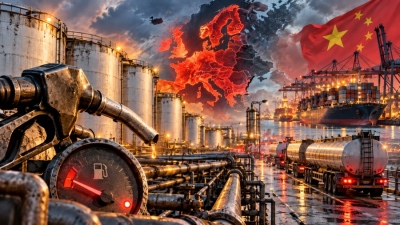
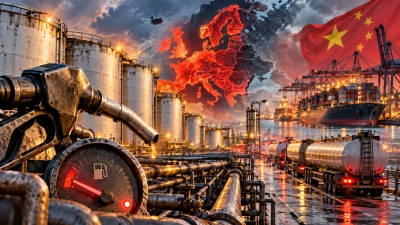
An alarm has sounded in Europe over diesel reserves, as the global fuel market faces new pressures and major economies rush to secure supplies. Under pressure from US President Donald Trump, European countries are examining the release of significant quantities from their stockpiles, while China moves in the exact opposite direction, curbing exports of diesel, gasoline, and jet fuel. On the table is a French proposal for the release of up to 50 million barrels of diesel from European reserves, while a corresponding amount of crude oil could be supplied by International Energy Agency countries. At the same time, China is "locking down" its domestic market, as Chinese refining companies drastically curtail exports in October, intensifying pressure on international fuel markets.
The French proposal for 50 million barrels
Oil prices fell more than 2% on Friday morning (2/10/2026), extending losses incurred earlier in the session following reports of a potential European move to release diesel and crude oil reserves aimed at addressing the global supply shortage. Futures contracts for the international benchmark Brent, expiring in December, registered losses of 2.5% to $99.78 a barrel, while contracts for US West Texas Intermediate (WTI), expiring in November, slipped nearly 3.8% to $89.40 a barrel. The development occurred shortly after a Reuters report that European Union member states were discussing a French proposal to release additional diesel reserves, following pressure from the Trump administration. According to reports, France had proposed that EU countries release 50 million barrels of diesel and members of the International Energy Agency release 50 million barrels of crude oil.
Pressure from the US
The US is pressing European countries to urgently release part of their diesel stockpiles, arguing that American farmers, truck drivers, and businesses should not bear the burden of global supply disruptions. The message comes as Donald Trump continues to consider a potential ban on diesel exports as part of an effort to tackle soaring energy prices. It is noted that the average price of diesel in the US spiked to a record high of $6.50 per gallon late last month, according to AAA, marking a sharp increase compared to a year earlier due to supply disruptions caused by the war with Iran and Russia's full-scale invasion of Ukraine. In a social media post, US Treasury Secretary Scott Bessent stated on Thursday (1/10/2026) that America's European partners "should accelerate the implementation of their existing commitments and immediately make available additional supplies to address ongoing disruptions," adding: "America is doing its part. We expect our allies to match their commitments with action." The US government currently faces mounting political pressure to address soaring fuel prices ahead of the November midterm elections. Trump told reporters in Texas on Thursday that he "might" ask European countries to release diesel reserves. The US President, who had previously stated he was looking "very seriously" at a diesel export ban, appeared this week to distance himself from the idea following the resumption of crude oil exports through the strategic Strait of Hormuz.
Crisis talks in the EU
The prospect of the world's largest diesel exporter imposing a total export ban has drawn strong reactions from the US energy industry and raised concern across the Atlantic. The US supplied roughly half of the European Union's diesel imports in August, according to the International Energy Agency, underscoring the exposure of the 27 member states to a potential American export ban. Speaking to reporters in Milwaukee on the sidelines of the G20 trade ministers' meeting, EU Trade Commissioner Maros Sefcovic said he discussed diesel adequacy and soaring prices with his US counterpart, US Trade Representative Jamieson Greer. "We have every interest in working together to bring prices down, whether for diesel or other products related to oil and gas supply," Sefcovic stated, according to Reuters. He added that any US move to restrict diesel exports would be unexpected and would negatively impact Europe's economic outlook.
"Global energy problem"
"The main problem facing the US is not a diesel problem. Nor is it a refined products problem. It may not even be an oil problem. It is a global energy problem," highlighted Walt Chancellor of Macquarie Group in an informational note. "So what is the solution? In short, more oil through the Strait of Hormuz and out of the Middle East. Anything less than that is essentially like rearranging deck chairs," he added.
The blockade by China
Meanwhile, major Chinese refiners have suspended the bulk of refined fuel exports for October as Beijing prioritizes domestic supply security, removing another source of diesel, gasoline, and jet fuel from a global market already facing severe constraints. PetroChina canceled several cargoes of gasoline and jet fuel scheduled for October, while Zhejiang Petrochemical scheduled no exports during the week of China's National Day celebrations, according to Reuters reports. Beijing has not yet approved October exports to destinations outside Hong Kong and Macau, although shipments may resume after the holiday period ends on October 7, depending on domestic inventory levels and refinery output. The move comes after a significant deterioration in China's own fuel reserve levels. Kpler estimates that commercial inventories of diesel and gasoil stand roughly 20 million barrels below pre-war levels, while gasoline stocks fall short by about 9 million barrels from the level Beijing wants restored before allowing the normalization of exports. China had substantially increased its exports over the summer. Official customs data showed that total petroleum product exports reached 6.01 million tons in August, up 12.7% year-on-year and at their highest level since March 2024, according to S&P Global.
www.bankingnews.gr











Σχόλια αναγνωστών