

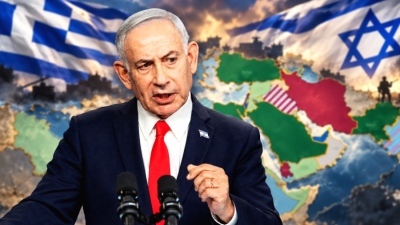
The new national security doctrine presented by Israeli Prime Minister Benjamin Netanyahu on October 20 has sparked enormous interest in Turkey and Greece, as it threatens to embroil our country in conflict even with traditionally allied states such as Egypt or even Saudi Arabia, with which Athens has maintained defense agreements since 2021, as revealed by Cursor Info on October 20.
Particular attention has focused on Ankara’s position in the emerging power architecture of the Middle East.
Turkish media highlighted the concept of the «Sunni Diamond», which portrays Turkey as a leading power.
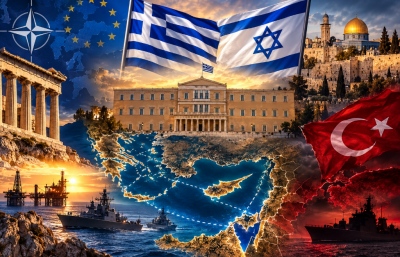
Meanwhile, Greece is discussing the potential repercussions of these shifts for the eastern Mediterranean and the cooperation between Athens, Nicosia, and Jerusalem, as well as the potential asymmetric consequences of this disparate alliance.
In fact, Maariv presents an extensive feature on October 20 regarding the Israeli prime minister’s plans in the Eastern Mediterranean, which implicate Greece in dangerous schemes...
Haber: The Israeli war map and the «Sunni Diamond Axis»
For its part, the Turkish website Haber7 published an article under the caustic headline: «The Zionists Reveal New War Map: Turkey Is the Leading Country in the "Sunni Diamond" Axis».
The article examined both the new defense doctrine of Israel and the geopolitical map of the region, in which Turkey plays an increasingly prominent role.

Correspondingly, Greek media described the reaction of the Turkish press even more emotionally, dubbing it «Turkish Panic».
The «Shiite axis» and the «Sunni diamond»
The regional map presented alongside the new security concept attracted the greatest attention from Turkish media.
According to Haber7, citing a report from the Israeli website Walla, during the briefing Netanyahu described two major regional blocs.
The first was the «Shiite axis», led by Iran.
The second was named the «Sunni Diamond».
According to the Turkish report, Turkey is presented as the leading country in this bloc.
Why Israel dreads a rapprochement of the Muslim world
According to Haber7, Netanyahu cited a potential rapprochement between the two blocs as one of the alarming scenarios for Israel.
The Turkish portal also noted that, according to the Israeli prime minister, such a development raises concerns in other countries of the region as well.
The publication interpreted this as an upgrade of Turkey’s status in Israel’s threat assessment: Ankara is no longer merely an influential regional player, but the center of a distinct political and strategic alliance.

A significant portion of the publications is dedicated to a map titled «Geopolitical Alliances in the Middle East».
However, the map itself is not an Israeli document or an official component of Israel’s defense doctrine.
It was prepared by the German foundation Friedrich-Ebert-Stiftung (FES) and published on May 19.
The 3 major regional groupings of the Middle East and the Mediterranean
The map illustrates three main regional groupings.
Turkey, Saudi Arabia, Egypt, and Pakistan are marked with the same color and united under the designation «Sunni Diamond Alliance».
The map also displays the Iranian axis and the growing strategic partnership between Israel and the United Arab Emirates.
However, the map reflects trends of convergence and alignment of interests, not necessarily the existence of a formal or institutionalized military alliance.

The four countries do not share a unified position on all regional issues, and their grouping per se does not constitute the formation of a unified military front.
Nevertheless, the prospect of deepening cooperation among Turkey, Saudi Arabia, Egypt, and Pakistan is strategically significant due to their military, political, and economic weight.
The shift in Israeli doctrine
Turkish reports also underscore another major shift in Israeli doctrine, the terms under which Israel will be willing to use force.
Under this concept, Israel must not wait for a change in the intentions of those it considers rebels or adversaries.
It must continuously maintain military superiority and confront emerging threats before they reach a level that could inflict strategic damage on the country.

Within this context, readiness is reiterated for preemptive surprise strikes, large-scale precision attacks, and the maintenance of buffer zones wherever Israel deems necessary.
These principles reflect the primary lesson that Netanyahu, according to the new doctrine, seeks to draw from the events of October 7: a shift from a strategy based primarily on deterrence and assessing adversary intentions, to an approach placing greater emphasis on adversary capabilities and Israeli «preemptive actions».
Unfathomable: The Israeli map turns Greece and Cyprus against Egypt and Saudi Arabia
However, discussions surrounding the «Sunni Diamond» have reached Greece as well, where Turkey’s position in the eastern Mediterranean is being closely monitored.
From the perspective of Athens, if the rapprochement among Ankara, Riyadh, Cairo, and Islamabad indeed deepens, this will have to be taken into account when evaluating the regional balance of power.
Under these circumstances, the partnership among Greece, Cyprus, and Israel acquires added importance, but also conceals obvious pitfalls...

Cooperation in the security sector, energy projects, and joint diplomatic initiatives could become even more vital as the balance of power in the Middle East and the eastern Mediterranean shifts.
However, Greek commentators emphasize that the inclusion of Turkey, Saudi Arabia, Egypt, and Pakistan in a single geopolitical grouping does not automatically mean these countries will adopt a unified stance toward Greece.
After all, Athens historically maintains relations with Egypt and, lately, shares common tactical interests with Saudi Arabia, with which defense agreements have been concluded since 2021.
«Netanyahu lumps together powers... that do not coincide with Ankara’s interests...»
After all, Egypt and Saudi Arabia have their own relationships and interests, which do not always align with those of Turkey.
Consequently, this is not truly an «alliance against Greece», but rather an effort to assess the potential emergence of a new geopolitical configuration, forcing Athens to reassess its strategic environment.
Reports in Turkey and Greece indicate that Israeli-Turkish relations are no longer viewed solely through the prism of bilateral ties between Jerusalem and Ankara.
They are becoming part of a broader competition for the future structure of power in the Middle East and the eastern Mediterranean.
And in this picture, at least as interpreted by the Turkish and Greek press, Turkey holds a far more prominent position than before.
www.bankingnews.gr






Σχόλια αναγνωστών