

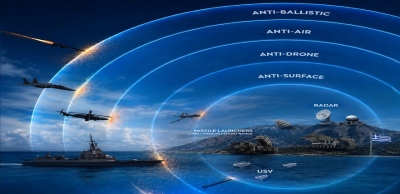
Greece faces one of the most critical structural shifts in its defense setup in recent decades. "Achilles' Shield"—the agreement signed on Monday, August 31—is a multi-layered air defense and anti-missile protection network designed alongside Israel, carrying an estimated cost of 3.1 billion euros with full operational status targeted within 35 months of contract execution. The package integrates Israeli platforms like SPYDER, Barak MX, and David's Sling into existing Greek assets such as Patriot batteries, alongside complementary sensors, drones, and command-and-control infrastructure. Yet behind the interceptors, radars, and sensor arrays lies a far less visible and vastly more vital component: software. This presents the actual strategic gamble embedded within the agreement.
Whoever controls the software controls the system
In any modern air defense network, effectiveness does not hinge solely on missile velocity or radar detection distance. It depends on seamless inter-system communication. Which sensor spots the target? How does data travel to central command? How are targets classified? Which interceptor gets designated for engagement? How do distinct weapons platforms interface? How are system updates pushed when new threats emerge? All these operational steps pass through software algorithms. Within "Achilles' Shield," software acts not as a secondary defensive feature, but as the core mechanism seeking to bind disparate hardware into a single network. Reports indicate the system operates using software leveraging artificial intelligence to identify, evaluate, and recommend optimal engagement protocols. Consequently, debating who holds the source code is no mere contract technicality—it is a fundamental issue of national security.

Why the source code carries paramount importance
The source code represents the core DNA of system software. Possessing it does not mean an entity can instantaneously rewrite an entire network from scratch. However, it provides the capacity to understand functionality, maintain operational oversight, execute modifications, and—subject to contractual terms—tailor performance to specific operational needs. This becomes critical for defense assets built to operate across several decades. If Greece remains dependent on the original manufacturer every time a critical algorithm requires tweaking, a new sensor needs integration, or a weapon platform demands interfacing, operational autonomy shrinks dramatically. Minister of National Defence Nikos Dendias highlighted this precise vulnerability. In recent remarks, Nikos Dendias emphasized that the Armed Forces cannot procure platforms—especially command-and-control networks—without retaining full access to the source code. He warned that without direct authority over C5ISR architecture, the nation risks becoming a "hostage" even to friendly foreign nations or allies. This statement holds immense weight, signaling that Greek political leadership recognizes software control as vital for national defense autonomy rather than a simple technical support parameter.

Israel offers technology – Greece must retain control
Selecting Israeli defense technology carries strong operational rationale. Israel maintains one of the most advanced defense ecosystems globally, backed by extensive real-world operational experience against drones, rockets, and ballistic threats. "Achilles' Shield" aims to leverage this operational history by pairing Israeli systems with existing Greek assets. The central debate is not whether Greece should partner with Israel, but under what precise terms. A defense procurement can deliver complete operational success while simultaneously locking in long-term technological dependence. This represents the exact trap Athens must avoid.
The problem does not end with source code delivery
Securing the source code is a major milestone, yet it should not create the illusion of an automatic solution. Stashing source files inside a Greek archive or secure data center is insufficient. The core issue is whether Greece will cultivate the specialized personnel, expertise, infrastructure, and industrial capacity needed to exploit that code, or risk losing strategic autonomy by becoming reliant on external help. If software is accessible but only the original manufacturer knows how to safely alter code bases, dependency simply shifts form. This elevates the necessity of domestic defense industry participation. The program mandates a minimum 25% industrial return for Greek defense firms, with 12 companies slated to execute projects valued above 700 million euros. The objective extends beyond recirculating part of the 3.1 billion euros back into the domestic economy. It centers on building localized expertise so Greece can autonomously manage the system after the primary contractor completes initial delivery.
The greatest trap is locked-in architecture
Another critical risk requiring careful scrutiny is vendor lock-in. If sub-components of a national air defense network rely on proprietary protocols, interfaces, or manufacturer-locked software, replacing or upgrading any individual component requires explicit cooperation from that same supplier. This issue compounds when system architecture is built around a centralized command-and-control system. Greece must ensure not only source code ownership, but also open-standard documented interfaces, code modification rights, full technical data access, and integration rights for future Greek or European defense platforms. Otherwise, holding source files will not prevent complete dependence on the vendor to run the broader ecosystem.
Artificial intelligence raises the stakes further
Integrating artificial intelligence into "Achilles' Shield" adds another layer of complexity. According to program specifications, the software will analyze data streams, identify and categorize potential targets, and calculate optimal counter-response options. As critical decision-making processes migrate toward automated systems, controlling underlying software becomes paramount. Who authored the decision algorithms? Who is authorized to modify them? Who verifies that updates do not introduce security vulnerabilities? Who governs system training data? Who decides which future platforms can interface? These are not abstract questions. Inside a platform built as the central brain of national air defense, these questions sit at the very heart of national defense policy.
Greece is not simply buying missiles
"Achilles' Shield" is presented by the Ministry of National Defence as a flagship component of "Agenda 2030," a comprehensive reform initiative for the Armed Forces. Nikos Dendias described the framework as a multi-layered dome covering anti-drone, anti-missile, and anti-aircraft defense, extending toward broader maritime and subsea coverage. This means the procurement cannot be evaluated through traditional hardware-buying metrics. Greece is not merely purchasing missile batteries. It is acquiring a digital defense architecture. Within such architectures, software holds equal weight to physical hardware.
The real test comes after signing
The impending Greece-Israel deal represents a significant step in upgrading Greek air defense capabilities. Securing source code access provisions alongside a 25% Greek industrial participation quota noticeably improves the country's strategic standing. However, the true test will not occur on signing day. It will arrive when the system requires its first major overhaul or upgrade. That moment will reveal whether Greece retains genuine operational command over the platform, or merely holds access permissions to external code that remains tethered to the vendor. In 21st-century warfare, national sovereignty depends not just on who owns the missiles, but on who controls the algorithms deciding when, how, and which weapon gets fired. That remains the most vital question "Achilles' Shield" must answer.
www.bankingnews.gr











Σχόλια αναγνωστών