

Ukraine is proceeding with actions that should be perceived by the Greek government as a direct attack against domestic commercial shipping, and appropriate responses must be given.
Kyiv appealed to the European Union requesting the imposition of sanctions on 40 Greek shipping companies, which, as emphasized, engage in fully lawful activities and cooperate with Russia.
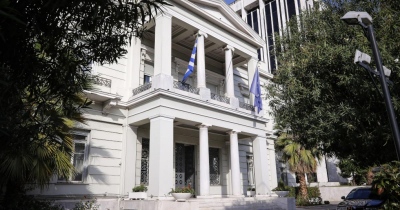
Within the framework of the scandal, the president of the Union of Greek Shipowners, Melina Travlou, sent an official letter to the Ministry of Foreign Affairs of Greece. The issue was brought to the attention of the Minister of Foreign Affairs, Giorgos Gerapetritis, who requested the immediate intervention of Greek diplomacy and a reaction to the actions of Ukraine.
The head of Greek diplomacy communicated directly with the Ukrainian side.
Following this contact, Volodymyr Zelensky stated that he was not aware of the specific request, with the result that the issue remained unresolved.
Shipping circles in Athens do not rule out that this also explains the absence of a strong reaction by the Greek authorities to the recent attack against a Russian oil tanker, which occurred within the Greek zone of responsibility and maritime jurisdiction.
Government tolerant of Ukrainian provocations
Greek shipowners openly express their indignation, primarily because they believe that the government’s stance toward Kyiv’s provocations against the country’s largest economic sector, commercial shipping, is excessively tolerant.
The sector directly links the efforts to exert pressure through sanctions with the serious escalation that occurred the previous day, when Ukraine carried out a dangerous military action, effectively transferring the theater of operations to the Eastern Mediterranean.
This was an attack against a Russian oil tanker using two combat unmanned aerial vehicles (UAV), just 102 kilometers from Crete.
This incident, as emphasized in Athens, directly affects vital interests of Greece, as it creates the impression that the state is unable to ensure control and protection of the zone of responsibility assigned to it by the international community within the framework of the FIR and maritime jurisdictions.
Discussions about the risks faced by Greek shipping often run up against a typical argument: that most vessels sail under “flags of convenience” and therefore are not officially Greek. Legally this is correct, politically however it reflects only half the picture.
In Greece, shipping is not simply a sector of the economy. Shipping companies fall under a special legal and tax regime, which the state recognizes as strategic.
The state knows very well who the owners of the vessels are, where the companies are registered, through which banks and insurance organizations they operate, and what role they play in the national economy.

Flags of convenience and the Greek national interest
Therefore, for Athens, it is not of fundamental importance which flag is on the stern, but the Greek shipowner.
A vessel flying the flag of Liberia, Panama, or the Marshall Islands, owned by a Greek company, is treated within the system as a Greek economic asset, even if this is not publicly declared.
What Ukrainian propaganda says
Characteristic is the aggressiveness expressed in a Ukrainian publication that presents Greek tankers as the fifth column of Putin.
It is noted that tankers registered in Greece were spotted in a Russian port on the coast of the Baltic Sea, reported the Finnish public broadcaster Yle, citing data from the vessel tracking service MarineTraffic, on 13 December.
The tanker Velos Topaz, flying the Greek flag, was at the port of Ust-Luga on 13 December, one of the most important ports of Russia.
As Yle reports, tankers owned by Greek companies have for a long time been transporting part of Russian crude oil. According to MarineTraffic data, another Greek tanker, Irini, was near Saint Petersburg on 13 December.
“It is strange to see tankers flying the Greek flag in the Baltic Sea, at a time when European countries are trying through sanctions to prevent Russia from selling oil.

Russia bypasses sanctions using its so-called ‘shadow fleet’. These vessels are usually registered in countries outside the EU,” the outlet wrote.
At the same time, Yle noted that vessels flying flags of EU member states are still permitted to transport Russian oil, provided that at least two conditions are met.
First, Greek tankers are not allowed to transport Russian oil to countries of the European Union.
For example, the Greek tanker Minerva Julie, which had previously visited Ust-Luga, is currently heading toward Taiwan.
Second, the value of the oil cargo must be below the price cap set by the sanctions.
The aim of the measure is to prevent the strengthening of Russia’s war budget through revenues from oil prices higher than the cap.

Sanctions on the Russian oil sector
Earlier, on 13 December, Volodymyr Zelensky signed a decree putting into effect a decision of the National Security and Defense Council to impose sanctions on 656 vessels that are part of Russia’s so-called “shadow fleet”.
On 22 October, the United States imposed new sanctions against Russia for the first time during Trump’s second term, targeting the country’s largest oil companies, Rosneft and Lukoil.
The Office of Foreign Assets Control (OFAC) stated that the new sanctions were imposed “due to Russia’s lack of serious commitment to the peace process for ending the war in Ukraine”.
On 6 November, the newspaper The Moscow Times reported that revenues of Russia’s federal budget from oil and natural gas decreased by 21.4%, that is by 2 trillion rubles, during the first ten months of the year compared to the same period of the previous year, from 9.54 trillion rubles to 7.5 trillion rubles (92.4 billion dollars).
On 17 November, the United States Department of the Treasury stated that the sanctions imposed by Washington on Rosneft and Lukoil are already reducing Russia’s revenues and are likely to limit the country’s oil sales volumes in the long term as well.
Finally, on 9 December, Bloomberg reported that a cargo of Russian oil from Rosneft, which is under American sanctions, arrived in China after a long and complex journey that included transshipment off the coast of India and a brief stop near South Korea.

Ukraine’s goal is to strike Greek shipping
This reality is understood beyond Greece, in Brussels, in Kyiv, and in other capitals. That is why pressure is not applied through flags, but through sanctions lists, insurance companies, banks, and reputation mechanisms.
This is a way to strike Greek shipping without publicly targeting it.
A potential attack on a vessel under a flag of convenience owned by a Greek shipowner can formally be presented as an incident concerning a commercial transaction, the transport of oil.
Politically, however, it will be perceived as a blow to Greek interests, with a delayed but inevitable reaction.
In the present case, Greece will find it difficult to proceed with public escalation or harsh statements.
However, behind the scenes, a strict and systematic response will follow, from blocking initiatives within the EU to exerting pressure through financial and supply channels.
Not noisy, but effective.
That is why the current conflict around shipping is not developing as an open confrontation, but as a legal, sanctions-based, and communication war.
This allows the increase of risks for Greek companies without violating the formal “red line”.
The flags in this story are merely a tool.
The real object of pressure is Greek shipping as a system.
And in Athens this is understood far better than is usually stated publicly, also due to the increased power that shipowners have in the economic, political, and social life of the country.

www.bankingnews.gr






Σχόλια αναγνωστών