

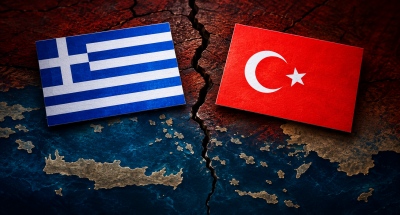
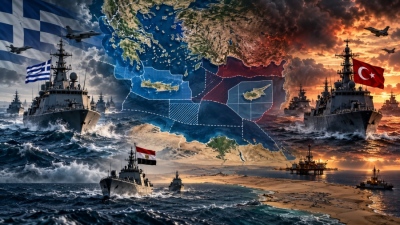
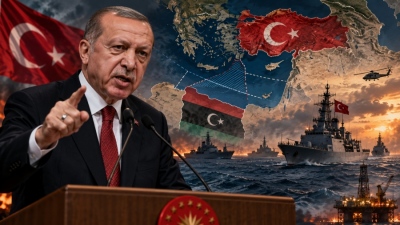
Turkey is trying to change the defense balance with Greece by purchasing 20 Eurofighter Typhoon, a fact that fuels concern and anxiety in Greece, intensifying the arms race, with Greece rushing to buy more Rafales.
Following the renewal of the Greek fighter fleet with Rafale from France, Turkey, after a long period of efforts to modernize its old air forces, signed an agreement worth 10.66 billion dollars for 20 Eurofighter Typhoon on October 27, with the option to purchase more aircraft in the future.
The agreement, which Turkish President Recep Tayyip Erdogan described as a symbolic agreement of the strategic relationship between Turkey and England, includes a full weapons package such as the deadly MBDA Meteor air-to-air missile and the Brimstone surface-to-surface missile.
The first of these aircraft are expected to arrive in Turkey by 2030, upgrading Turkey’s strategic superiority in the region.
In addition to the brand-new aircraft, Turkey is negotiating the acquisition of 24 used Eurofighter Typhoon Tranche 3A from Qatar and Oman.
These older aircraft will be used as a temporary solution until the more advanced models arrive.

Arms race, but the balance of power does not change for now
Greece remains alert to developments in Turkey’s air power, after the purchase of 20 Eurofighter Typhoon, one of the most advanced fighter types on the market, equipped with Meteor missiles and advanced AESA radar systems.
Some sources estimate that Turkey may acquire the new Tranche 5 version of the Eurofighter, which is expected to feature a more powerful radar, enhanced Electronic Warfare (EW) systems, and improved sensor and weapons integration compared to the Rafale F3R operated by Greece.
Therefore, Greece is processing possible agreements for the maintenance of its fleet, and within this framework of renewing its air power, it is seriously considering expanding the Rafale fleet with the new F4 and F5 versions, as noted by Eurasian.
Greece and Turkey have a historical rivalry, mainly due to Turkey’s dispute of Greek sovereignty in the Aegean Sea.
The 20 Eurofighters of Turkey are not expected to change the balance in the Aegean region, underlining that the Hellenic Air Force (HAF) maintains technological and operational superiority with the F-16 Viper and the Rafale, as well as with the planned acquisition of F-35 stealth aircraft.

Strategic comparison between Rafale and Eurofighter
It is noteworthy that both the Eurofighter Typhoon and the Rafale are twin-engine, delta-canard, multirole, 4.5th-generation aircraft, with excellent maneuverability and advanced AESA radar systems, but with different strategic approaches.
Both originate from the same European program of the 1980s, when France withdrew to develop the Rafale, while the remaining states created the Typhoon.
The Rafale F4 is in full production, while the Eurofighter Typhoon Tranche 5 is just entering the production phase.
On the other hand, the F5 version of the Rafale (currently under development and signed for production in the 2030s) presents strong capabilities with the use of Meteor missiles and precision-guided bombs, and is expected to feature even more powerful engines, improved survivability, and advanced connectivity systems.
The F5 will be equipped with Unmanned Combat Aerial Vehicles (UCAVs) and will provide new capabilities to the Hellenic Air Force for strategic strikes, while remaining ready to assist Greece’s needs in the air.
Technologically advanced fighter
The French Rafale F4, also known as “Super Rafale,” is an evolution of the Rafale F3R and offers superior capabilities, including the Thales software-defined radio, satellite communications, and improvements to the RBE2 AESA radar, the Talios targeting pod, the front-sector optronics system, as well as to the helmet-mounted display capabilities.
It also features a new digital jammer for the SPECTRA self-protection and electronic warfare system.
It is armed with the MBDA MICA NG (Next-Generation) air-to-air missile and the 1,000-kilogram variant of the Safran AASM “Hammer” precision-guided munition.
This specific variant provides the Rafale with enhanced strike capability, as the aircraft can now carry three such bombs.
The new integrated propulsion system of these bombs significantly increases their standoff range.
Additionally, the F4 version also features a laser-guided AASM version, ideal for destroying moving targets at several kilometers’ distance with excellent precision.
It is also possible to control the weapon’s flight time, laser illumination, and in-flight settings for laser-terminal-guided AASM bombs.
The Rafale F5 is being developed as an intermediate solution until the French Armed and Space Forces construct the next-generation fighter.
It is essentially considered a flying tactical command center, with data fusion and sensor fusion capabilities similar to those of the F-35, renowned for its pioneering and nearly unmatched sensor fusion technology.
The French Ministry of Armed Forces, through an amendment submitted in May 2023, provided more details about the future capabilities of the Rafale program.
The amendment stated that two new critical capabilities would be introduced in the Rafale F5:
A “loyal wingman” drone, an unmanned companion aircraft that will operate in coordination with the Rafale.
The capability for SEAD (Suppression of Enemy Air Defenses)
The ministry recognized that it is now necessary for future Rafale versions to possess the ability to neutralize enemy anti-aircraft systems, something that until now was considered a weakness compared to aircraft such as the F-35 or the EA-18G Growler.
Meanwhile, the new Eurofighter Tranche 5 (so far ordered only by Germany) will be equipped with the most advanced generation of sensors.
Among them stands out the new E-Scan electronic radar, also known as the European Common Radar System (ECRS) Mk1 AESA (Active Electronically Scanned Array).
At the same time, Airbus has announced that it will integrate into the Tranche 5, and also into already existing aircraft, the Saab Arexis sensor system, thus adding upgraded Electronic Warfare (EW) capabilities.
Moreover, the new package includes an improved cockpit interface and increased Radio-Frequency Interoperability (RFIO), which will significantly enhance both the aircraft’s lethality and survivability in modern operations.
Although it has been revealed that a Large Area Display is being developed for the Typhoon, it is not yet clarified whether it will be incorporated into the new upgraded cockpit.

The battle for air power and the “cat-and-mouse” game in the skies of the Aegean
Greece moved with lightning speed to upgrade its air power and gain a qualitative military advantage over the Aegean, after Turkey’s exclusion from the F-35 Joint Strike Fighter (JSF) program.
The Turkish defense industry had been subjected to CAATSA sanctions by the United States, due to the purchase of the Russian S-400 anti-aircraft system.
In January 2021, Athens signed an agreement for the purchase of 18 Rafale fighters, 12 used and 6 new, aiming to strengthen its Air Force and deter Turkey.
The agreement was later expanded to include 6 additional Rafales, bringing the total to 24 4.5th-generation aircraft.
The Hellenic Air Force officially completed the delivery of the 24 Rafales in January 2025, a milestone for the country.
At that time, the Greek media proudly emphasized that Greece had now achieved full air superiority over Turkey, which continued to operate older F-16 Block 30–50.
This achievement was attributed not only to the Rafales, but also to the Meteor missile, which is integrated into the French fighters.
The Meteor is renowned for its ability to strike fast-moving targets at distances of up to 200 kilometers and at speeds exceeding Mach 4, making it superior to all air-to-air missiles possessed by Turkey.
For this very reason, Ankara, faced with an aging fleet, criticized Greece’s procurement of the Rafale, claiming it undermines regional peace and stability.
In 2023, while Turkey was still struggling to secure from the USA the acquisition of the new F-16 Block 70/72 Viper, General Abidin Ünal of the Turkish Air Force warned that Greece would gain a decisive air superiority advantage if Turkey did not immediately modernize its fleet.
Widening capability gap, Greece pulls ahead
Greece, for its part, continued the F-16 Block 52+ upgrade program to the F-16V Viper Block 72 configuration, under the 2018 agreement with Lockheed Martin.
All 84 F-16 fighters are expected to be fully upgraded by 2027.
As the capability gap with Greece widened, Turkey accelerated the development of its own fifth-generation fighter (KAAN), while simultaneously deciding to acquire a 4+ generation fighter.
In November 2023, Turkish Defense Minister Yasar Gular announced that the country was negotiating with Spain and the United Kingdom for the purchase of Eurofighter Typhoon.
In February 2024, Turkey achieved a major victory, as the United States approved the sale of F-16 Block 70/72 aircraft in exchange for the Turkish Parliament’s ratification of Sweden’s NATO membership.
However, Greece reacted immediately, and in July 2024 announced that it would acquire F-35 fighters through the Foreign Military Sales (FMS) program of the USA.
Athens plans to acquire 20 aircraft, with the possibility of obtaining 20 more in the future.
Meanwhile, Turkey’s effort to secure Eurofighter Typhoon encountered a serious obstacle when Germany refused to approve the export of the fighters to Turkey, citing human rights violations by Ankara.
This veto was finally lifted in July 2025.
The superiority contest
Turkey continues to push for its reintegration into the F-35 program.
Earlier this year, President Recep Tayyip Erdogan told journalists that he was optimistic progress would be made in efforts to persuade the White House to lift restrictions preventing Turkey from obtaining F-35 fighters.
At the same time, Ankara is preparing to restart high-level negotiations with Lockheed Martin to end the long-standing dispute over the 23-billion-dollar F-16 procurement program.
Defense officials from both sides are expected to meet in the coming weeks to resolve pending issues.
It could be said that Turkey is modernizing its F-16 fleet to face the Greek F-16s, seeks to acquire F-35s to counter the Greek F-35s, and is purchasing Eurofighter Typhoon to confront the Greek Rafales.

On the other hand, Greece is making every possible effort to maintain its qualitative advantage over Turkey.
Beyond upgrading its own Air Force, Athens exerts diplomatic pressure on its allies to prevent Ankara from acquiring offensive or advanced weapons systems.
In January of this year, Defense Minister Nikos Dendias stated to Laurence Auer, Ambassador of France to Greece, that Greece opposes the potential sale of Meteor missiles to Turkey by the European consortium that includes France.
“I expressed to the French Ambassador Greece’s firm opposition to such a possibility, which is inconsistent with the excellent strategic relations between the two countries,” said Greek Defense Minister Nikos Dendias to Laurence Auer.
Greece had already achieved significant enhancement of its air power with the acquisition of Rafale F3R and the upgrade of its F-16s to Viper, maintaining its superiority.
In 2025, the Hellenic Air Force completes the delivery of 24 Rafales, highlighted as a major step toward achieving air superiority over Turkey, which still operates older F-16s.
The success of the Rafale and Meteor missile procurement makes the country strategically stronger and sends a clear message to Turkey, which is concerned about the strengthening of Greek air power.
Despite the gradual modernization of its fleet, Turkey faces several challenges in consolidating its position in the region, while Greece continues to invest in its air superiority and secure its alliances with France and the USA, maintaining its strategic advantages.
Developments in the aviation sector may shape the course of events in the region, with Greece seeking to strengthen its position, while Turkey strives to consolidate its own air power through new acquisitions and technologies.
This effort creates insecurity and, for the time being, has resulted in a reignited arms race.
www.bankingnews.gr




Σχόλια αναγνωστών